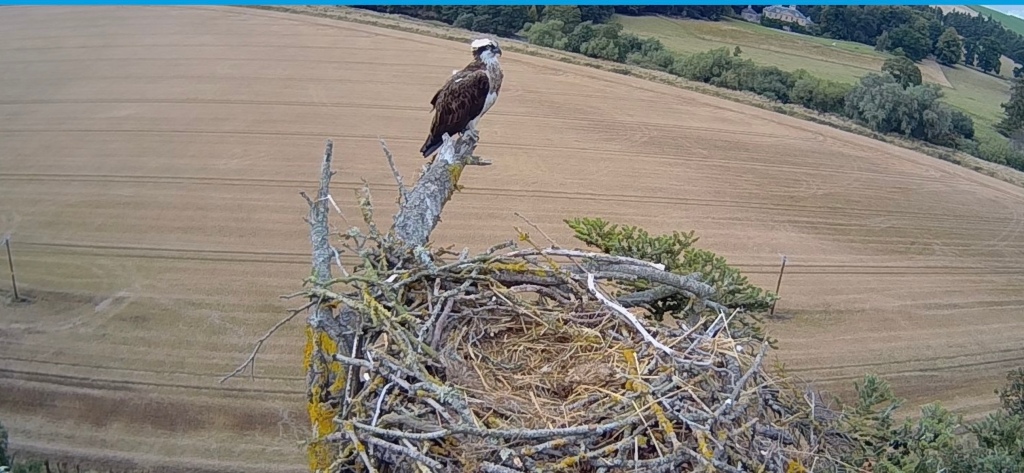
He appeared on screen just after 0600 and has been around ever since.
When I arrived in the field, I broke the first rule: don’t assume; check. I saw one bird deep in the nest and assumed it was JW6 but only got suspicious when “she” started to nest cup. “She” then flew up to the nest perch before showing us a pair of ringless legs and a totally different design of head and breast feathers! I raced to the camera recordings and sure enough, there he was, sitting proud as punch and not in the least concern about all the anguish he’s caused. He’s 4 days later than he’s ever been before!
There’s just one thing missing and, you’ve guessed it, JW6. She hasn’t been seen so far this morning but I expect she’ll be back fairly soon and my earplugs are ready for her greeting him with the romantic “where’s my fish” call.
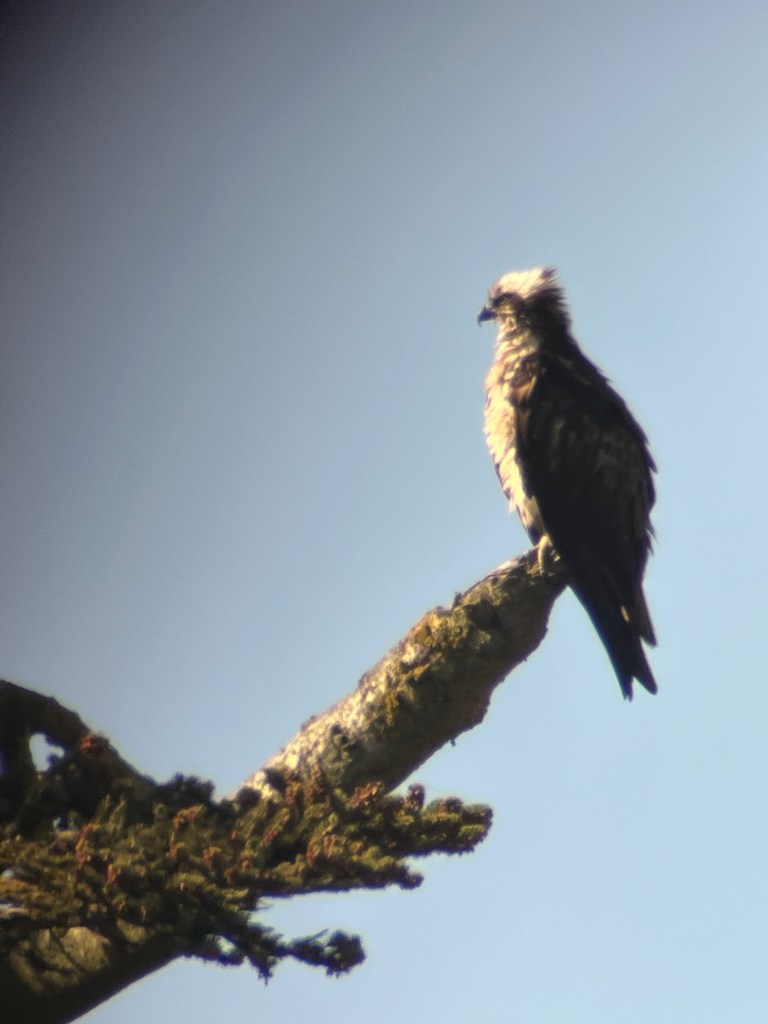
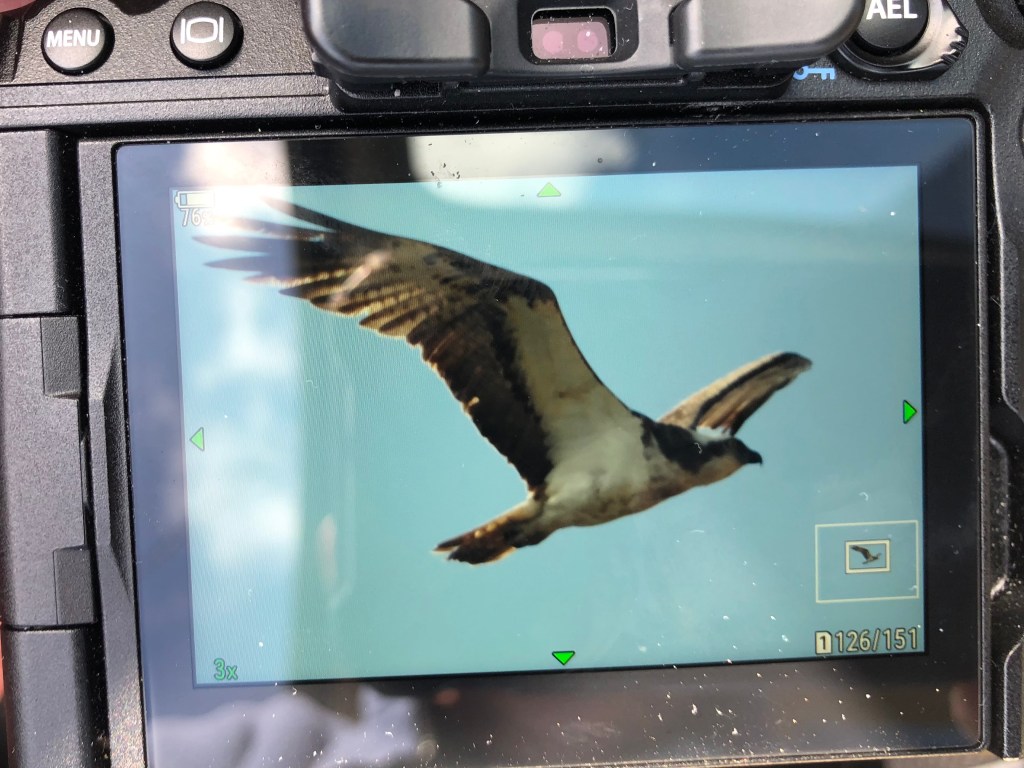
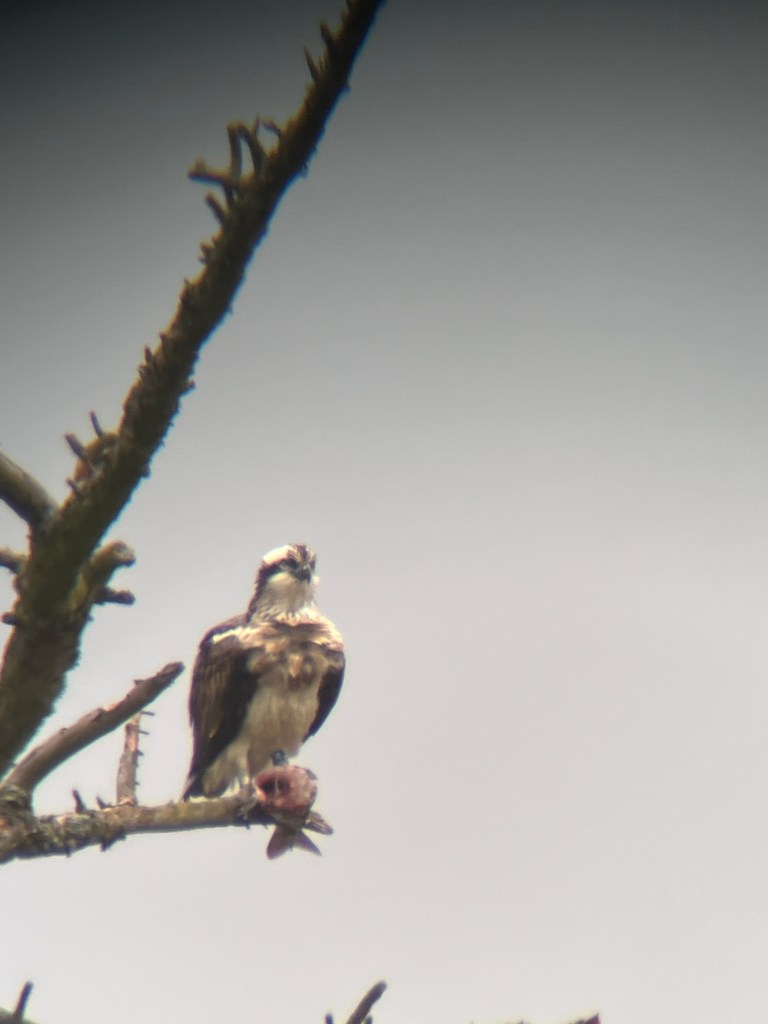
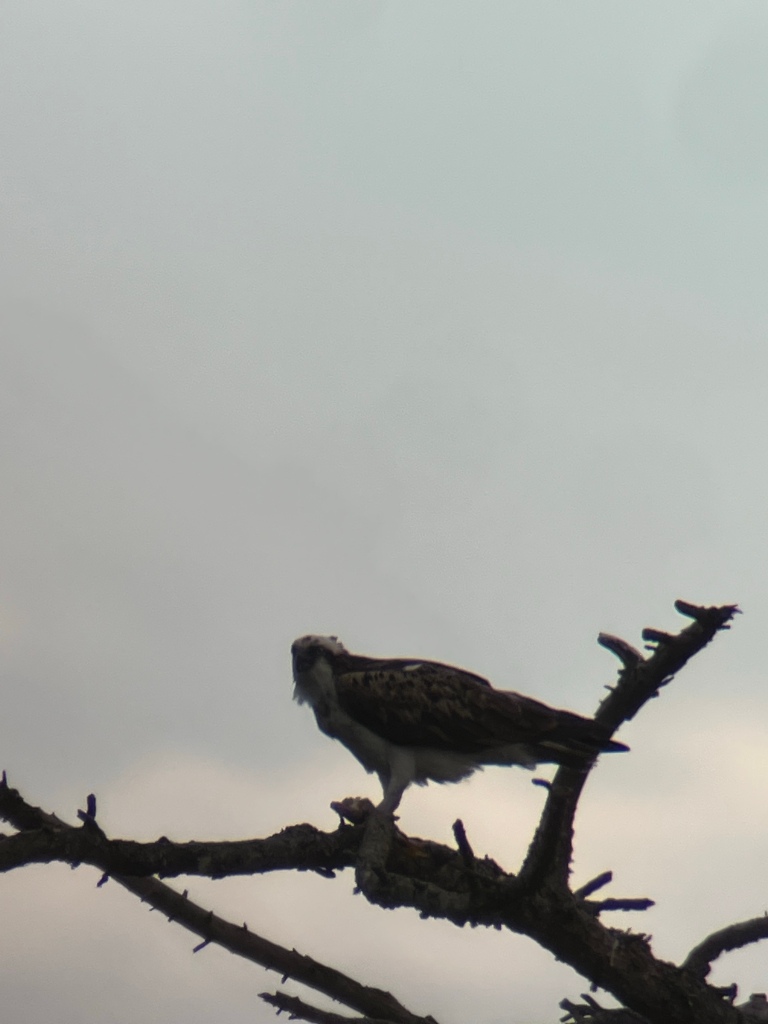
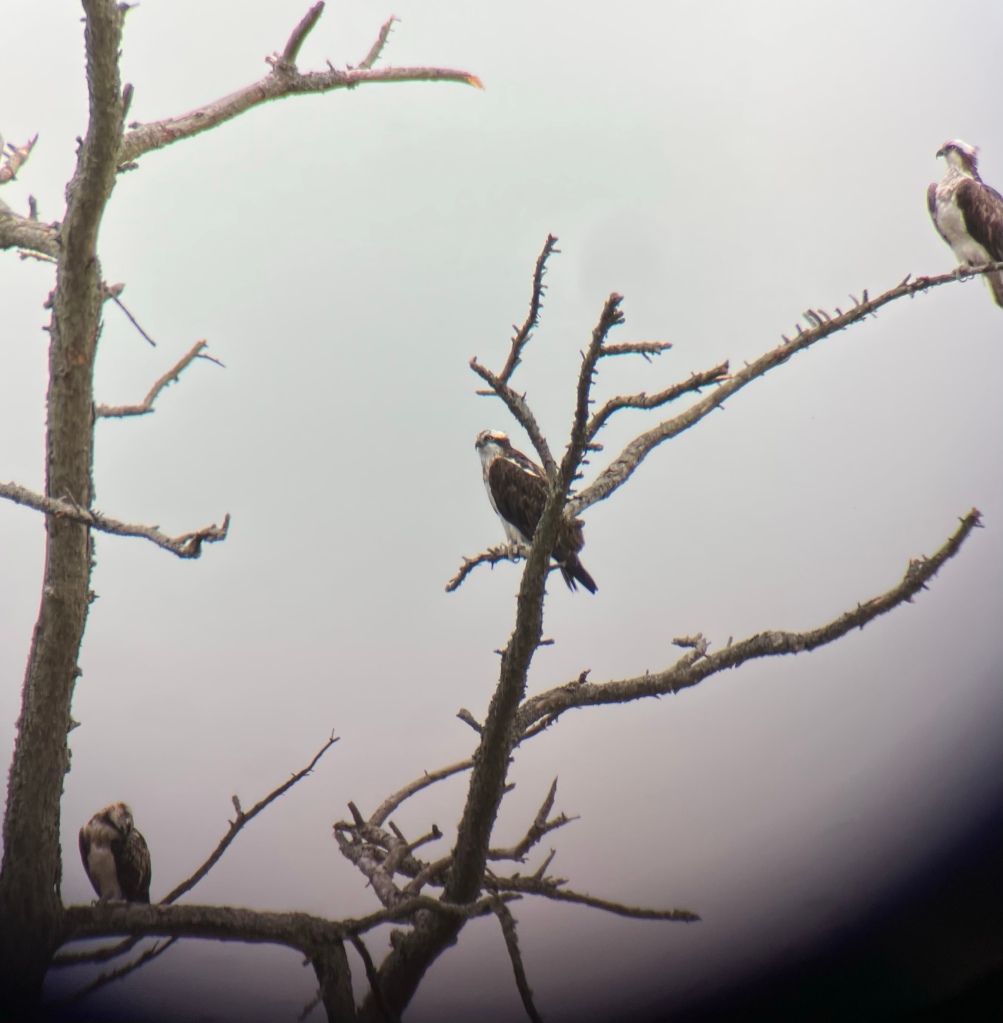
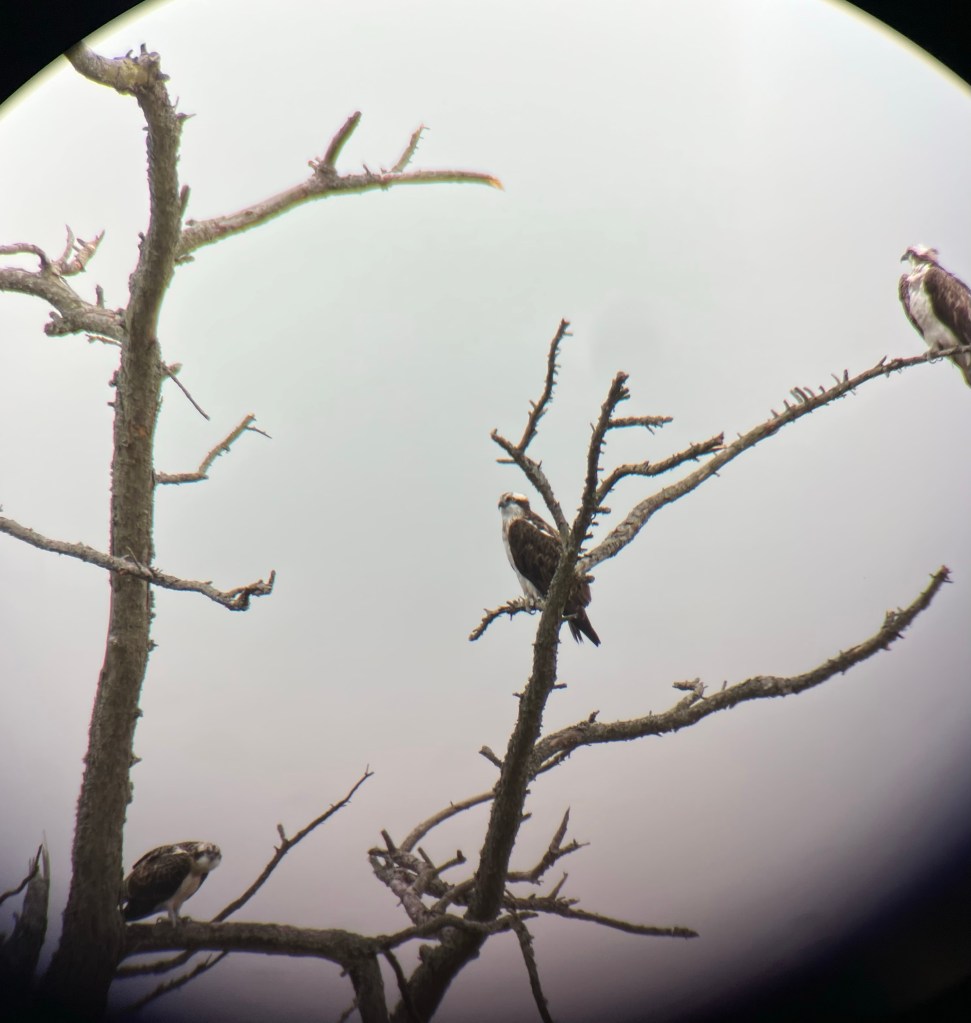
I’ll let you know about the happy reunion when it happens but in the meantime here are a couple of snaps of him taking possession of his territory again.
I’m getting quite a few queries from people concerned about whether Samson has arrived and I’ve not told you, or he’s late, or what is happening, so I thought I’d give you an update to say… there’s nothing to update.
Samson has a “window” of normal arrivals dates and we are right in the middle of it now. I’m hoping that writing this blog saying that he’s not arrived will prompt his immediate arrival, as you know he loves to prove us wrong, but there’s no need to worry if he isn’t there tomorrow, just yet.
In the meantime, JW6 has surprised me by her patience. We see her for about 3 hours each morning before she disappears off to do whateverit is that she does. She eats in that time as we’ve only seen her bring a fish in once so far, a nice juicy pike, and I think she’s just wandering the area, perhaps checking out other local nests (she’s been down to Kielder at least 3 times so far this season) and keeping an eye out for passing males. She has done a bit of work on the nest but needs to curb her enthusiasm for the size of sticks she brings in.
Lunch
While we are waiting for Samson to return, I thought you might be amused with this video of JW6 tussling with a stick that clearly would have been more than happy still being attached to a tree and wasn’t giving up without a fight.
In the meantime, just stay calm and I’ll update you when we have any progress, whatever shape it may take.
I mentioned in my last blog about a new camera and equipment etc etc. Well, this week was testing week, making sure everything was up to speed and working as it should. Recording needed to be tested and a bit of fine tuning of the software was needed. I wasn’t expecting to start a proper osprey watch until next week.
So it was with some surprise when checking through some of the footage of Wednesday’s nest that we saw an unringed female osprey land on the nest perch at just after 4pm! I don’t recognise her from any of Samson’s previous visitors but I’ll have a better look at the pictures tomorrow. She stayed for about 5 minutes, being buzzed continuously by the local jackdaw pair before she left to find a quieter spot with more welcoming neighbours.
Unringed stranger arriving Viewing the possibilities before being driven away by the noisy neighbours
If that wasn’t enough, about an hour later, another female osprey came in from a downstream direction and landed right in the nest and it was Juno (JW6), our female! She looked magnificent, although I know you’ll think I’m biased, and arrived 9 days earlier than she had done last year. She sat for a while, surveying her territory before heading off, probably to find herself her supper.
Touchdown for JW6
I scrabbled around to get to yesterday’s recordings and, sure enough, as the light increased, she appeared on the nest at about 6am and stayed for about 3 hours, making one foray to collect some nesting material and moving one of the prepositioned sticks to a place she deemed more appropriate. She flew out of sight just after 9am and did not appear on camera again that day, although she could well have been on the dead tree for at least part of the day.
I have yet to download today’s recordings so I have no idea if she’s been on the nest much, although the weather has been so unstable she might not have wanted to stay in such an exposed position for long. I certainly didn’t see her when I was there for several hours this morning.
So, the birds have taken no time at all to rekindle the challenge of who’s the birdbrain and I’m already losing! However, I’m delighted that Juno is back and seems to have come straight in this year, rather than stopping off at Kielder. Samson needs to get his skates on if he’s sensible as we know from last year’s experience that Juno is not the most patient of birds. The earliest we’ve seen him in any year is 30 March. He’ll need to at least match that if he’s not to be in trouble with the missus before he even arrives!
Guess I’ll be starting osprey watch properly tomorrow then. I’ll let you know any updates.
I’m hoping that both Samson and JW6 (Juno) are well on their way now back to their nest site. Juno arrived first last year, on 2 April and Samson on 11 April. The previous year he’d arrived on 30 March, which was the earliest we’d seen him and him not coming until nearly a fortnight later last year had me having sleepless nights and no fingernails.
Since the family disappeared on migration last year, we had the sad news that the Born in Scotland restaurant and shop were to close and they remain closed. So there will be no opportunity to refresh yourself with coffee and cake or something more substantial while watching the view from the nest camera on the monitor in the restaurant. I am looking at various options at providing that view to the public, via a 4g router for example, but the costs of that and an internet link are prohibitive at present. Nevertheless, people can still walk down by the river and we will be in our normal position to provide information and allow people to view the nest with binoculars and scope.
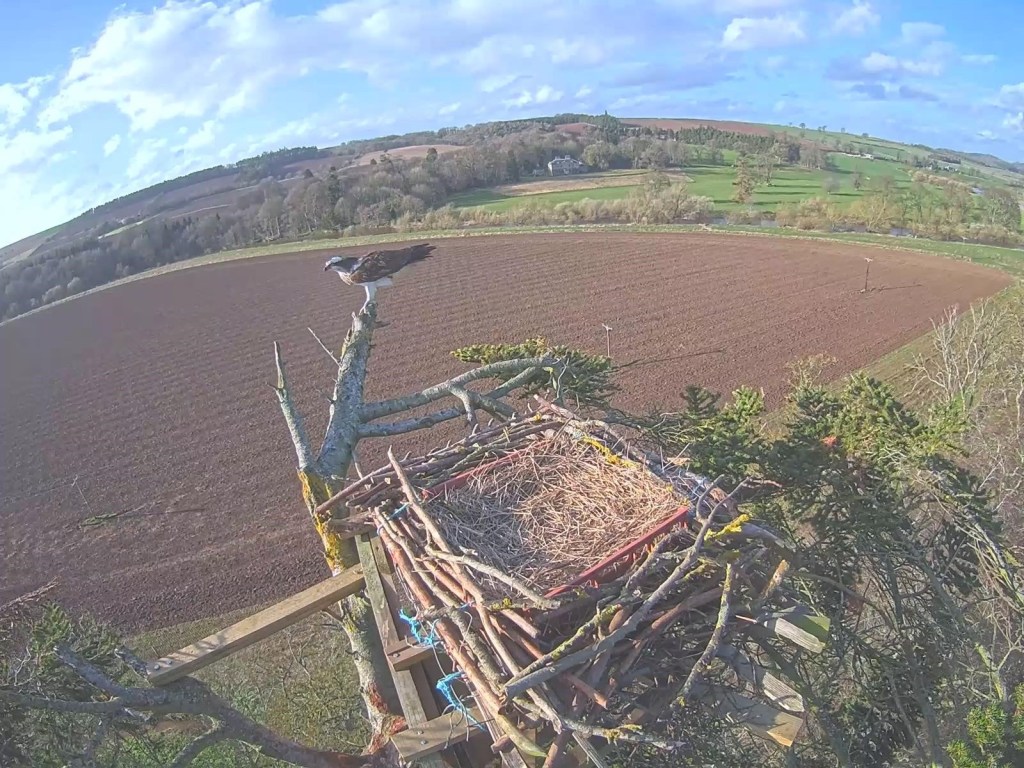
We have made significant changes to the nest and camera equipment, including a new camera and supporting software which will hopefully allow us to record nest activity this year, the lack of which capability caused a great deal of angst last year. We have also renewed all the cabling and wifi links and everything is working beautifully now, although I’m sure there will be a few last minute panics as there are every year. The biggest change you, the readers of the blog, will notice is that the nest has been completely rebuilt. The base of the nest that was constructed by us in 2016 needed replacing and the nest was almost teetering by the end of last year. We were very grateful to Tony Lightley of Forestry and Land Scotland for his skilful rebuilding of the nest, which looks much smarter and neater but will no doubt be completely redecorated by the birds within a couple of days of their return. You will notice that the structure of the nest is based around a bread basket which hopefully will keep the centre vaguely where it is meant to be; Samson was great at piling sticks on one side or another and gradually moving the central part of his previous nest away from the manmade base. Every winter, we therefore had to move it all back, so it was again properly supported and not overhanging the 100ft void to the ground! The breadbasket idea is one that has been used on a number of manmade nests around the country and has proved to be successful. No trade names are visible but if any bread companies want to sponsor the nest………..
The new nest on a dreary day
So, there we have it. We’re on our starting blocks for the new season, ready for all the excitement and traumas that we have each year. I read that the Tweed and its tributaries (of which the Teviot is one) had seen an upturn in the number of salmon last year, so I’m hoping that the increase is reflected in all the fish species that Samson catches either in the river or in local lochans. I worried last year that the size and frequency of his catches were down since the last time he’d had a family to support (2017). Let’s hope he has good luck and good hunting this year. See you down at Lanton if you’re visiting (please drop me a note beforehand so I can make sure I’m around) or I’ll be in touch on the blog to let you know of arrivals.
You wouldn’t expect to hear from me at this time of year but I need to advise you of significant news, especially those who visited the facility of Border Ospreys at Lanton Mill.
Very sadly, the Born in Scotland restaurant and shop have been forced to close with immediate effect due to the ongoing financial pressure that is affecting so many small businesses in the country. As you may be aware, a monitor was set up in the restaurant which allowed visitors to watch what was happening in the nest during the osprey season and this facility is obviously affected by today’s announcement.
It is too early to say what will happen in the future and I will be chatting to the owner in the weeks to come about his plans. My monitoring of the nest will hopefully continue and I will keep the blog going if this is the case. I also hope that visitors will still have access to the riverside walks so that people can still see these magnificent birds “in the feather”.
I will update you as soon as I know any more. The most important thing is that the birds will be unaffected.
The site is empty, the nest is deserted and the area no longer rings to the sounds of ospreys calling. It’s actually quite a spooky thing, walking around the field and seeing and hearing no sign of our birds having had them be such a feature of my life (at least) for the past 5 1/2 months.
3AF, typically, left the day after I published my last blog saying that she looked like she had no intention of leaving. I’m not sure why I bother making any comments in the future tense about ospreys; you’d have thought I would have learnt by now that they always make me out to be a liar or just plain stupid. I wonder if she stopped off at Abbotsbury Swannery on the Dorset coast like she did the year she spent with us? Her timing would have been very similar and certainly there were ospreys sighted there but I didn’t hear about if any of them were ringed.
3AF. Will she return here in 2023?
Samson stayed around for a few more days. I don’t know whether he was checking that 3AF had really gone or whether he was hoping that another female would arrive unexpectedly but he was last seen as a confirmed sighting on 2 Sep. A couple more visiting ospreys were seen in the area over the next few days, too far away to see whether they were ringed, or even if they were male or female, adult or juvenile. They wandered up and down the river and over the nest but only one landed, and then only very briefly, in the dead tree.
A last view of Samson for this year
And so we come to the end of the 2022 season. What a season it has been too, hasn’t it? Excitement as JW6 arrived, tinged with a little trepidation bearing in mind her behaviour last year; nerves as Samson was 2 weeks later arriving than he had done in 2021; anticipation as eggs were laid; celebration as two hatched; tragedy on ringing day when the one chick had to be euthanised after a nest accident, probably by its sibling, robbed it of an eye; euphoria as 688 (Sasha) took to the skies and then that odd mix of emotions as the birds one by one took leave of the territory to begin the long and dangerous journey to their wintering grounds. My fingers are firmly crossed that 688 completes that journey and finds himself a decent fishing ground where he can see out the winter and next year, and grow strong and healthy before making the trip back in 2024. He has excellent genes and will hopefully also get that slice of luck that all of them need to survive. Likewise, it is to be hoped that both his parents have a good migration and winter and return to us next year to rear another family.
In the meantime, we have work to do here. The nest requires a complete rebuild as some of the supporting structure needs replacing. I also have to strengthen the communication link to improve the picture in the restaurant and also to resolve the problems which prevented us from recording anything this year. So, several things to keep me out of mischief. In the meantime I would like to thank the people that make Border Ospreys work. Brian Clark, without whom I would probably end up completely bald as he does sterling work in supporting me for long periods meeting the public, answering questions and monitoring the nest; most importantly, he is also responsible for taking most of the cracking aerial photos that grace this blog. He is unnecessarily modest about his photographic abilities but I am very grateful for them. Tony Lightley and Joanna Dailey, my two experts who answer my numerous questions, provide advice and support and, in Tony’s case, who is the crazy person who climbs the 100ft tree to collect the birds for ringing and will be doing the nest rebuilding work. Michael Thomson of MT Tree Care (and Nathan) for their work in the winter climbing the tree to install the new camera, do running repairs on the nest and, critically, when we had the emergency with the baling twine this summer, Michael dropping everything to race to the rescue of the chicks. Without him acting so quickly, we may have lost some, if not most of the family. Jain Jameson of Techstar for her invaluable work and support with the wiggly amps side of the house; a black art to many of us. John Henderson, owner of Born in Scotland, and the staff there for all their help and support. Lastly, to you who read my blog, visit in person and give me such encouragement with your support, however it is provided. I do enjoy the interaction and, while I try to keep things lighthearted, I hope I also convey my enthusiasm and respect for these magnificent birds. If I can extend their fan club by just a handful each year, while also doing something in which I believe passionately, then I am content. Best wishes for the remainder of 2022 and I’ll see you all in 2023.
Firstly, I’d like to apologise for the length of time since my last blog. I thought that, after fledging, there would be just one more post saying how everyone had left and it had all gone quiet. Ha! I’ve been waiting for over a week to say that and, in the end, I still can’t say it but I’m getting gentle nudges from faithful followers asking what’s going on? I am now getting ahead of myself so, if I may, I’ll remind you that my last blog left us celebrating the fledging of the remaining chick, ringed 688 and named Sasha.
Sasha grew in confidence and skill rapidly over the next few days. There’s a long, horizontal, bare branch in a pine tree on the edge of a nearby group of trees that’s always a favourite with our youngsters, once they’ve managed to acquire the skill to flare out and land under control, rather than grabbing a branch and hanging on for grim death while beak planting whatever is beyond the selected perch and tangling wings in anything to the left and right of said perch. Sasha found that perch within a day of fledging and could usually be located there when he felt a fish was in the offing. He would then meet Samson at the nest and usually returned to the perch to eat, so confident was he with carrying a fish and landing one footed.
Yet more protein for SashaSasha on his favourite perch
He began to explore the area, while keeping an eye open for Samson of course, and I was lucky enough to see him practising his diving in the river on one occasion. Juno, on the other hand, was getting very frustrated as Samson, as soon as Sasha fledged, immediately stopped bringing fish to her, despite her insistent food begging. She soon got the hint and started fishing for herself and preparing for her migration. There was one occasion when she brought in a monster rainbow trout, a rarity to be brought to the nest area, and she ignored the pleading of Sasha, stood beside her on the pine tree perch, and started gobbling it down. It showed she was breaking the bonds with her chick which had now become Samson’s sole responsibility. Unfortunately for Sasha, Samson arrived with a decent sized brown trout while he was food begging and Samson, seeing and hearing him right next to Juno, wrong assumed he was being fed by her and landed out of sight of Sasha and proceeded to eat his offering. Poor old Sasha probably got two tail ends but missed out on the juicy bits of the fish that both parents had brought.
Mum? What bit of “feed me” are you not getting?Samson with his fish
Juno was last seen on Tue 16 Aug and I have to say that she was looking, as someone diplomatically put it, less than aerodynamic, so successful had she been at feeding herself. Following the principle that bumblebees shouldn’t fly but do, she probably left on migration sometime that day. I wonder if she will be spotted at her wintering grounds sometime in the next few months?
A rather chunky looking Juno
Samson continued providing fish after fish for Sasha until he too resembled a barrel and he was last seen on 19 Aug, aged 80 days, when he probably began his migration. All things being well, he should come back to the UK for the first time in 2024. Bon voyage and the very best of luck, Sasha. What an amazing adventure he has set out upon.
Sasha (photo courtesy of B Clark)
Well……. What we normally expect is that a day or two after the male is left on his own, he too will migrate but things didn’t work out quite like that. Some of you who’ve been following me for a while will remember Astra (3AF) who was our female in 2020, although too young to breed. She was hatched at Rutland and was the first known Rutland bird to be seen in Scotland. She returned in 2021 and was one of the many female visitors to the nest that were entertained by Samson last year, before being evicted by the joint effort of a buzzard and later by our present female, Juno. She found herself a mate several miles away, a male from Kielder (Blue 39), and they successfully raised 3 chicks this year. I visited that nest on 19 Aug and saw both parents coming in with fish for the youngsters while I was there. It showed that she was still quite closely bonded to the chicks and the nest at that stage.
Imagine my surprise then when, 48 hours later, I saw a female osprey sitting on the nest perch and, when I got the scope on her, found it to be 3AF!
The return of 3AF…….and wanting feeding!
And here she has remained ever since. Samson at first was his normal skittish self when a new female appears, getting her a fish, which she accepted; finding lots of nesting material, which she ignored; and trying to mate with her, which she rebuffed. However, he soon settled down and they’ve behaved since like a normal pair, comfortable with each other and spending hours sitting together until she decides she’s getting peckish, yells at him and he goes fishing and returns to present her with what he’s caught.
Very comfortable in each other’s company
It’s been 9 days now, she is showing no signs of being ready to migrate and he is showing no signs of stopping providing her with fish. As far as I know, we haven’t seen previous examples of this type of behaviour where a female decamps from one nest site to another at this stage of the season and settles at the new site nor where the male has been so keen to feed her so late. Is she making a move into JW6’s territory in readiness for 2023? Are they both seeing the other as an insurance in case their partners don’t make it back next Spring? I’ve asked Tim Mackrill for his thoughts and I’d be interested in yours as well.
I’ll let you know how long this goes on for in my next blog, which I assume will be my last for 2022, but the ospreys may know better.
The first fledge of an osprey chick in 5 years at Border Ospreys took place today just before 1400 when Blue 688 (Sasha) took off and made his first flight, landing successfully in the dead tree. He was joined there by his proud parents and I was able to get a family photo of them all together.
From the left: Sasha, Juno and Samson
He had been helicoptering more and more enthusiastically yesterday and so it was clear that he was ready to take that huge step; today’s weather conditions of a light breeze and cooler temperatures made it an easy decision for him.
Final rehearsals
He was still in the dead tree when I left with the light levels dropping this evening and my hopes were dashed that I would see him fly to the nest when Samson brought a fish. Much to Juno’s disgust but Sasha’s indifference, Samson sat in the dead tree rather than bringing the fish to the nest…and ate the lot! From Juno’s reaction, I feel sure that he was going to be sent away to fish again before nightfall. Sasha seemed very confident sitting in the tree and was completely unconcerned about the interest of the local crows. Juno however, was determined that nothing was going to share the tree with her chick and she readily chased away anything landing in the vicinity, included two somewhat unfortunate wood pigeons who suddenly found themselves the centre of the attention of a aggressive female osprey and departed rapidly as a result.
“Look, mum. One leg!” Sasha demonstrating his competence standing on a branch
The activity will now switch increasingly from the nest to the surrounding trees and area as Sasha will quickly gain more confidence and will start to explore and refine his flying skills. He will also start to practise fishing, an instinctive not taught technique. Samson will continue to bring fish in to feed him but Juno will start to fish for herself in the coming days and will build up her reserves as she prepares to leave on migration, her job of guarding the nest nearly complete.
Coincidentally, exactly 6 years after the first chicks were ringed following the rebuild of the nest and the installation of the osprey nest camera, we were back again to ring the 2022 class. Both chicks have grown exponentially since they hatched and were starting to wing flap and exercise their flight muscles ready for the big day of fledging.
Soggy family lunch
Tragically, it was not to be for one of the chicks. Since it was last seen clearly on the nest camera, it sustained a serious injury to its eye, probably as a result of an accidental piercing by either its sibling’s or a parent’s talon. An osprey cannot survive with only one eye as both eyes are needed to judge perspective during the dive and the loss of that would have meant a slow death by starvation. I rushed the chick to the vet in a vain hope that the damage might have been limited and the eye saved, but the vet confirmed that the eye was lost and the heartbreaking decision was taken to put the chick to sleep.
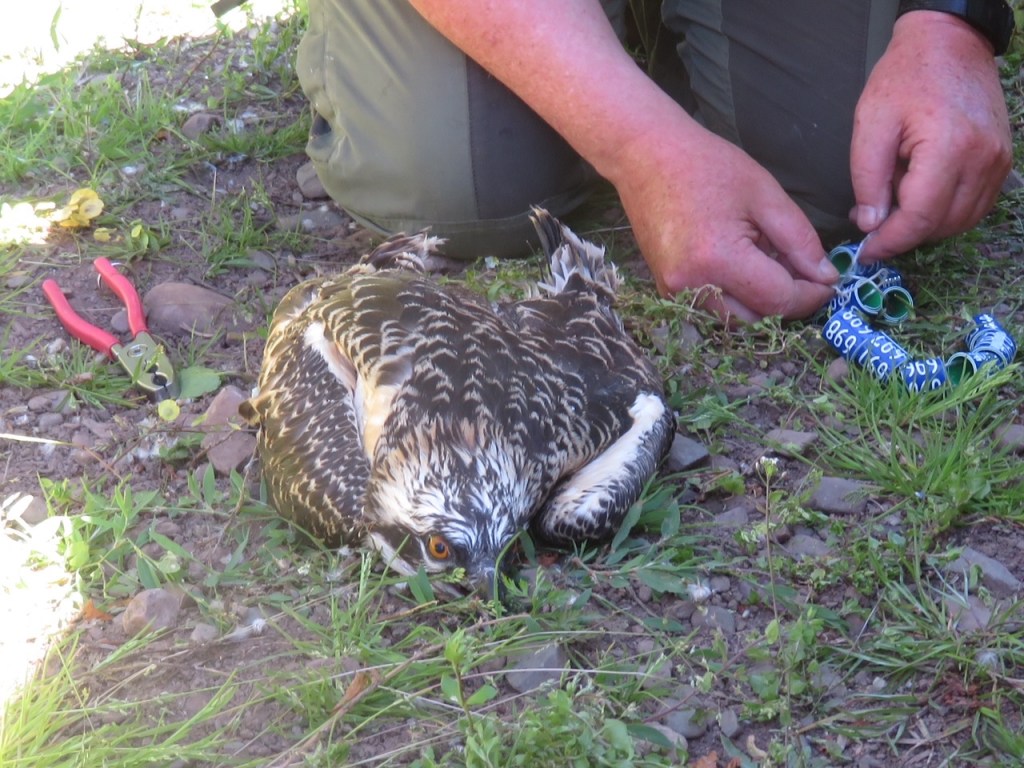
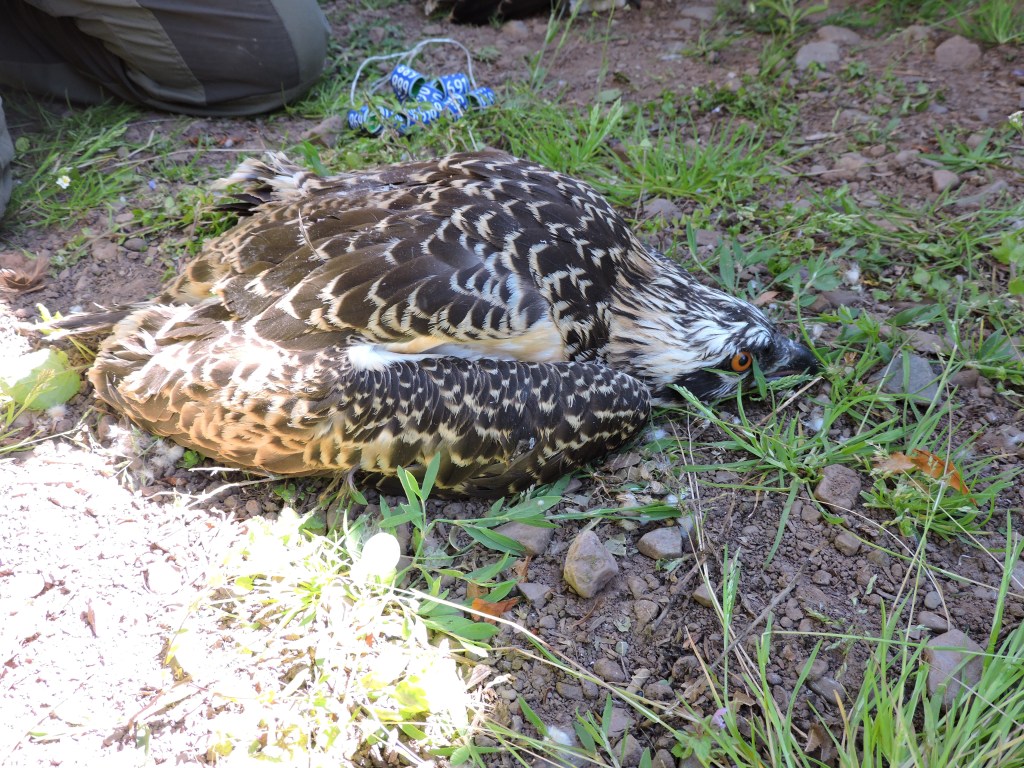
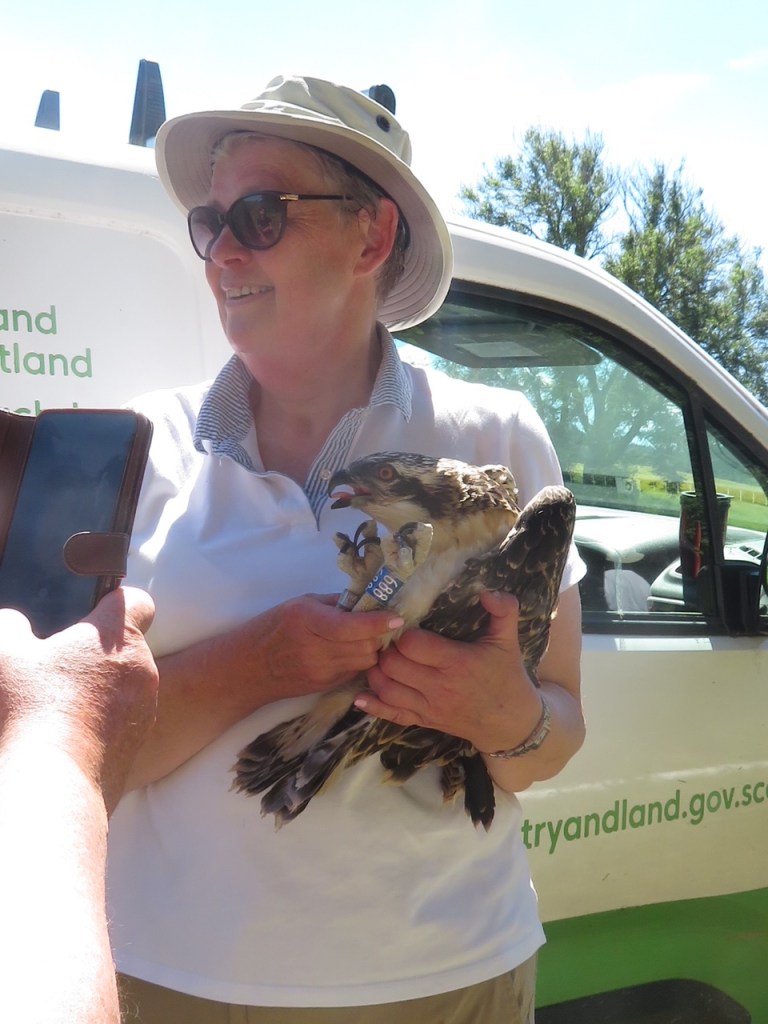
Samson was away from the nest when ringing took place but Juno stayed close throughout, circling and warning her chicks to “play dead” in the nest. Both chicks were lowered to the ground, and it was confirmed that the one bird needed the attentions of a vet. The surviving chick was weighed and measured as normal, was found to be 1400g and therefore, in all likelihood, male, and was ringed as Blue 688. Many of you will know I have a Ukrainian family staying with me. The ringer kindly invited them to watch the ringing and so Blue 688 will be known as Sasha, a common name in Ukraine.
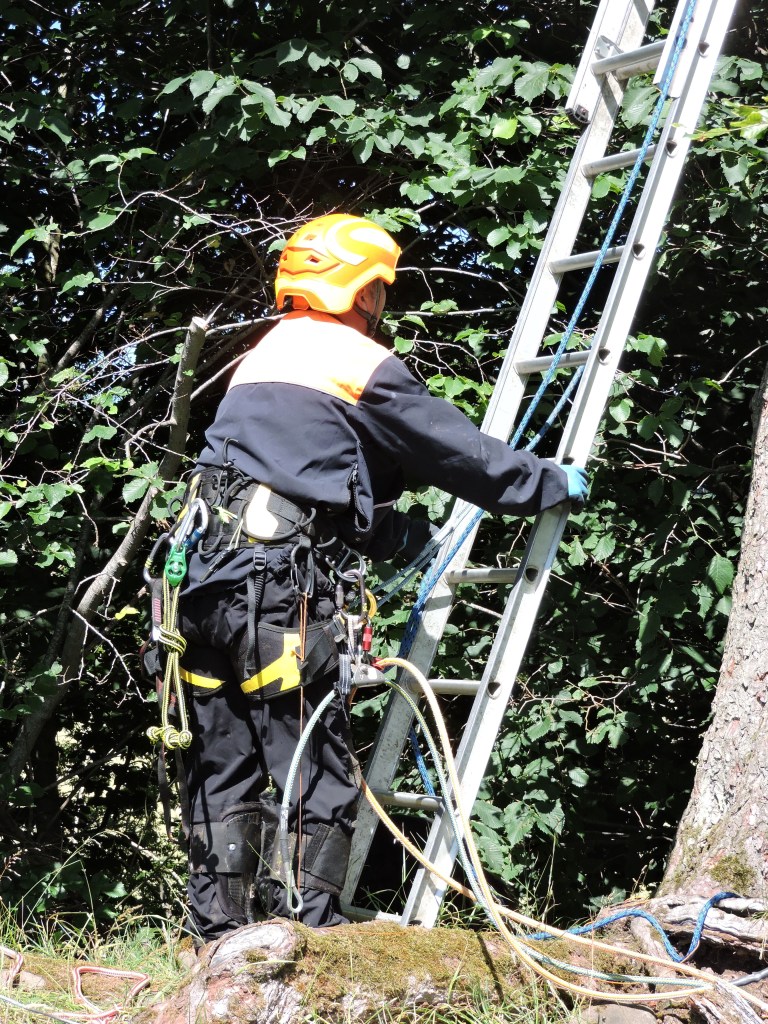
Not the most comfortable outfit when you’re climbing and it’s 29 degrees! (Photo courtesy: A Smith)Selecting the ring (Photo courtesy: C Tees)Waiting patiently (Photo courtesy: A Smith)
The remaining chick was returned to the nest, just in time for Samson to return with a fish to add to the one already lying there. As I left, I could see Juno feeding Sasha enthusiastically, seemingly unaffected by the events of the day and the fact that there was only one chick in the nest. It was good to see that she had returned quickly once we left the immediate vicinity and taken up her maternal duties again, and also that Sasha was ready to feed straight after his ringing adventure.
A very warm ‘yours truly’ with 688 (Photo courtesy: C Tees)
The demise of the chick had a very sobering effect on what is normally an exciting day but we can be glad that the injury was found and dealt with so quickly, minimising any distress and pain. Any loss is difficult to bear but it was so close to feeling the wind under its wings, that it seems particularly poignant. Nevertheless, we still have one chick that will, in about 10 days’ time, hopefully launch himself off into the next stage of his rapidly changing life by fledging and starting to explore the area he has been studying since he could peer over the edge of the nest. I’ll let you know how he gets on.
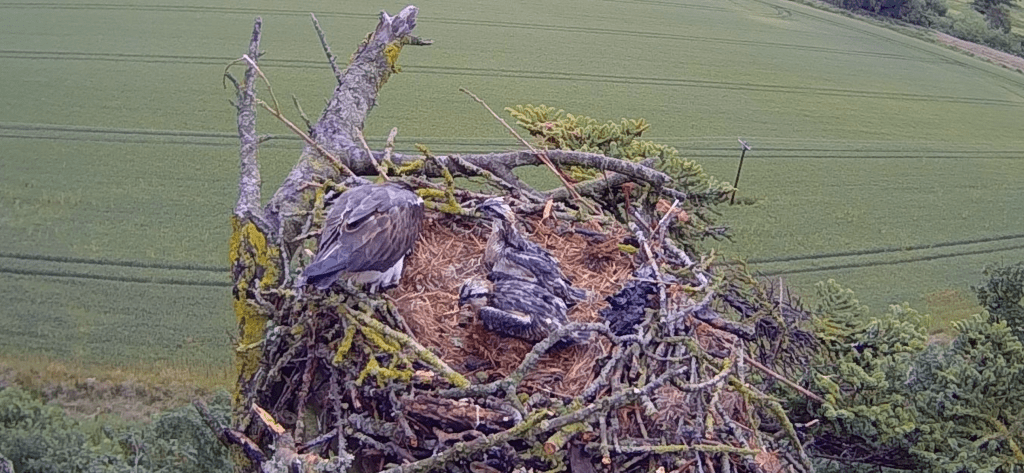
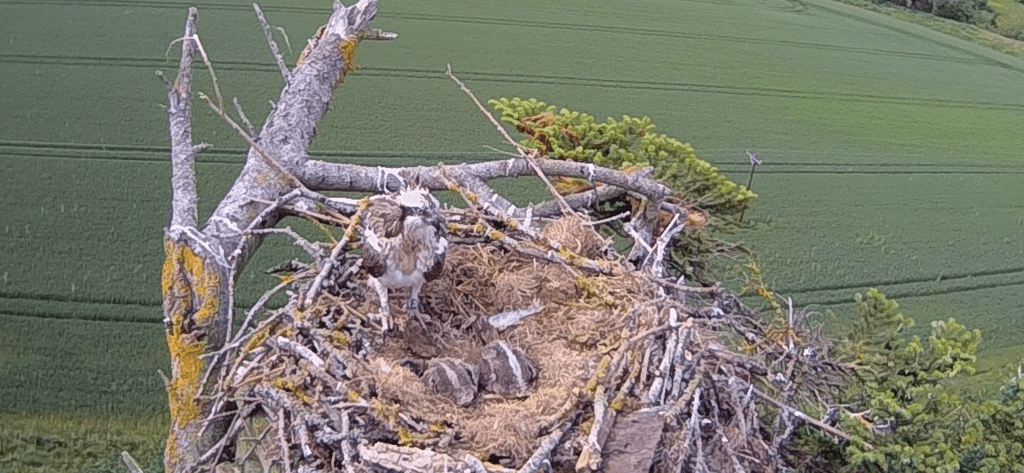
The chicks are growing quickly and well, getting bigger every time I look. They dropped their fluffy down overnight at the weekend to transform into mini dinosaurs and now are starting to venture around the nest, propping themselves up by their wing stubs. Samson has been working hard providing a good supply of fish; pike for the first few days of their lives from a lochan somewhere upstream and then he swapped to fishing downstream and started bringing in sea and brown trout. Juno is doing a super job feeding them and looks like an experienced female rather than one bringing up a first brood. She even let Samson have a go at feeding the chicks, something his previous mate, Delilah, never allowed.
Juno quickly mastered feeding her tiny offspringSamson showing off new parenting skills as well
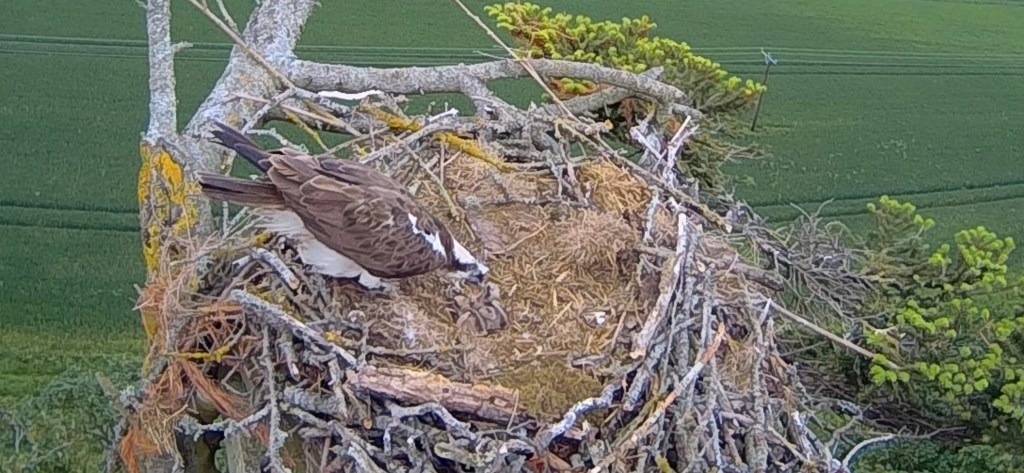
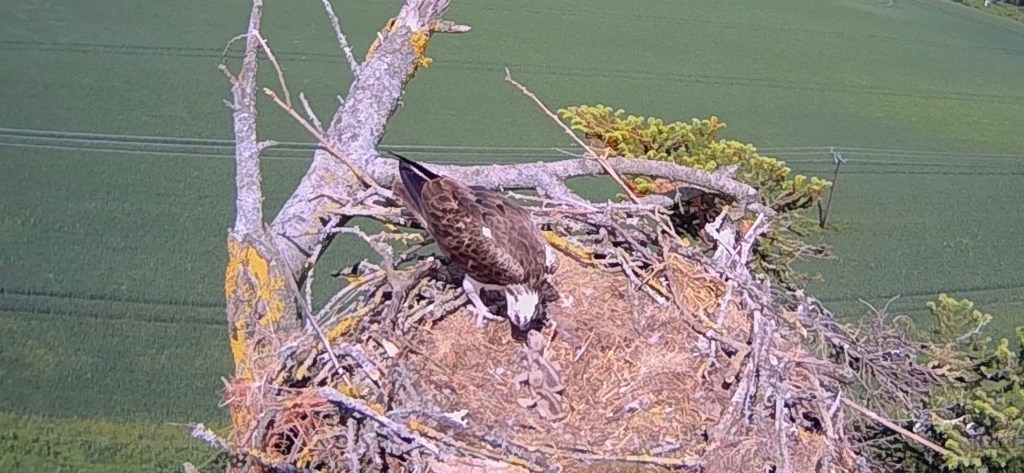
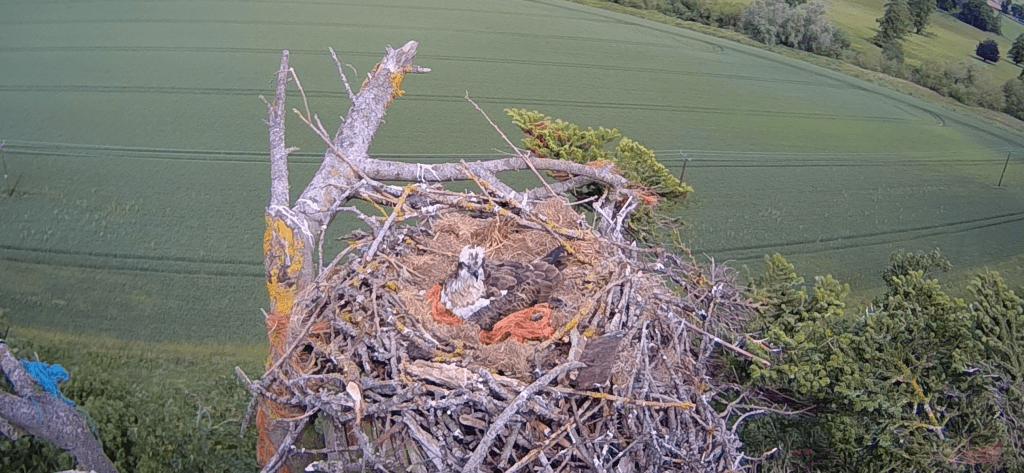
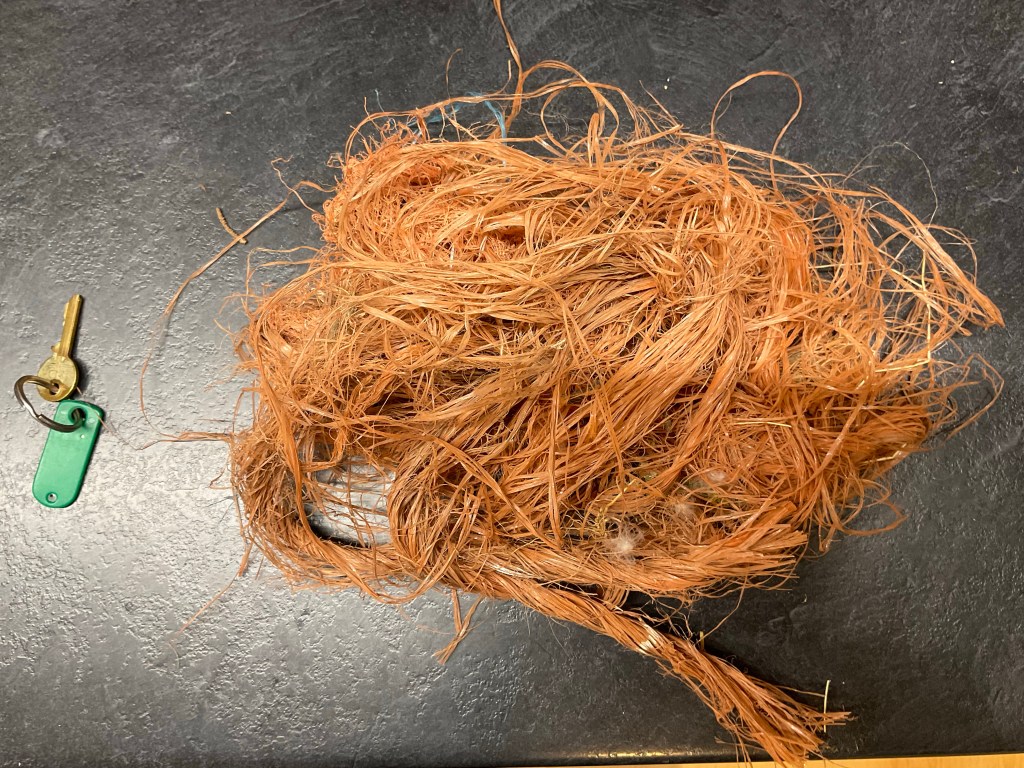
Everything was going so well but that all changed today when the camera was switched on to reveal that a large tangle of baler twine had been brought to the nest and Juno was brooding the chicks with much of it tucked under her. I’ve spoken and written before about this scourge to the health and well-being of wildlife and it is sadly an addition to the nest most years but never before in this quantity. Samson probably would have picked it up from the river, thinking it was a lump of reeds or grass, little realising that he had brought something so potentially deadly to both adults and chicks onto the nest. The twine could have choked the chicks and the adults could have had it tangled in their talons making a real possibility of them pulling the chicks from the nest when they got airborne or getting caught and left dangling if the twine subsequently snagged on a tree branch. In most cases it would have meant a slow and painful death.
Juno lying on the baler twine
It was difficult to assess the situation while she was lying down but my worst fears were realised when Samson brought in a fish and Juno stood up to reveal that one of the chicks had twine twisted around its neck!
The right hand chick well tangled in the twine
There is often a debate in osprey discussion groups about whether or not intervention is appropriate when something occurs on a nest but there was little doubt that, in this case, we were obliged to try and resolve a situation that was completely man made in its origin. My ringer was injured and unable to climb so, with time of an essence, I called upon my normal tree climber and he was able to come almost immediately. I gave him a comprehensive brief on how to handle the chicks if necessary, bearing in mind their Schedule 1 status, and I made it clear that he was to spend as little time as possible on-site, commensurate with the security of the nest and its occupants. He did an excellent job, climbing the tree swiftly and, with the minimum of fuss, he was able to release the entangled chick and remove the twine. Luckily for all, the twine did not get caught in the female’s talons and so the worry that she might pull the chicks off the nest when she flew did not transpire.
The chicks were decidedly laid back about this large orange and black human intruder (sorry, Michael) on their nest. Samson and Juno circled the tree throughout, calling out to the chicks to “play dead” but, once we had departed, she returned to feed them the remnants of the lunchtime fish while Samson sat on guard in the dead tree.
Normal service is resumed
So, a disaster was averted but had that occurred on an unmonitored nest, the end result could have been very different. Baler twine is a useful and, in some cases, essential part of farming but it lasts for ever and becomes more and more dangerous as it degrades and tangles; I so wish that the people using it would dispose of it more carefully, considering the threat that it poses. So much of it is just left littering fields and farmyards and, as probably happened here, entering waterways. It could have travelled miles downstream before Samson found it. If you use the stuff or know someone who does, please make every effort to keep it tidy and not left lying around endangering wildlife and leaving an unsightly mess.
The offending twine; the house key gives a sense of scale
No lighthearted comments or jokes from me tonight. We could have lost the family today. Thank goodness luck and a speedy response from my tree climber prevented such a tragedy.






 Border Ospreys