UP AND AWAY

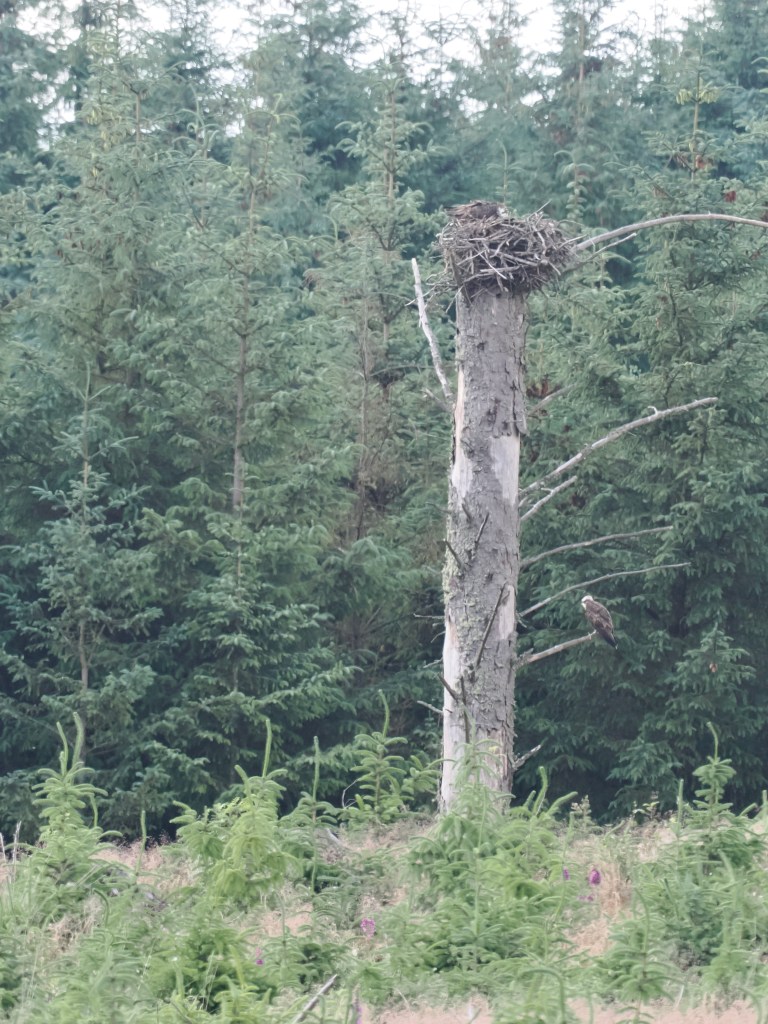
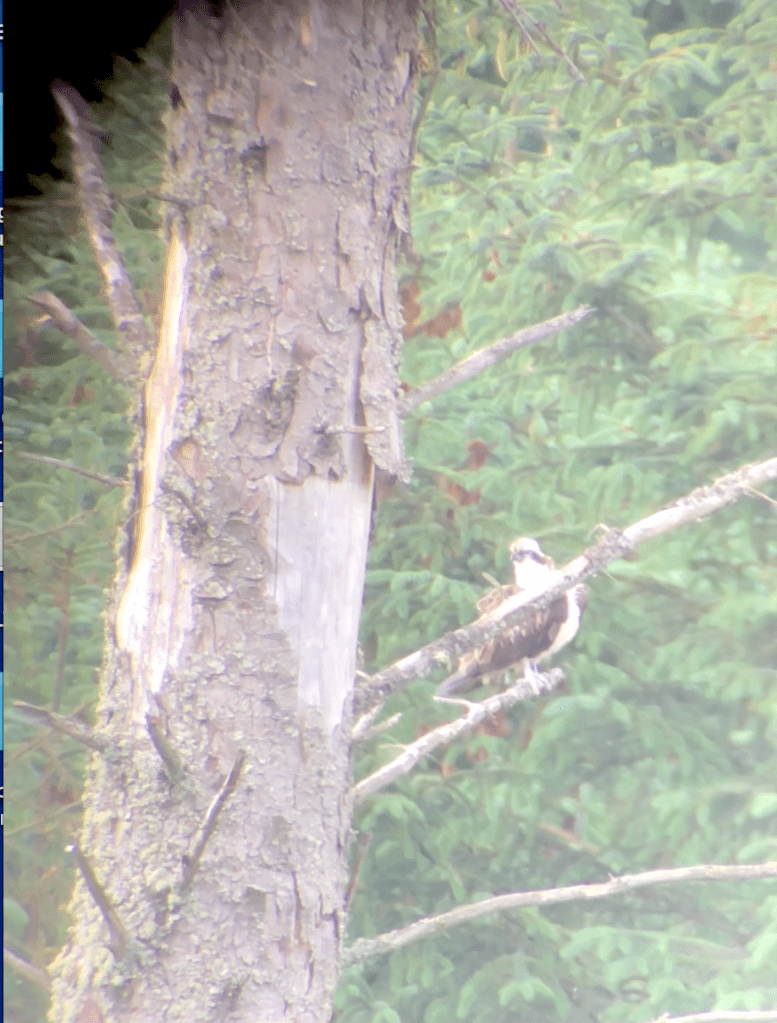
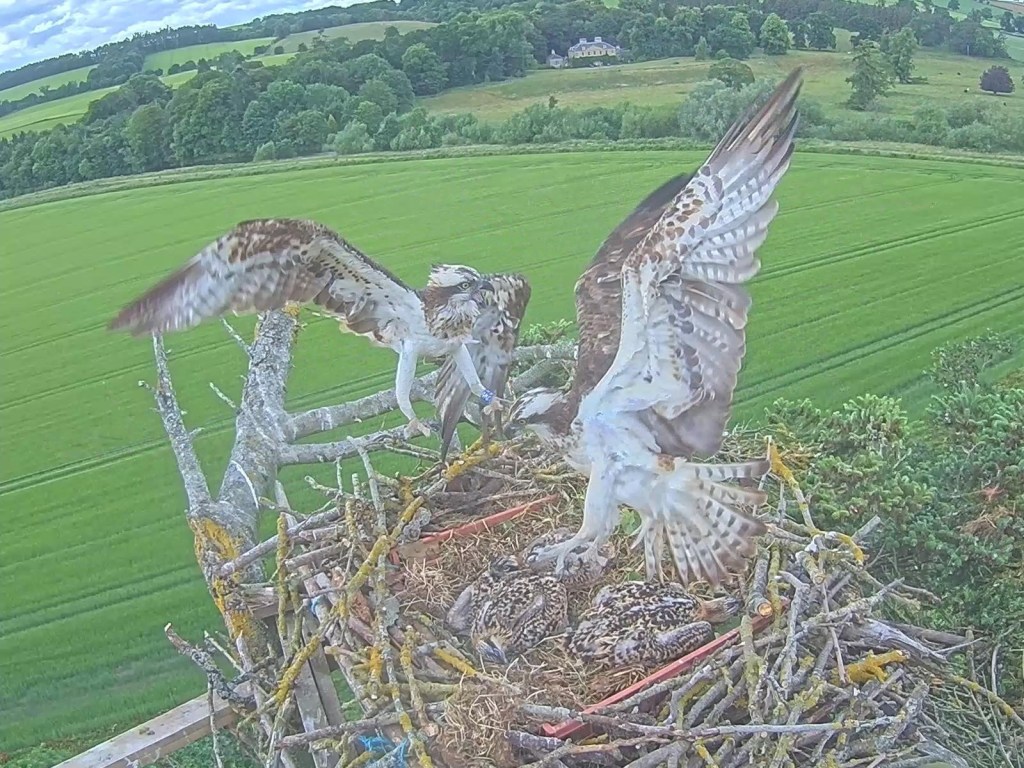
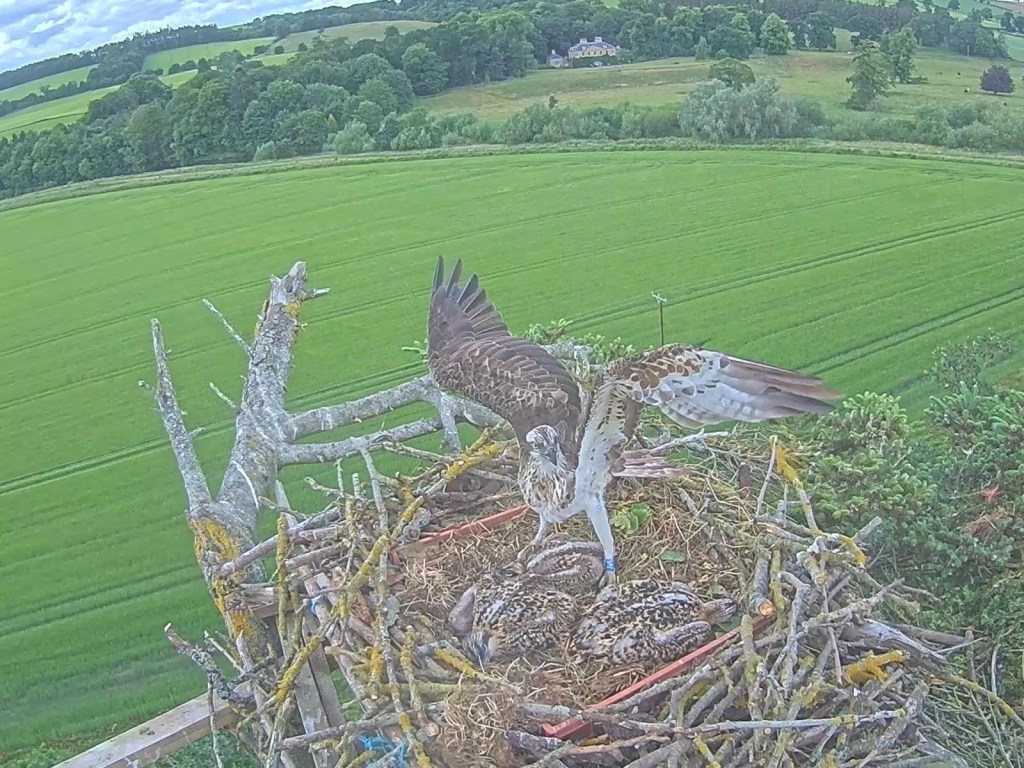
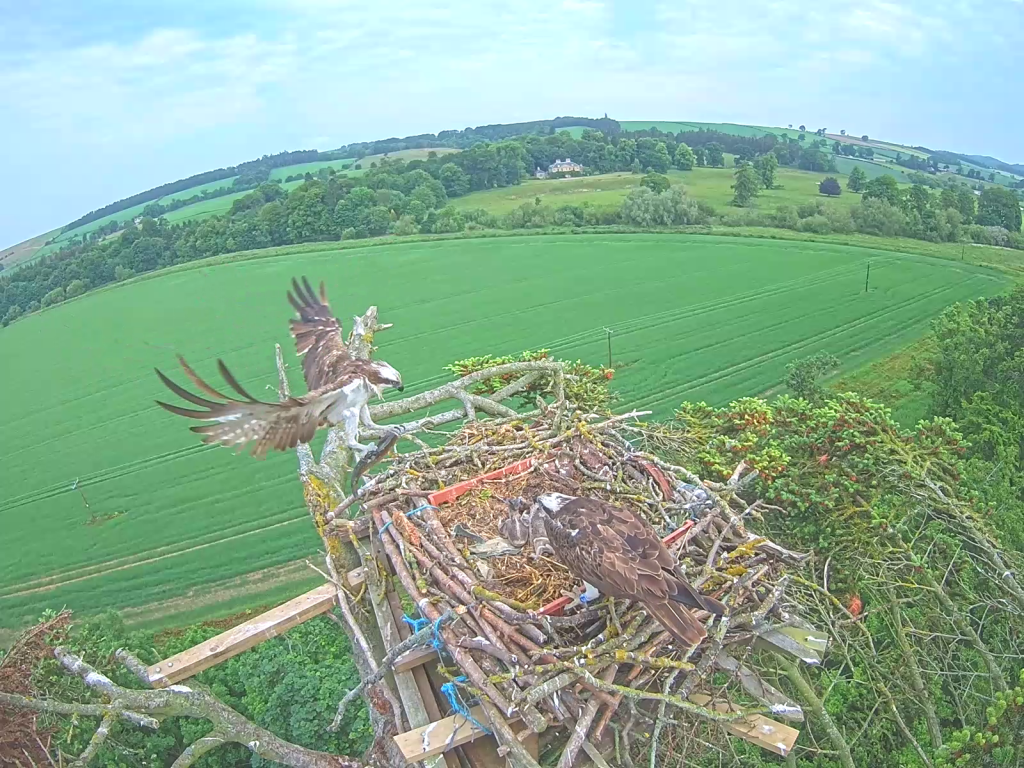
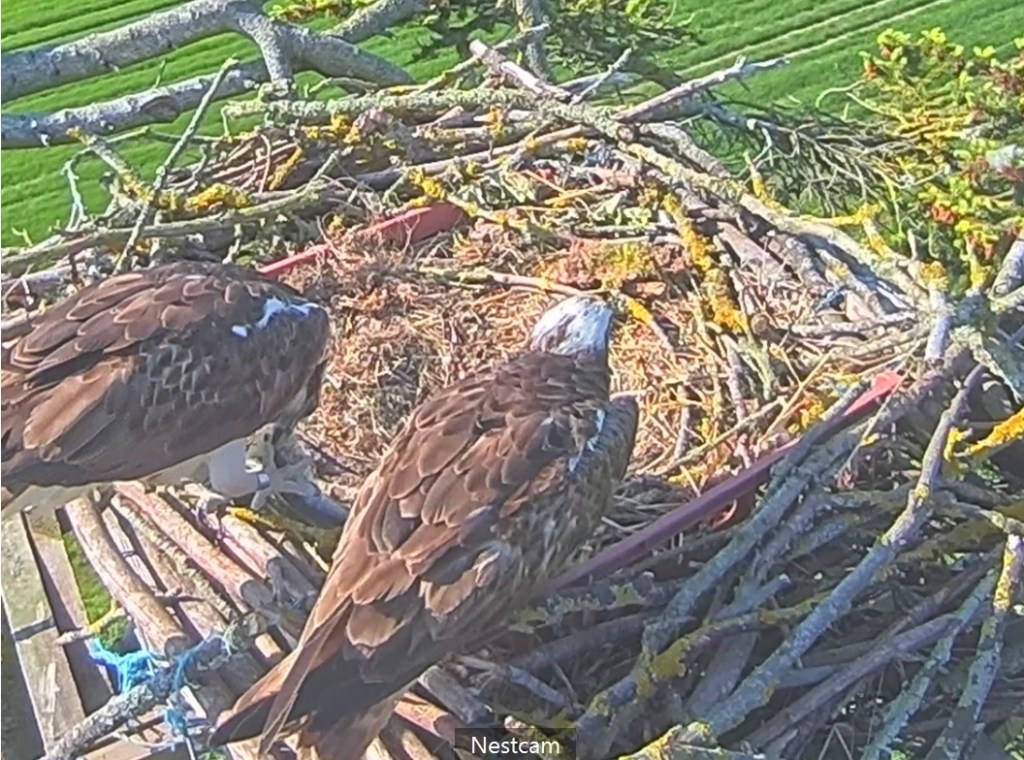
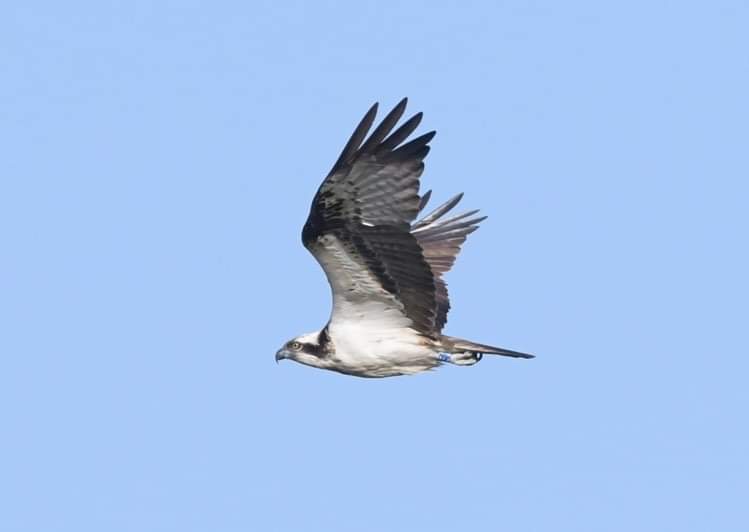
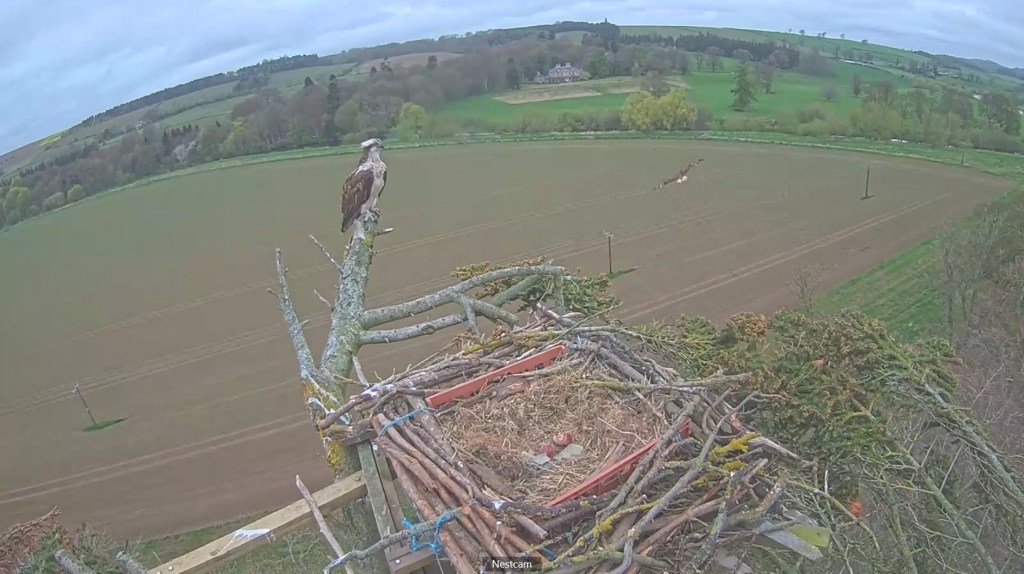
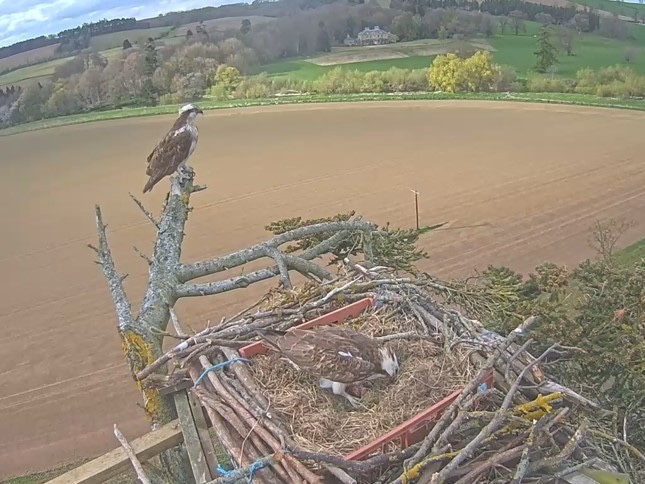
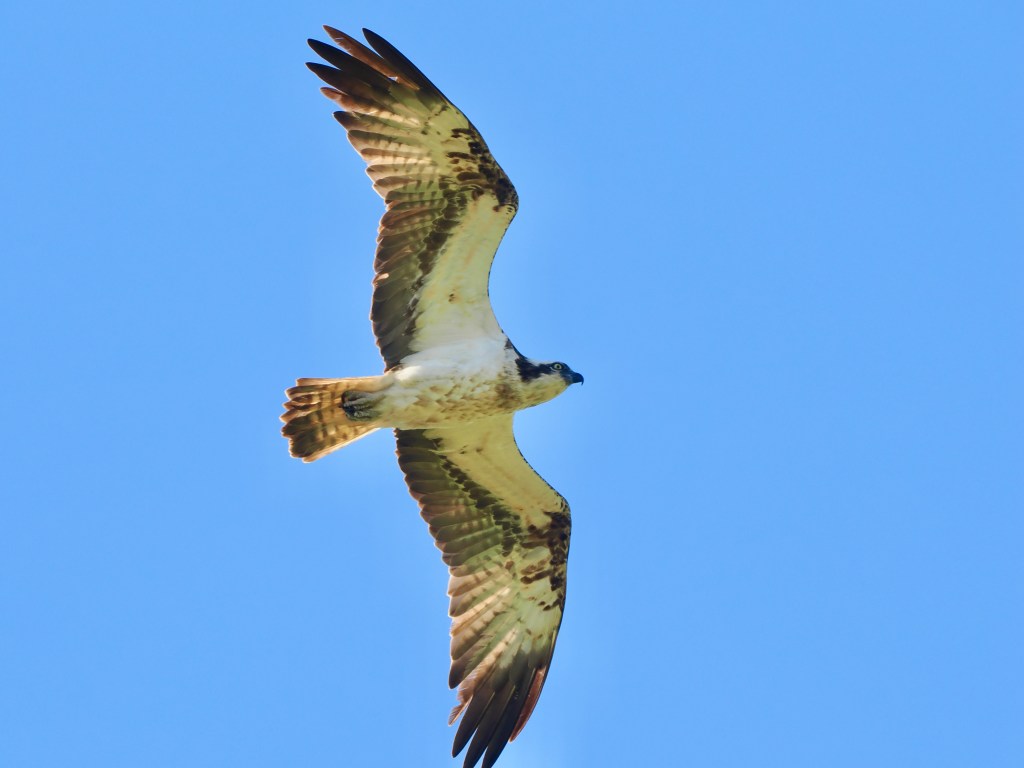
The first fledge of an osprey chick in 5 years at Border Ospreys took place today just before 1400 when Blue 688 (Sasha) took off and made his first flight, landing successfully in the dead tree. He was joined there by his proud parents and I was able to get a family photo of them all together.

From the left: Sasha, Juno and Samson

He had been helicoptering more and more enthusiastically yesterday and so it was clear that he was ready to take that huge step; today’s weather conditions of a light breeze and cooler temperatures made it an easy decision for him.

Final rehearsals

He was still in the dead tree when I left with the light levels dropping this evening and my hopes were dashed that I would see him fly to the nest when Samson brought a fish. Much to Juno’s disgust but Sasha’s indifference, Samson sat in the dead tree rather than bringing the fish to the nest…and ate the lot! From Juno’s reaction, I feel sure that he was going to be sent away to fish again before nightfall. Sasha seemed very confident sitting in the tree and was completely unconcerned about the interest of the local crows. Juno however, was determined that nothing was going to share the tree with her chick and she readily chased away anything landing in the vicinity, included two somewhat unfortunate wood pigeons who suddenly found themselves the centre of the attention of a aggressive female osprey and departed rapidly as a result.

“Look, mum. One leg!” Sasha demonstrating his competence standing on a branch

The activity will now switch increasingly from the nest to the surrounding trees and area as Sasha will quickly gain more confidence and will start to explore and refine his flying skills. He will also start to practise fishing, an instinctive not taught technique. Samson will continue to bring fish in to feed him but Juno will start to fish for herself in the coming days and will build up her reserves as she prepares to leave on migration, her job of guarding the nest nearly complete.

RINGING DAY

Coincidentally, exactly 6 years after the first chicks were ringed following the rebuild of the nest and the installation of the osprey nest camera, we were back again to ring the 2022 class. Both chicks have grown exponentially since they hatched and were starting to wing flap and exercise their flight muscles ready for the big day of fledging.

Soggy family lunch

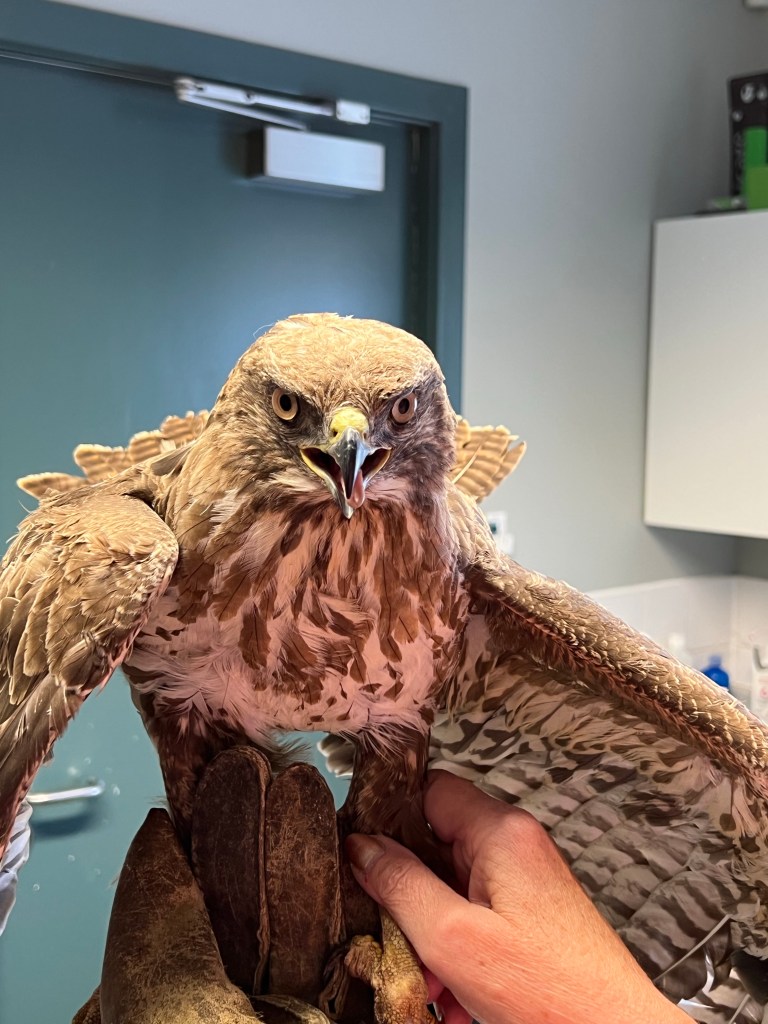
Tragically, it was not to be for one of the chicks. Since it was last seen clearly on the nest camera, it sustained a serious injury to its eye, probably as a result of an accidental piercing by either its sibling’s or a parent’s talon. An osprey cannot survive with only one eye as both eyes are needed to judge perspective during the dive and the loss of that would have meant a slow death by starvation. I rushed the chick to the vet in a vain hope that the damage might have been limited and the eye saved, but the vet confirmed that the eye was lost and the heartbreaking decision was taken to put the chick to sleep.

Samson was away from the nest when ringing took place but Juno stayed close throughout, circling and warning her chicks to “play dead” in the nest. Both chicks were lowered to the ground, and it was confirmed that the one bird needed the attentions of a vet. The surviving chick was weighed and measured as normal, was found to be 1400g and therefore, in all likelihood, male, and was ringed as Blue 688. Many of you will know I have a Ukrainian family staying with me. The ringer kindly invited them to watch the ringing and so Blue 688 will be known as Sasha, a common name in Ukraine.

Not the most comfortable outfit when you’re climbing and it’s 29 degrees! (Photo courtesy: A Smith)
Selecting the ring (Photo courtesy: C Tees)
Waiting patiently (Photo courtesy: A Smith)

The remaining chick was returned to the nest, just in time for Samson to return with a fish to add to the one already lying there. As I left, I could see Juno feeding Sasha enthusiastically, seemingly unaffected by the events of the day and the fact that there was only one chick in the nest. It was good to see that she had returned quickly once we left the immediate vicinity and taken up her maternal duties again, and also that Sasha was ready to feed straight after his ringing adventure.

A very warm ‘yours truly’ with 688 (Photo courtesy: C Tees)

The demise of the chick had a very sobering effect on what is normally an exciting day but we can be glad that the injury was found and dealt with so quickly, minimising any distress and pain. Any loss is difficult to bear but it was so close to feeling the wind under its wings, that it seems particularly poignant. Nevertheless, we still have one chick that will, in about 10 days’ time, hopefully launch himself off into the next stage of his rapidly changing life by fledging and starting to explore the area he has been studying since he could peer over the edge of the nest. I’ll let you know how he gets on.

NEAR DISASTER!

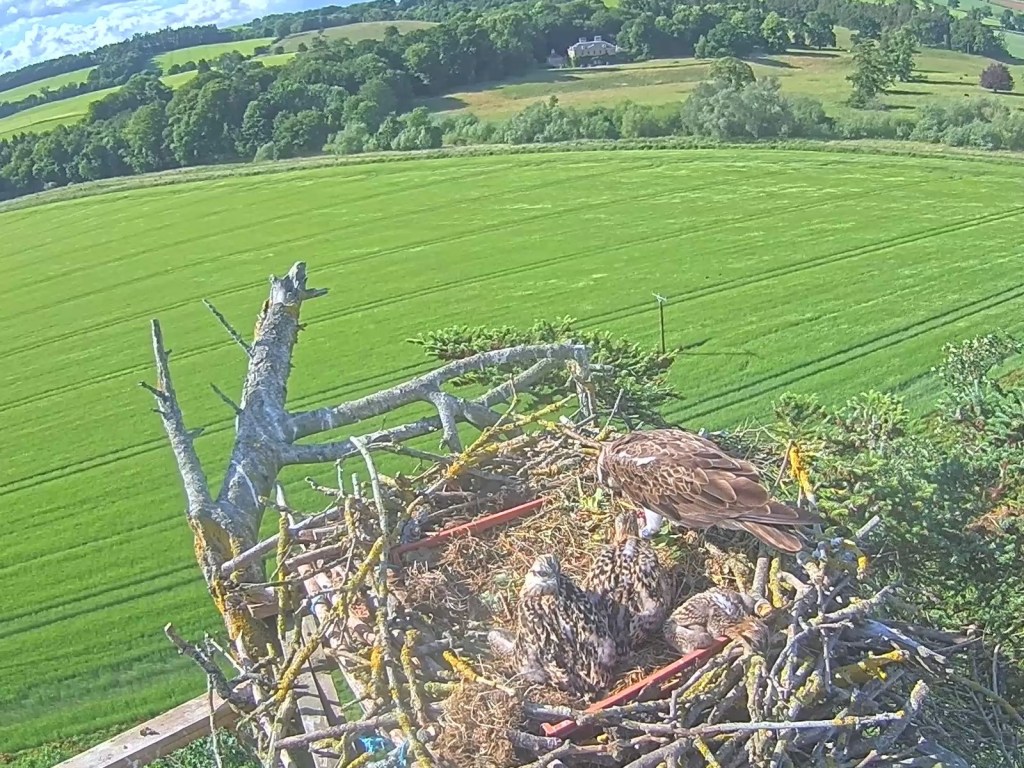
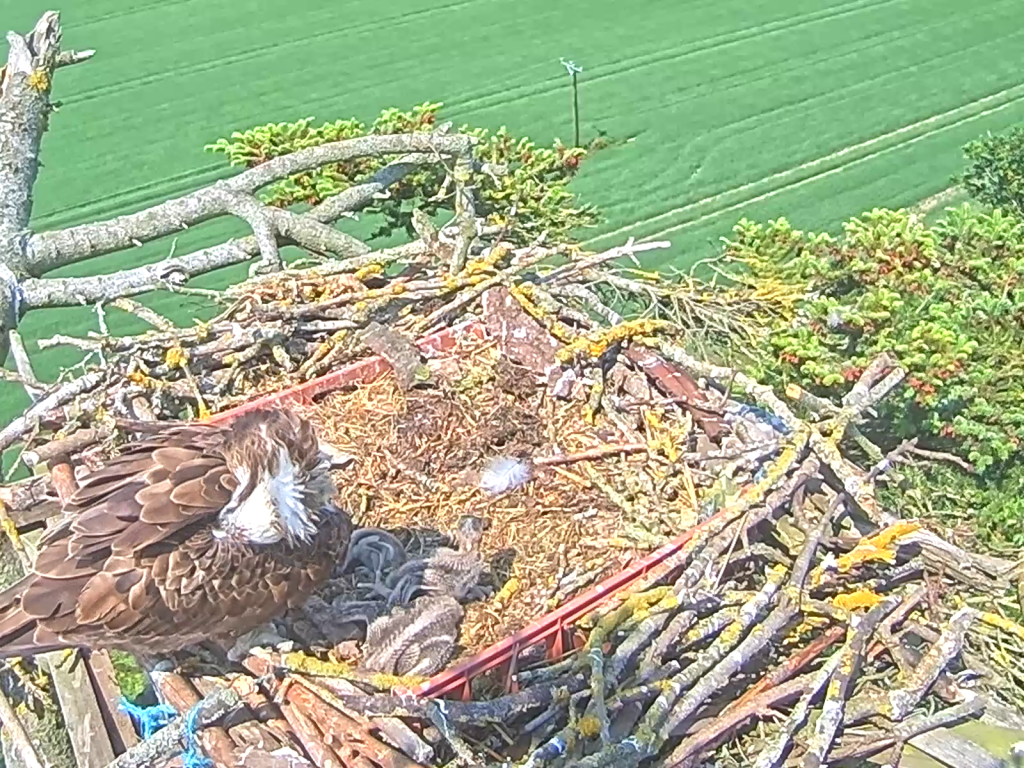
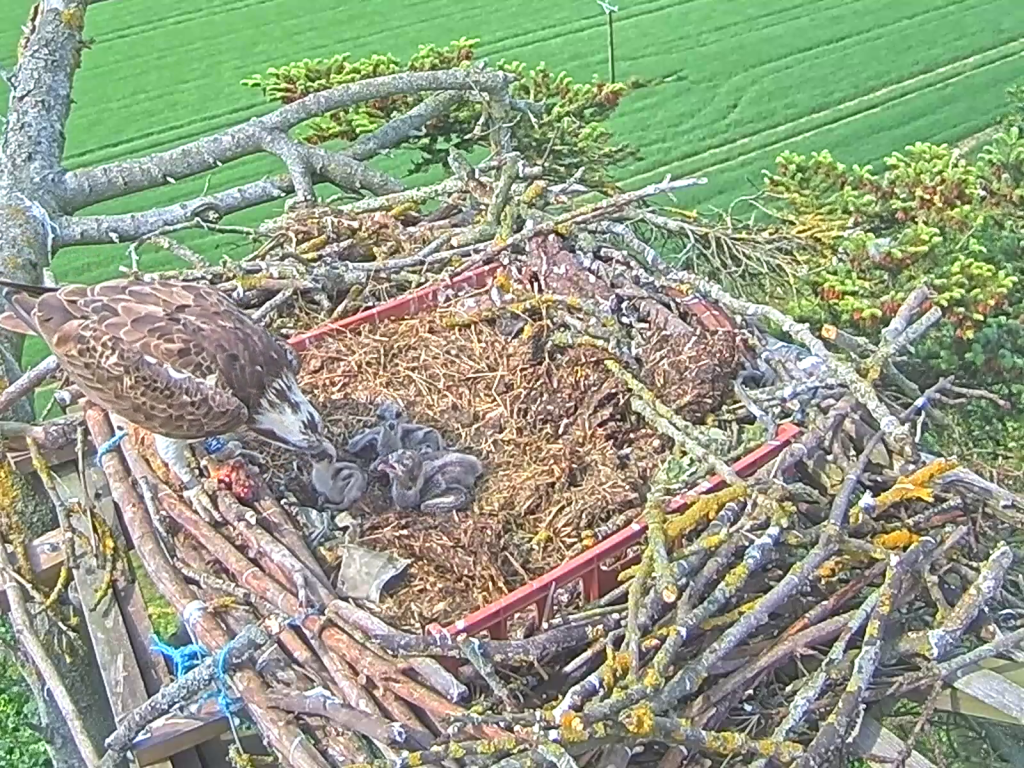
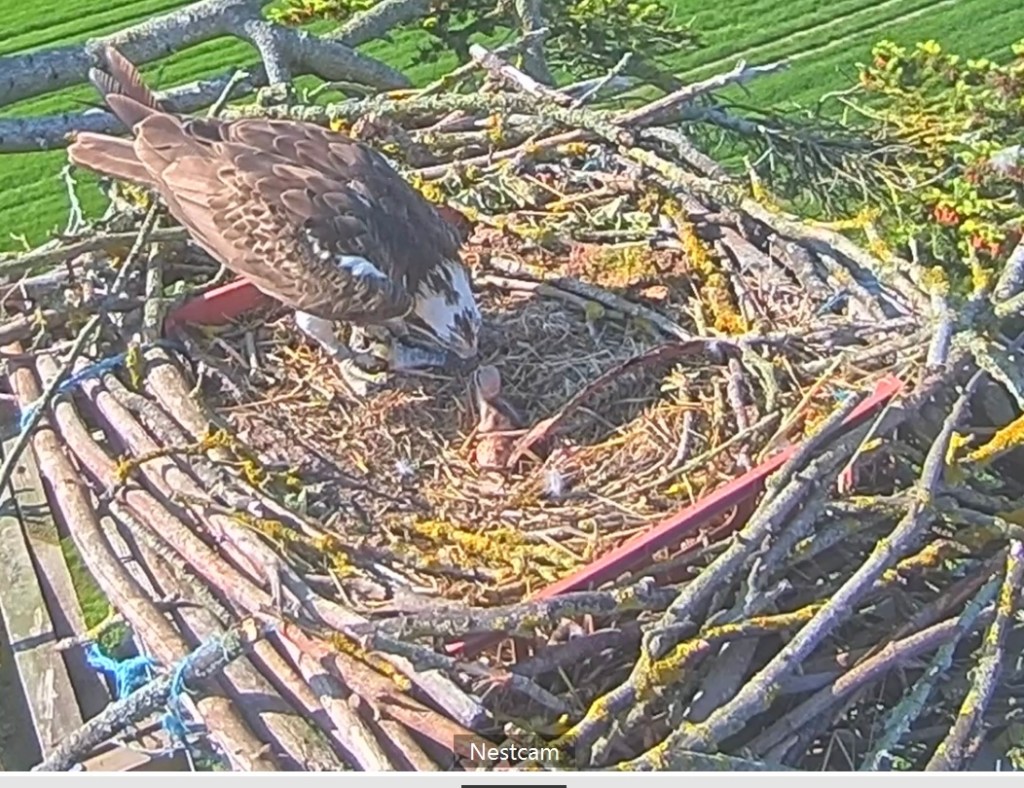
The chicks are growing quickly and well, getting bigger every time I look. They dropped their fluffy down overnight at the weekend to transform into mini dinosaurs and now are starting to venture around the nest, propping themselves up by their wing stubs. Samson has been working hard providing a good supply of fish; pike for the first few days of their lives from a lochan somewhere upstream and then he swapped to fishing downstream and started bringing in sea and brown trout. Juno is doing a super job feeding them and looks like an experienced female rather than one bringing up a first brood. She even let Samson have a go at feeding the chicks, something his previous mate, Delilah, never allowed.

Juno quickly mastered feeding her tiny offspring
Samson showing off new parenting skills as well

Everything was going so well but that all changed today when the camera was switched on to reveal that a large tangle of baler twine had been brought to the nest and Juno was brooding the chicks with much of it tucked under her. I’ve spoken and written before about this scourge to the health and well-being of wildlife and it is sadly an addition to the nest most years but never before in this quantity. Samson probably would have picked it up from the river, thinking it was a lump of reeds or grass, little realising that he had brought something so potentially deadly to both adults and chicks onto the nest. The twine could have choked the chicks and the adults could have had it tangled in their talons making a real possibility of them pulling the chicks from the nest when they got airborne or getting caught and left dangling if the twine subsequently snagged on a tree branch. In most cases it would have meant a slow and painful death.

Juno lying on the baler twine

It was difficult to assess the situation while she was lying down but my worst fears were realised when Samson brought in a fish and Juno stood up to reveal that one of the chicks had twine twisted around its neck!

The right hand chick well tangled in the twine

There is often a debate in osprey discussion groups about whether or not intervention is appropriate when something occurs on a nest but there was little doubt that, in this case, we were obliged to try and resolve a situation that was completely man made in its origin. My ringer was injured and unable to climb so, with time of an essence, I called upon my normal tree climber and he was able to come almost immediately. I gave him a comprehensive brief on how to handle the chicks if necessary, bearing in mind their Schedule 1 status, and I made it clear that he was to spend as little time as possible on-site, commensurate with the security of the nest and its occupants. He did an excellent job, climbing the tree swiftly and, with the minimum of fuss, he was able to release the entangled chick and remove the twine. Luckily for all, the twine did not get caught in the female’s talons and so the worry that she might pull the chicks off the nest when she flew did not transpire.

The chicks were decidedly laid back about this large orange and black human intruder (sorry, Michael) on their nest. Samson and Juno circled the tree throughout, calling out to the chicks to “play dead” but, once we had departed, she returned to feed them the remnants of the lunchtime fish while Samson sat on guard in the dead tree.

Normal service is resumed

So, a disaster was averted but had that occurred on an unmonitored nest, the end result could have been very different. Baler twine is a useful and, in some cases, essential part of farming but it lasts for ever and becomes more and more dangerous as it degrades and tangles; I so wish that the people using it would dispose of it more carefully, considering the threat that it poses. So much of it is just left littering fields and farmyards and, as probably happened here, entering waterways. It could have travelled miles downstream before Samson found it. If you use the stuff or know someone who does, please make every effort to keep it tidy and not left lying around endangering wildlife and leaving an unsightly mess.

The offending twine; the house key gives a sense of scale

No lighthearted comments or jokes from me tonight. We could have lost the family today. Thank goodness luck and a speedy response from my tree climber prevented such a tragedy.

AND THEN THERE WERE TWO!

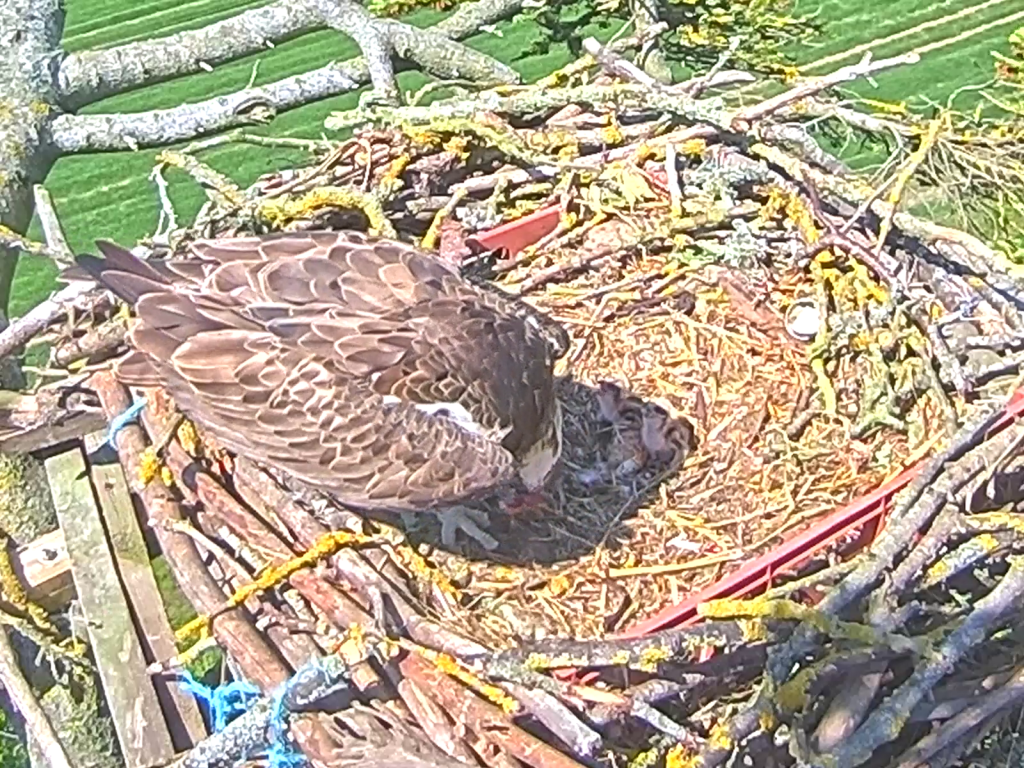
Well, excellent news and sad news in this short blog. The more exciting is that we have a second chick, which we first saw at just before 3pm when Juno stood up to collect a fish, another pike, from Samson. This little one was very sneaky because views of the contents of the nest at 1215 did not show any breaks in the second egg, although we are unable to zoom in our camera and check closely.

Mmmm. Pike again

The sad news is that there will only be two chicks. I had not seen 3 eggs together for about 10 days but hoped that the very deep soft grass in the centre of the nest meant that I wasn’t seeing the entire clutch in the brief glimpses I caught of it during the inclement weather. However, the weather improved today, Juno was standing up much more and it was clear that, as I had feared, one of the eggs had been lost. I don’t think it was predated as both parents have been meticulous in guarding the nest from the wiles of the crows, but I think it much more likely that, in the sometimes atrocious weather of high winds and driving rain in the past 2 weeks, it somehow got dislodged, perhaps during a handover, and ending up falling from the nest. It’s an unfortunate thing but, in many ways, the silver lining is that Juno as a first time parent will be able to concentrate on a smaller brood with a greater chance of success. This is particularly important because natural fish stocks are not as abundant as they were a few years ago. Only one of the lochs and rivers to which Samson has access within his fishing range is artificially stocked, so only having two chicks to feed will help him provide adequate supplies to his growing family.

So, a bit of a roller coaster couple of days but such a delight to at last have chicks again on the nest. I’ll bring you more news as the chicks grow. If you’re intending coming down to see them, they’ll only be cute and fluffy for a couple of weeks until they lose the fluff and transform, almost overnight, into creatures more resembling something out of Jurassic Park (other dinosaur movies are available), but their parents will still love them and so will I!!

AT LAST!

For the first time in 5 years, and after so much heartache and disappointment in the intervening period, I can announce that we have a chick. Hatched out overnight, it looks strong and ready for breakfast. Let’s hope it doesn’t have to wait long. Proud new parent, Juno, is being very protective so we have had just glimpses so far but there will be more photos to follow.

Such a welcome sight!

Welcome to the world, little one.

THE LONG WAIT

Juno finally allowed us to see that there were 3 eggs and, at present, we are on track for the hatching window to open on 30 May.

Three eggs

She has continued to make me eat my words of last year and she has been an attentive and careful incubator – when she has been allowed on the eggs. Samson clearly feels he has a lot of lost incubating time to make up as there have been no eggs for the past 4 years and is proving difficult to move when he is incubating. His main role is to catch fish and he’s been doing that, despite some really unpleasant conditions, but she should be doing the vast majority of the incubating and that’s just not the case during the day. She is willing to do so and often flies up to take her turn but he won’t budge and she hasn’t yet got the confidence to force him off the nest. At first, she would land on the nest perch but he would just ignore her. She then started landing on the nest itself and that worked some of the time but she will have to learn the technique that her predecessor, Delilah, had off to a tee. She would get her shoulder under his keel and with a quick flick roll him off the eggs and over. By the time he recovered, she was safely nestled down and he had no option other than to fly off. Juno will work it out but at present he is enjoying hunkering down out of the wind for long stretches of the day and she has to find a sheltered perch as best she is able until he decides otherwise. She became so frustrated earlier this week that she took herself off for a very quick trip to Kielder and back and was spotted intruding on their Nest 6. She was allowed to incubate when she returned and Samson was able to mollify her with a fish not long after.

C’mon Samson; it’s my turn!

It’s been mainly quiet as is often the case during incubation but there has been an unringed female osprey that hung around for several days and caused the pair a bit of concern. The worst was on Monday 9 May when she had a real go at Juno who was on the nest with Samson. The two females battled on the nest and in the immediate surrounds but Samson, bless him, stayed tight on the eggs, protecting them from any harm and probably got well trampled upon for his troubles. She now appears to have left the area but Juno does occasionally patrol the skies when Samson is incubating just to make sure that she hasn’t sneaked back.

Intruder patrol by Juno

I’ve mentioned before how there seems to be a constant battle between Samson and Brian (my colleague, photographer and fellow observer), as to whether or not Samson can get onto the nest with a freshly caught fish without Brian being able to take a photo of him. Samson is winning by about 978-3 at the moment since we started Border Ospreys! Well, it now appears that the competition has been extended to include my taking screenshots of events on the nest. I came in one morning to see that one of them had erected a screen of beech leaves and branches, totally obscuring the centre of the nest and, potentially, any views of chicks from the camera. However, they had reckoned without the weather and one sustained gust of wind restored the view and deposited their screen over the side of the nest. I wait to see what they think of next.

We can still see you, Juno.

Well, I think that’s about it for news. We are now just over half way through the incubation period for the first egg and excitement is mounting here. I probably won’t write again before The Big Event unless there is something important to say but please keep your fingers and toes crossed for this family and come down and say hello if you’re visiting.

A COMPLETE CLUTCH?

Well, I know you’ve all been waiting to hear whether Juno laid a third egg yesterday and I can tell you that she did…..probably. However, handover of incubating duties have been very slick, Juno seems to have particularly feathery pantaloons and the loss of the nest camera for 24 critical hours have combined to leave a tiny bit of doubt as to whether she managed a third egg or not. What I will say is that there was a very odd incident yesterday when Juno who was in the nest, suddenly jumped up, flew a circuit and then landed back on the nest for no apparent reason, almost as if she’d had an electric shock or someone had stuck a pin in her. Perhaps it might have been the surprise arrival of a third egg? Moreover, Samson seemed to be having far more difficulty incubating comfortably yesterday and today than he did earlier in the week, which might suggest a larger clutch than there was on Friday. The screenshots so far have been inconclusive.

How many eggs have you got under there, Juno?

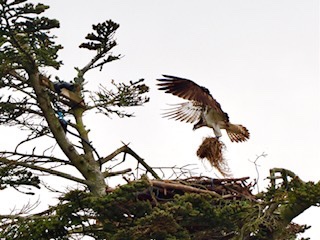
I also promised to let you know of any other goings on during the past 10 days or so. Nest furnishing proceeded apace at the start of the period with both birds bringing in primarily soft material to furnish the nest having perhaps decided that they had done enough building of stick walls. As in previous years, man made rubbish continued to be mistaken for natural material and baler twine and bits of plastic continue to cause concern when they are deposited on the nest. Luckily, most has ended up outside the nest, thankfully as a result of a few windy days, but the threat is ever present. Juno has been particularly enthusiastic, on one occasion bringing in what looked like a giant wig! She felt that if she was going to spend the vast majority of May sitting on the nest, she was going to make absolutely sure that she was comfortable.

Juno bringing in the comfy chair

Since egg laying started, Samson has probably done more incubation than is normal for a male plus, of course, doing all the fishing. Juno has been content to sit in the dead tree and only take over incubating when she wanted him to go fishing. However, in the last day or so, she has started actively seeking to take her turn on the eggs, although she has still to learn the eviction technique of the shoulder under Samson’s body when he’s reluctant to give up the cosy nest.

There have been one or two intruding ospreys in the area but they have been seen off some distance away from the nest, often before they are even in sight of the human observers. Crow bashing has been tackled by whoever is on the nest perch and, with one exception where Juno got carried away with Samson’s pursuit of a pair and joined in, the incubator has been able to sit tight. The herons which appeared to be setting up home alongside the burn that runs under the nest tree have now decided that the other side of the River Teviot is a far safer option, especially as one of them was hotly pursued by an irate Juno on Thursday right across the field and the river before she called off the attack.

Samson escorting an intruding female osprey from the area

So now is the time where we just sit and wait. The hatching window opens at the very end of the month and the signs are encouraging that Samson and Juno are developing into a good team. She seems to be learning fast and developing her instincts equally quickly and Samson is doing a great job as teacher and provider. Nevertheless, May is going to seem a very long month and I’m trying hard to keep a lid on expectations from this new pairing. I’ll let you know how things develop.

A SECOND EGG

A very quick note to say that Juno has laid a second egg today, right on time. As a first time breeder, she may stop at 2 but, if she lays a third, it’s likely to be on Saturday. So far, Samson has been the keener of the two to incubate but she has been very good and sitting tight when it’s been her turn, ignoring crows trying to bait her and keeping that precious egg nice and warm and safe. I’ll write again at the weekend and tell you a bit more about the past week and what’s been happening.

A rather grainy screen shot of the two eggs
Changeover time. Juno is the one standing.

HER NAME IS JUNO

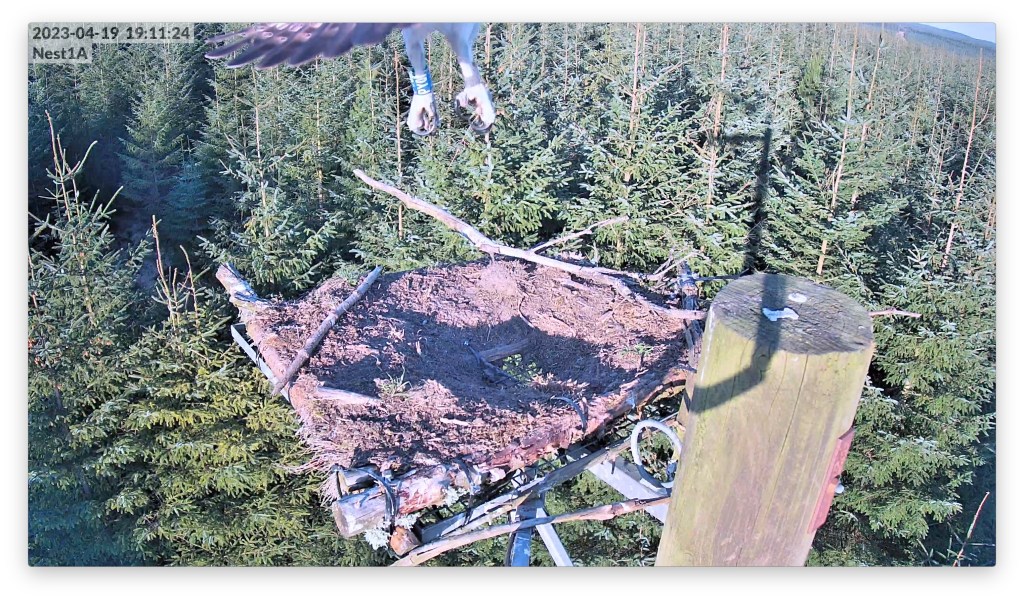
As those of you who read my last blog will know, one very important condition had to be met before I was prepared to give our female, JW6, a name. She was such a nuisance last year with chasing off any rivals but then not being prepared to settle down with Samson, that I said that she wouldn’t get a name until……SHE LAID AN EGG! That occurred with very little fuss this afternoon, but she hid it successfully from view in a very deep cup in the centre of the nest until about 6.30 this evening, when a shuffle of it allowed us to see and take a quick screenshot.

Proud Juno and her first egg

Juno and Samson have both been extremely attentive though his attempts to mate with her again weren’t particularly welcomed this afternoon. The long incubation now starts and I really hope that, as an inexperienced parent, she has the patience to sit out the 37-42 day period. Her character has changed significantly over the past few days and it’s obvious that her instincts, so sadly lacking last year, have really kicked in, so I hope she’ll be fine. A second egg may follow in about 72 hours and possibly a third a further 72 hours on again.

There are many hazards the eggs(s) will face before any chicks hatch. Abandonment, predation, accidental damage by the parents, infertile eggs are all dangers which can occur between now and hatching time. I will update you further in the coming days but for now, we are celebrating the arrival of the first egg at Border Ospreys in 5 years; it’s been a long wait.

MIGHT SHE?

I know many of you have been wondering what has been happening since Samson appeared last Monday and whether he’d found a willing female this year. Well, I wanted to make sure that we weren’t witnessing a flash in the pan but he has found a female and she seems very interested in breeding. What some of who are regulars readers of the blog may be more surprised to hear is that it is JW6. Last year she was, to be frank, a real headache. She chased away any other females but showed little interest in Samson, the nest or any aspect of breeding. When she arrived this year she again spent long periods of time away from the nest area for the first few days, including visiting various nest sites at Kielder, and then wasn’t seen at all for several days. It looked like she may have gone for good but, she was clearly keeping an eye on the nest site because the morning following his arrival, there she was on the dead tree calling at him for fish.

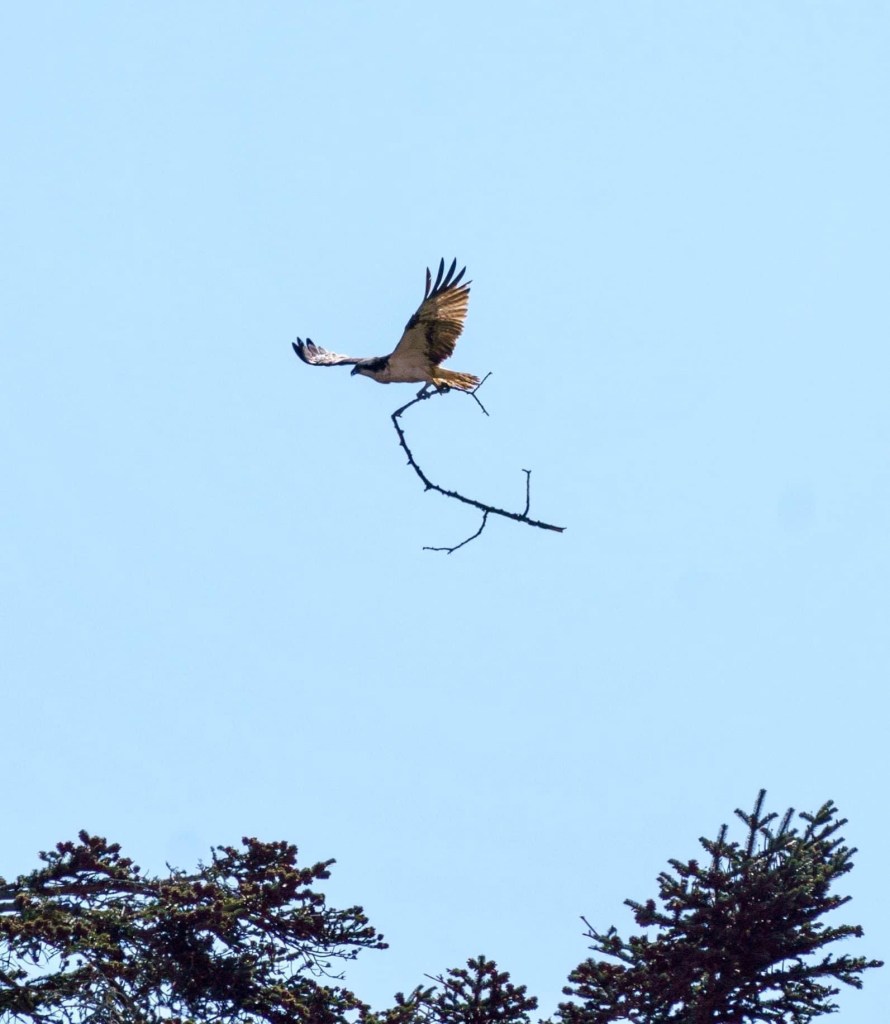
Samson bringing in a “small tree“
The happy couple discussing nursery decoration

Since then she has displayed exactly the sort of behaviour we would expect from a female preparing to breed. She has allowed Samson to mate regularly with her, she has spent far more time than she has done previously in the nest itself, rearranging the nest material, and has been regularly seen collecting more material herself. Most importantly, she has stayed in and around the nest area, not wandering out of sight for more than very short trips.

JW6 on patrol
Supper arriving

All in all, things look very promising and, while I’m not counting my osprey chicks, we are hopeful that we may see eggs laid in the next week. I promised that I would give her a name when she laid her first egg; I have a few ideas but if you think of an appropriate name, please let me know but you’d best make it soon!

After significant frustration, the nest camera is now working and a picture can be seen in the restaurant once more, so I hope that we may be able to soon bring you exciting news with photographic evidence. Please keep your fingers and toes crossed and I’ll let you know when something happens.