THE BEGINNING AGAIN

This is just a very quick blog as I promised to let you know when we had news to give you.


Chronologically, our first bit of news was that our young female KX7 was most probably sighted on 21 Dec in Senegal by two ornithologists (Bram Piot and Frederic Bacuez) out there and Frederic kindly sent me a long-distance photo he took of her.

KX7 in Senegal 21 Dec 19. Photo courtesy of Frederic Bacuez.


Initially, they thought her ring number was XX7 but, as that number has not been designated, the closest to that was KX7, and certainly, the head feathers in the photographed bird resemble those of KX7. My thanks to them both for letting me know and providing the photograph. It was good news to know that she had survived her southbound migration and was clearly doing well, as the large fish she was enjoying showed.


We then waited, impatiently as normal, for the Spring. The influx of birds started well and several appeared to be arriving earlier than in previous years but then the weather deteriorated which seemed to hold them up. Over the last few days, it has cleared and there has been a flood of birds arriving back at their nests. The lockdown restrictions have made life difficult for many observers across the country and we have been lucky to be close enough to our nest to be able to take our daily exercise along the river, although we miss being able to spend the amount of time there as we have done previously. I received two reports of a possible osprey being seen on 4 Apr but we could not confirm them. The following day, KX7 appeared on a nest at Kielder, food soliciting with another intruder female from the rather confused male on the nest.


KX7 and the female from Nest 6 food soliciting from White YA,  the male on Kielder Nest 1a. Photo courtesy of Forestry England.


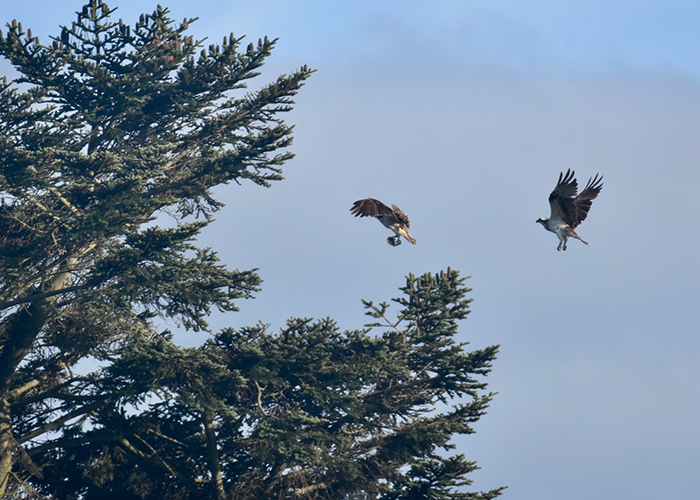
However, their efforts came to a rather abrupt halt when the resident female arrived home from migration. KX7 wasn’t seen by anyone back at her home nest but did make another foray onto the same nest at Kielder the following day, managing to steal half a fish before she was chased off by the female. I love this picture of the irate resident female (centre) arriving back at the nest too late to prevent KX7 from beating a hasty retreat (right) while the male from whom she stole it (left) looks sheepish! Apologies for the condensation on the camera lens.


KX7 escaping with her ill-gotten gains just in time! Photo courtesy of Forestry England


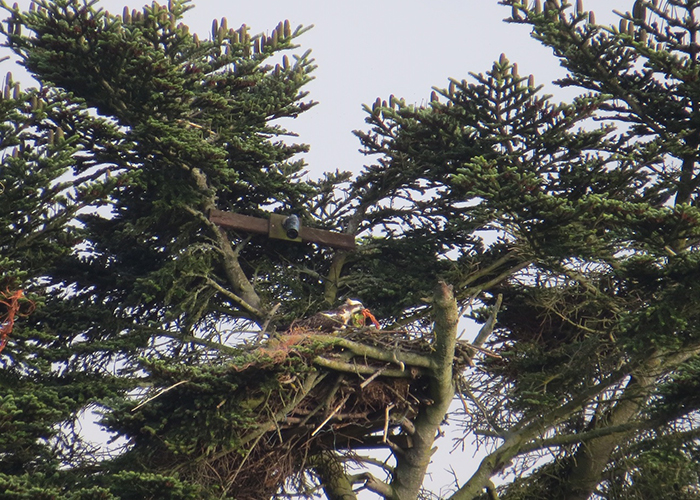
However, what she probably didn’t know at that stage, was that Samson arrived “home” the same morning and, having caught a fish, proceeded to eat it and then immediately started doing repairs to the nest. He has been busy ever since and has added lots of sticks and bits of mud etc and has dug out a nice cup in the middle ready for the eggs to nestle safely. All he needs now is for KX7 to return and settle down!


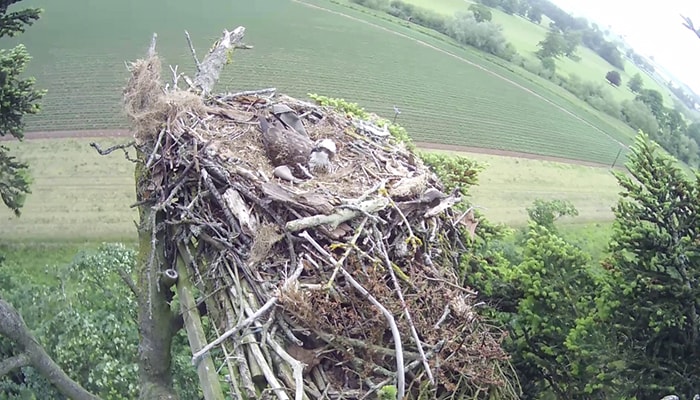
Samson reclaiming his nest 6 Apr 20.


We haven’t managed to see her yet at Border Ospreys but, hopefully, she and Samson will meet up and she won’t feel the need to wander too far again. A steady supply of fish might help cure her wanderlust, Samson!


We will do the best we can, during this lockdown period, to monitor what is happening on the nest. The government has said everyone must stay at home apart from strictly limited occasions. Sadly, this means we have to ask you not to come to Border Ospreys. The site does remain closed while the Coronavirus restrictions remain in force. We will keep monitoring the situation closely and will advise you when it changes. Thank you for your forbearance and stay safe.


Rosie Shields

7 April 2020

THE END AND THE BEGINNING AGAIN

I can’t believe that the osprey season is virtually over and I’m writing my last blog of 2019. Nevertheless, many birds are already on the move and we haven’t had a confirmed sighting of an osprey (probably Samson) at Border Ospreys since Wed 22 August, so our pair may well have migrated and be well on their way to wherever they winter. I’ll make sure that my friends who visit Senegal and Gambia over the winter keep a good look out for KX7 and report back any sightings; it would be great to know where she spends her winters. There is no way of knowing where Samson goes as he is unringed so, with the best will in the world, he couldn’t be identified. We wish both of them safe travels and “haste ye back” next Spring.

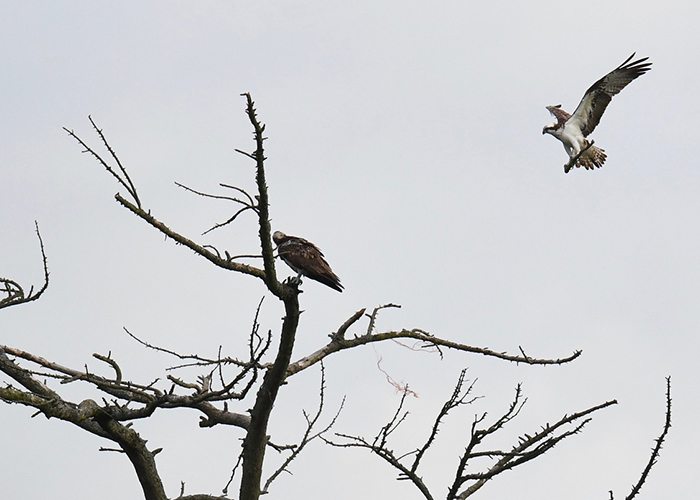
It’s been a very mixed bag of a season here. Samson made us nervous by being several days later than normal and we then had the tragedy of Freya’s non appearance and the sad conclusion that she had not survived one of the two migration journeys or her winter. We had the spectacular sight of Samson skydancing to attract a new mate and, after two false starts with other females, finally attracting the attentions of the stunning KX7. Too young to breed, she nevertheless treated us to great views while she was learning to be a territorial female and growing more and more confident as the season went on. Who can forget the sights we had of the fish-carrying Samson being chased onto the nest by a screaming KX7, seeing her snatch it off him and then retreat to the dead tree to eat, while he in the meantime sat close by with (I swear) a relieved look on his face?

Oi! Hand over that fish NOW!” KX7 pursuing Samson onto the nest to relieve him of the fish he’s brought for her.

The second year being without chicks has been extremely frustrating, especially as we had had such high hopes of Freya’s return and opportunity to breed and it was disappointing for the many customers who visited the restaurant hoping to see a family on the nest on the screen. I am however very optimistic for next year. Statistically, we were very unlucky to lose Freya and so to have a similar tragedy next year would be even less likely. However, predictions based purely on statistics can be wrong so I am therefore throwing the statistics out of the window and relying on good old fashioned crossed fingers and toes that both our birds return and breed successfully!

We also had the very exciting confirmed return of the first of our ringed chicks in the shape of PY0, our middle of the three chicks hatched in the nest in 2017, and nicknamed Walter. Others may well have also successfully returned but have not been reported as being seen.

PY0 intruding at Kielder. (Photograph courtesy of Forestry England)

So, despite the disappointment of no chicks, it hasn’t all been doom and gloom and there is a significant prospect of osprey breeding being attempted next year. In the meantime, we will be keeping our eyes open for transiting intruder ospreys as well as all the other wildlife that is to be seen along the river here. We will be doing our normal maintenance on the nest and the camera equipment over the winter and will be raring to go again by the Spring. The camera will hopefully be running from about mid March and I’ll let you know when there’s news to tell. In the meantime, my thanks to John, the owner of Born in the Borders, and all the staff there for their support; to Jain Jameson of Techstar, my computer and camera technology expert; to Steven Craig of Soutra Design for producing my blog; to Kirsty Smith of Tree Bird Arboriculture for braving the giddy heights of the tree to carry out work on the camera and the nest this year; and to Tony Lightley, of Forestry & Land Scotland, and Joanna Dailey, my opposite number at Kielder, for their knowledge, encouragement and commitment to the ospreys in the area on both sides of the Border. Finally, my thanks to you and all the lovely people I’ve met, in the restaurant, down by the river this year or at the various talks I’ve given. Your support and enthusiasm are always appreciated and I hope you’ve enjoyed my verbal and/or written bletherings. See you all in 2020.

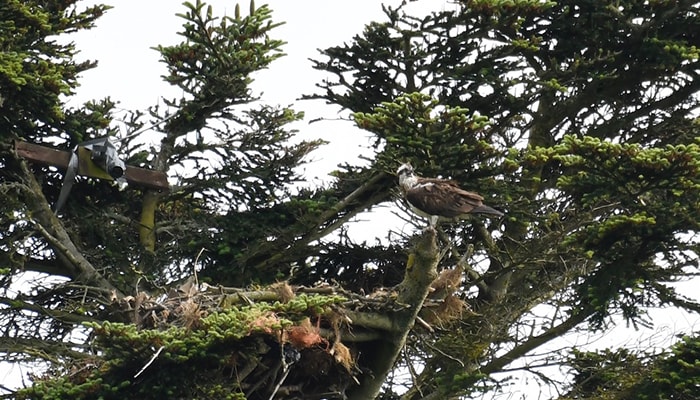
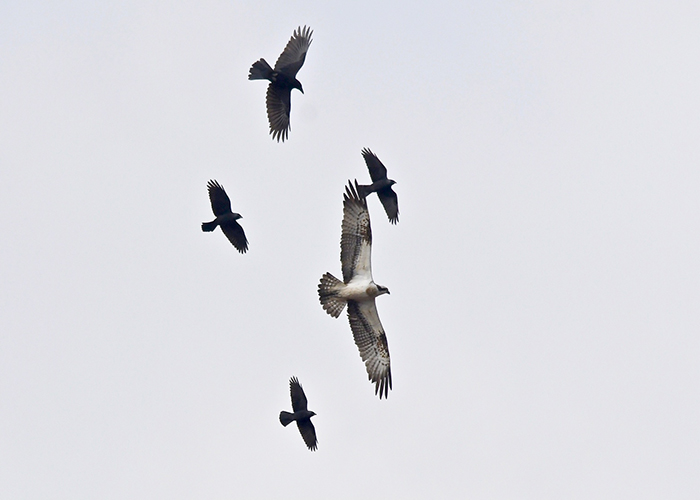
Samson, plus a close escort of jackdaws and a crow.
KX7

Rosie Shields
26 August 2019

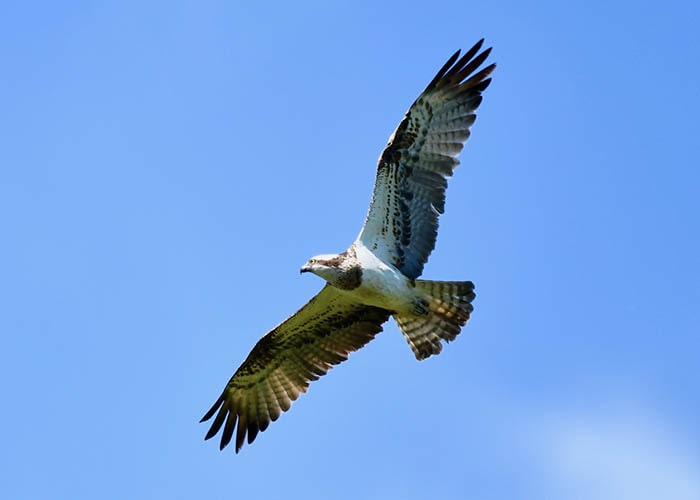
I THINK SHE PROBABLY WILL…(Flying photos by kind permission of Kate Sumner Wilson and Brian Clark)

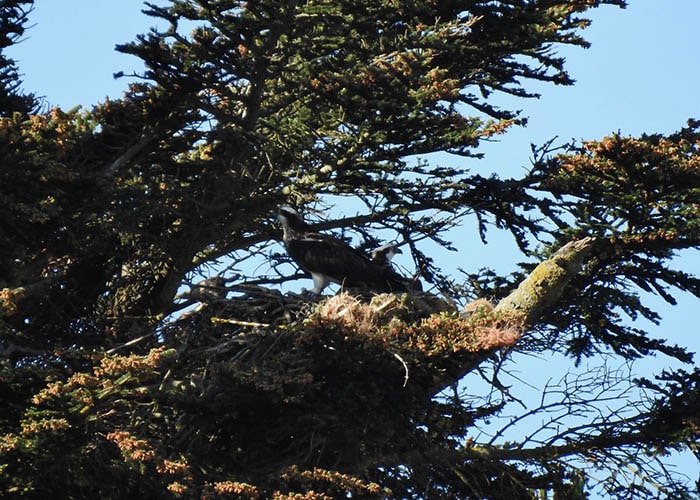
You will recall from my last blog we were left with the question still unanswered as to whether the female, leg ringed KX7, would stay or not. Well, the answer I have for you in this blog is that she probably will as she is still with us (that’s 7 weeks now!) and is looking very settled. There. I’ve said it. That should have her high tailing it out at first light tomorrow!

KX7 in hot pursuit of Samson bringing in a fish.

Joking apart, the pair are looking increasingly comfortable and settled with each other. In fact, they have set up such a routine that there’s been very little to report until recently. He has flown off and got her a fish in the morning. She has eaten it and then disappeared off to have a bath and a fly around the area, settling in a nearby tree on the far side of the river or in the dead tree to sit and sit, like ospreys do, until it’s time to shout for another fish which Samson normally provides in the early evening. He often eats away from the nest area as she sometimes nags him for some of his fish if he brings it where she can see him.

She has been displaying some very encouraging signs to show that she sees the area as her territory to be defended. She won’t tolerate crows coming near her and she chases them off. She is particularly intolerant of buzzards and I watched her recently chase one off that was circling on the far side of the river, not actually bothering her at all. She was doing a grand job until its mate got airborne and she had to beat a hasty retreat once she realised that she was outnumbered! This week, she saw an approaching female osprey intruder and she immediately got airborne with a very aggressive posture of legs (and talons) lowered. She chased it from the immediate vicinity and was later seen high in the sky, escorting it well away.

Samson’s behaviour has been changing over the last few days. Regular readers of my blog will remember last year that he started attempting to build a nest in the dead tree and I remarked that this was something that ospreys often do and that it is referred to as a frustration nest. He’s started again this year and has been (similarly to last year) both enthusiastic and unsuccessful. He has been driving KX7 mad as she sees him approaching and comes rushing in, only to find it’s a stick in his talons, not a nice juicy fish for her.

Samson bringing in a stick when KX7 wants a fish!

His enthusiasm for new nest building has only lasted a few days and he has now reverted to bringing in bits for the original nest. I was sad to see a huge lump of baler twine being brought in by him. He clearly mistakes the stuff for grass and tries to arrange it in the nest, little realising the peril he has brought back with him. Tangled around an adult bird’s legs or talons, it could easily snag on a tree branch and potentially lead to the bird’s death. A chick could also get tangled in it in the nest and choke. Unfortunately, the river brings lots of such debris down with it and there is little we can do. Whenever we visit the nest we remove any that we find but it is a great concern to us.

Samson with baler twine that he has brought from the river.

The other thing that has changed is that Samson is starting to ignore his mate’s calls for fish or is sometimes bringing back a fish and then not sharing it or eating most of it and leaving her only a small piece. As I’ve mentioned several times, she is much bigger than him and you’d therefore think it was quite a risky strategy to annoy her. I wonder if it is as a result of the advance of the season and the lowering of his instinctive drive to provide for her? At this time of year, if they were breeding, the chicks would no longer require a parent to feed them once the fish had been provided, they would be fledging and starting to explore the area and the female would be starting to loosen her bonds with both the family and the nest. She would then start to feed herself up in preparation for migrating in August. While most females are not averse to eating fish provided by the males, his priority has become to supply the chicks and less so the female. Perhaps, with no chicks to feed, Samson feels less need to bring back the steady supply of fish that he has done since KX7 arrived. It’s just speculation on my part but it does seem to be a noticeable trend.

There hasn’t been too much to see on the restaurant screen as they don’t spend a lot of time actually in view of the camera being as they are not breeding. However, he always brings her fish onto the nest to pass across to her so viewers/diners can’t afford to blink as they never know when there’s going to be a flurry of activity to watch. I was chatting to a group earlier this week in the restaurant and had just explained about the lack of screen time when Samson landed on the nest followed rapidly by KX7 and, not for the first time, the ospreys made me out to be a complete idiot!

A passing visit to the nest this week.

Nevertheless, down by the river one or other and often both are seen for most of the day.

KX7 looking rather beautiful in the evening light.
Samson patrolling his territory.

As you will have noticed, we have not yet named our female. We had a bit of a think about it and decided against naming her this year, not wishing to tempt fate. We have several ideas for names for her, assuming she returns next year, but if you think she suits a particular name, let us know and we’ll keep it in mind.

In the meantime, if you’re in the area please pop down and say hello and enjoy watching the two of them interact. Like all ospreys, they do a lot of sitting around and they are a lovely sight. If you’re lucky, you might even see a bit of sky dancing from him or intruder chasing from her; they are well worth watching. I’ll update you as they start to prepare for migration…..where has the season gone?

Rosie Shields

10 July 2019

WILL SHE…WON’T SHE???

Well, what a peculiar season this is turning out to be. Samson was a week later than normal in arriving and then spent a couple of days wandering around before settling down to do any repairs necessary to the nest. We then spent a long time waiting until it was clear that Freya wasn’t coming back. Then we got a female who seemed to settle down, only to disappear after a couple of days. The pattern then continued when, a week or so later, another female arrived and Samson launched into his, by now, well practised courtship display. She was clearly not impressed and only stayed for a few hours, not even waiting for a fish. Then finally, on Fri 24 May, another female arrived on the nest.Continue reading “WILL SHE…WON’T SHE???”

MORE DISAPPOINTMENT BUT…..

Not a lot of good news to tell you at the moment, I’m afraid. It now looks like Freya has not survived as she would probably have been here by now and she hasn’t been seen anywhere else (Kielder have been keeping a sharp eye out for her as well). The regular dangers that face ospreys, not just on migration but also in their wintering grounds, mean that even birds that you would expect to survive, like Freya who was young and feisty, succumb to them. We can only hope that she didn’t suffer.Continue reading “MORE DISAPPOINTMENT BUT…..”

SAMSON IS BACK…NOW WHERE’S FREYA?

Wow! Who forgot to tell the weather powers that be that it was a public holiday this weekend? What a scorcher, unlike the wet, cold, miserable conditions that we normally suffer on such occasions.

Samson returned to us on 11th but spent the first few days rarely visiting the nest or the immediate area so we weren’t exactly sure what he was doing but assumed he was keeping an eye on things from a distance.Continue reading “SAMSON IS BACK…NOW WHERE’S FREYA?”

THE 2019 ROLLER COASTER RIDE IS READY TO DEPART

Welcome to the 2019 osprey season. This is just a very short note to remind you that we are expecting our birds back at any time and, if you are in the area, to keep your eyes to the sky. For the previous 3 years, Samson has returned on 2nd, 9th and 7th April so it’s likely that he’s well on his way. We have no idea when Freya might return.Continue reading “THE 2019 ROLLER COASTER RIDE IS READY TO DEPART”

GETTING READY TO GO?

This will probably be my last blog of the year as I expect both Samson and Freya to depart shortly. They continue to frustrate attempts to work out any sort of routine for their movements and they appear and disappear from the nest area with gay abandon and no thought at all for us watchers.

Freya has continued her day trips to Kielder (it is spookily always on a Thursday that she is seen on camera there) and the links to the Kielder blogs are here:

https://kielderospreys.wordpress.com/2018/08/03/day-trippers

https://kielderospreys.wordpress.com/2018/08/16/a-couple-of-visitors-for-nest-1a-and-news-of-the-adult-females/

Nest 1a, where she went on her first and also on her most recent trip that resulted in her being spotted, is to the north of the area, so perhaps not surprising. But the second occasion where she was seen intruding was at Nest 2, much further away from the other nests and home! In each case, she returned here the same day and her behaviour is still indicative of her classing “our” nest as her home and territory.

Both birds continue to add nest material on a regular basis; the frustration nest did not survive the weather and attempts to rebuild have been abandoned. She often still demands (and he provides) fish although I’m sure she’s also fishing for herself as she builds up her strength for migration. They have also continued to chase any intruders, be they other ospreys, buzzards or even crows, away. I saw her on 18 August dive bombing a buzzard who was down, minding his own business, worming in the newly cut field and she forced him into the air and away. All these various behaviours and their continued occupation of the nest area are very good indicators that their bond to each other and the territory remains strong. I am very optimistic that, should they both survive migration and winter, they will come back here next year. Let’s hope we will see some eggs and chicks in 2019.

Before I close, I thought you might be interested in what has been happening around the other nests in the Borders. My thanks to the Tweed Valley Osprey Project (TVOP) for my use of their published statistics. The TVOP area encompasses the area around the Tweed and its tributaries (and so we are within their study area) and they have reported their worst year since 2007, with only 10 chicks fledged from the whole of the area. 15 nest sites were checked, of which only 11 had one or more adults, and only 5 nests produced chicks. Two nests were lost during Storm Desmond and their chicks perished. On a positive note, on several nests where one of the pair did not return or, in our case, returned and then was lost, the surviving bird has already found a new partner, so its hopeful that they too will breed in 2019. An interesting example is that a nesting platform was erected next to a tree in a dangerous condition that had an osprey nest in it. The nest was moved to the platform before the season started. Unfortunately, the male was the only one to return but he also has recently paired up with a new female and seemed to be content with using the new nest, so fingers crossed for this nest too.

So, the end of a totally unexpected and atypical season at Border Ospreys approaches. I’m sure many of you, like me, mourn the passing of Delilah. She was a magnificent bird, a highly successful parent and a powerful matriarch. I miss her immense presence in the area, whether she was guarding her precious nest, standing on the dead tree surveying her territory or patrolling the sky on outstretched wings. Her genes have been passed on to many chicks, hopefully several of whom have survived, and she has more than played her part in the continuing restoration of these superb birds to the UK.

The mighty Delilah

The 2017 family with Delilah and Samson top right

Now we turn our attention to the anticipation of a new generation. I believe Samson to be quite a young bird, in osprey terms, although we have no means of knowing that for sure and, with the arrival of a young, increasingly feisty mate in the shape of Freya, I am hopeful that, with luck, future years will bring many more successful broods of osprey chicks here. So, although this time of year is always tinged with sadness as the birds depart and concern about the huge journey ahead of them and the perils they will face at their winter homes, we can also look forward with eager anticipation to next Spring. Come next April, let us hope we can view Samson skydancing proudly above his nest while Freya sits below, preparing for her first brood. I’m excited at the prospect and will be there to watch it all. I hope you’ll join me.

Freya. Our hope for the future?

My thanks for your company this year, whether by the nest screen, out in the field or via these pages. My deepest thanks also to those without whom this project could not succeed. John, the owner of Born in the Borders; the staff in the restaurant who often end up fielding questions about the ospreys in my absence; Tony and Malcolm, my osprey and nest gurus and invaluable Raptor Study Group consultants; Jain, my long suffering computer and wiggly amps expert; Mark, our very willing volunteer tree climber and nest restorer (the latter being a complete surprise to him but he did a grand job); and Steve, who converts my blog into computer speak.

See you all for another trip on the Borders Osprey roller coaster in 2019!


Rosie Shields

OSPREY WANDERINGS

This is just a quick update to say that Samson and Freya are still with us but are often spending much of the day out of immediate sight so there’s little to report……except that Freya went visiting the neighbours on 5 Jul and intruded on an osprey nest full of chicks at Kielder, much to the annoyance of the resident female. For the full story, read the link below.

https://kielderospreys.wordpress.com/2018/07/07/an-interesting-visitor-on-nest-1a-and-other-nest-1a-news/

She returned home later on and was probably just exploring slightly further afield than normal. She might have even hoped to snatch an unguarded bit of fish, but no such luck! The low level of water in the Teviot and other sites they use must make fishing more difficult, so some wandering is not surprising but it at least answers the questions as to whether or not she knows her way back to her own nest area.

There’s a definite lull at present but I still expect the pair to stay for a few more weeks yet. I cannot guarantee a good time to see them as they have no routine that I can recognise. It feels more like cat and mouse than birdwatching but it’s worth the frustration of their absence when they do deign to show themselves. They are very comfortable with each other and always seem to come back to the nest area overnight which augurs well for next year. Let us hope that we can enjoy seeing them for a little while longer before they set off on their migration.


Rosie Shields

15 July 2018