Well, things seemed to have settled down a little bit after the excitement of May and there doesn’t seem to have been much to report on since my last blog.
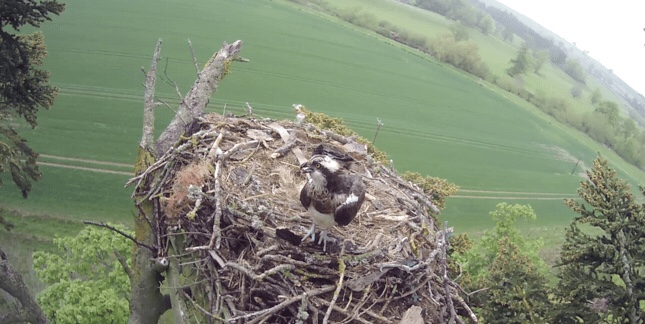
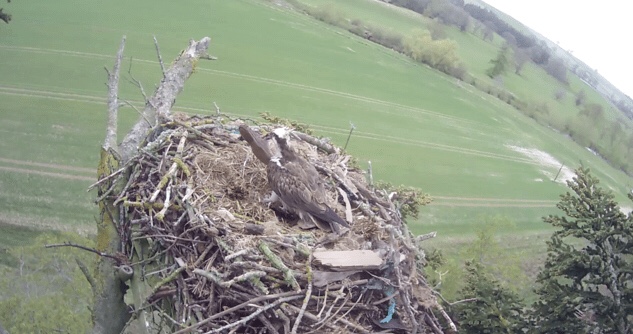
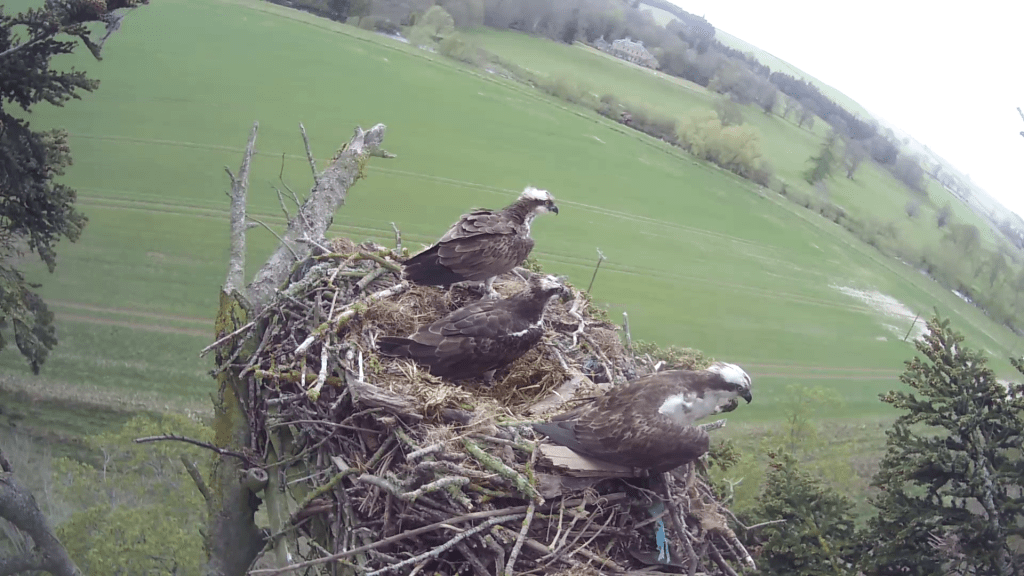
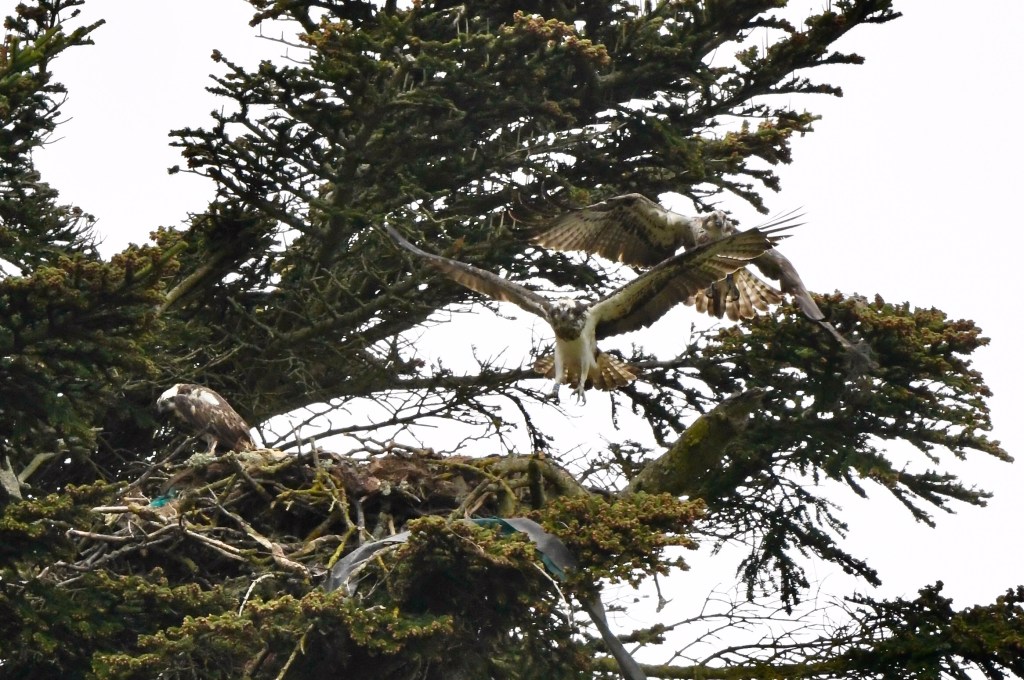
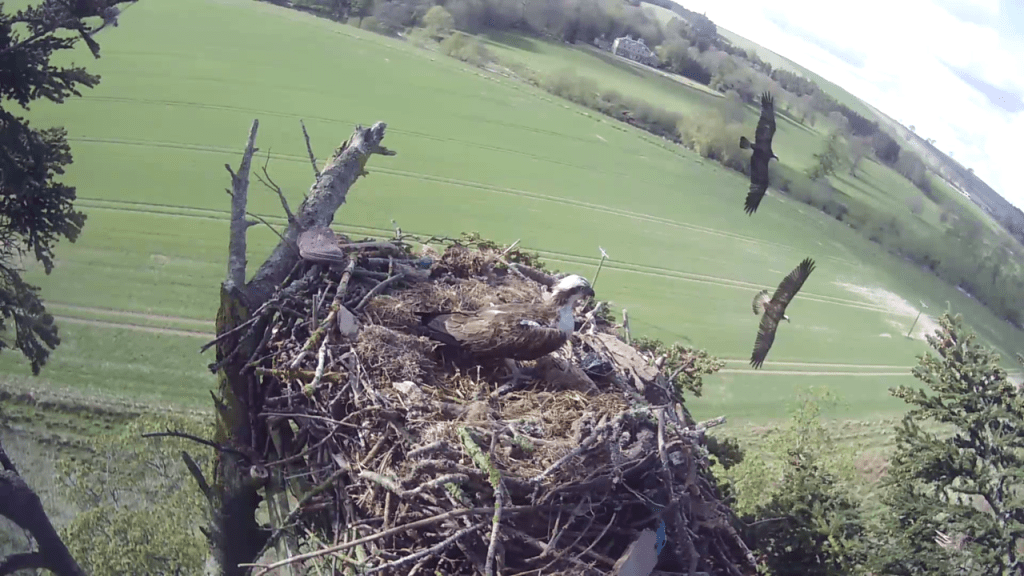
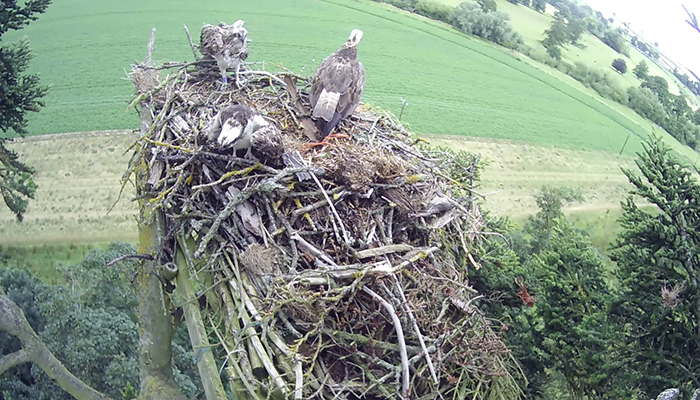
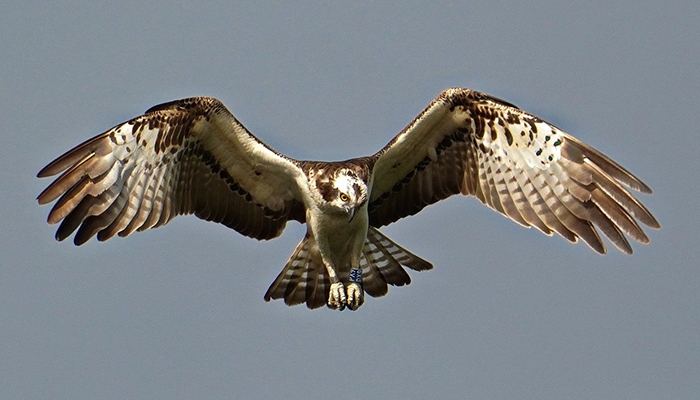
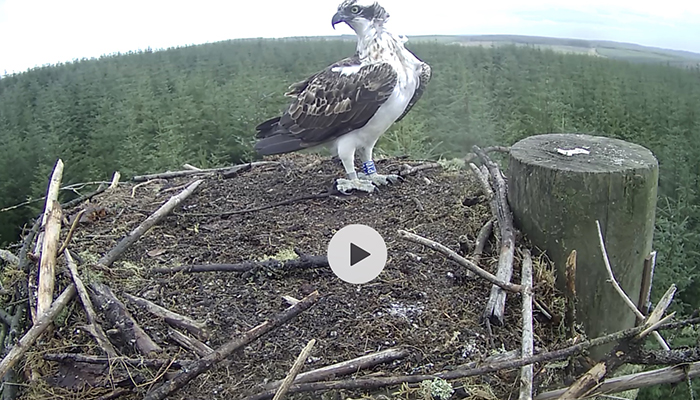
On 2 Jun we saw a new intruder appear on the nest, a rather boldly marked female with a left leg Darvic ring Blue 110. Enquiries with Tim Mackrill at the Roy Dennis Wildlife Foundation revealed her to be a 2018 bird, ringed on the Black Isle, who had also intruded, briefly, at Kielder the previous day. She stayed for several hours and managed to persuade Samson to hand over a fish he brought in. She left the nest and a short time later there was a kerfuffle and 4 ospreys appeared in the sky overhead and around the nest area. I established that it was 3 females and Samson observing (but staying out of the thick of it). One of the females was 110, another I assume was JW6 but I couldn’t see the third closely enough to observe it, although KS1 was at Kielder later that day and was well aware of this nest, so it could have been her. The three females spent about 10 minutes around the nest manoeuvring, diving, and twisting away from close contact. 110 made it as far as landing in the nest for a couple of seconds several times but JW6 (assuming it was her) did a great job of defending the nest from the two intruders and eventually all three soared higher and away. Samson stayed away from the action but flew with them as they disappeared. Half an hour later, it was Round 2, very much a repeat of the first action and the same end. With no camera working, I wasn’t able to check whether there was any subsequent action that evening but, the following day, JW6 was back in residence.
It was all quiet for a few days and at first JW6 stayed close to home but all too soon was sufficiently confident to make several short trips to Kielder on successive days but 110 was back on 8 Jun. She followed Samson in when he returned with a fish and she took it from him. JW6 reappeared and both females flew off, 110 still clutching the fish, and JW6 reappeared after a few hours, but still hungry. Samson was immediately “encouraged” by her to go fishing!

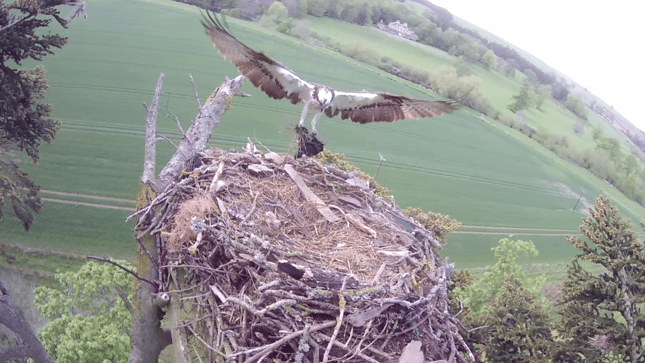
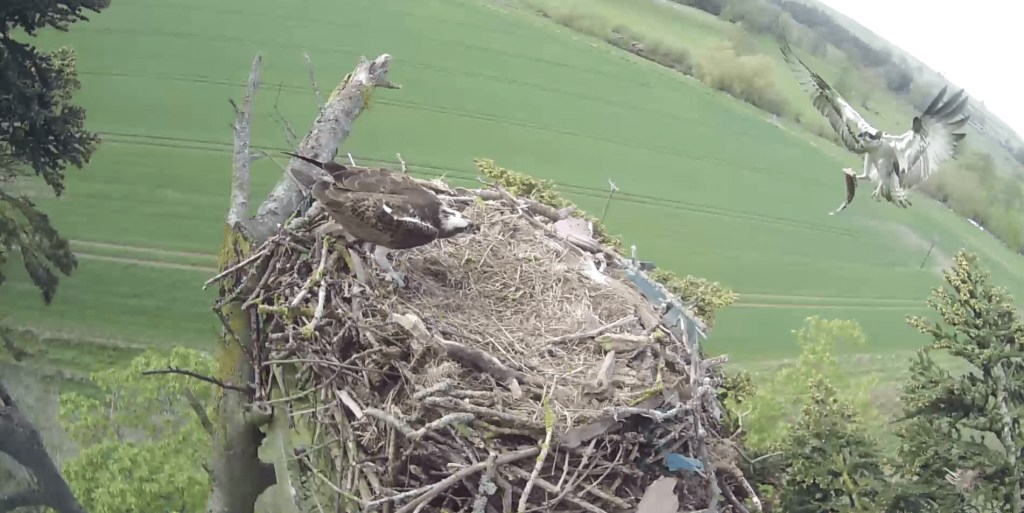
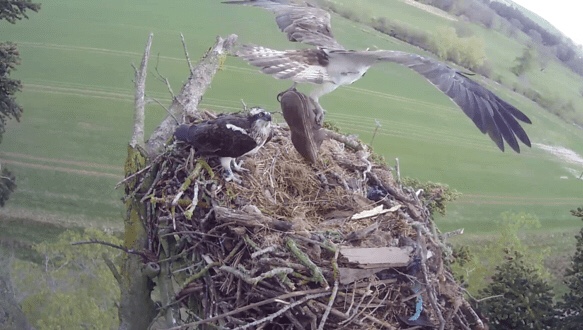
For the next few days, it seemed that neither we nor Samson knew which female was going to be on the nest. 110 was increasingly bold but also often came bringing her own fish, a contradiction if she was trying to take over, as Samson would be expected to still fish for his female, despite the lack of eggs/chicks. We had one amusing situation where Samson and 110 both arrived at the same time with a fish. In accordance with the normal nest protocol, Samson handed his fish over and 110 immediately dropped hers, picked up his and flew off to the dead tree to eat it. After a short while, Samson realised that there was a spare fish in the nest (the one she’d brought in), so picked it up and sat on the nest perch with it but not eating. 110 then must have seen JW6 approaching so made herself scarce, while Samson flew out to meet his mate and escort her back to the nest. She clearly saw he had a fish and, immediately upon them both landing, grabbed it from him and gobbled it up. So, in effect, 110 had provided the fish that was eventually, third-taloned, consumed by her arch rival, JW6!


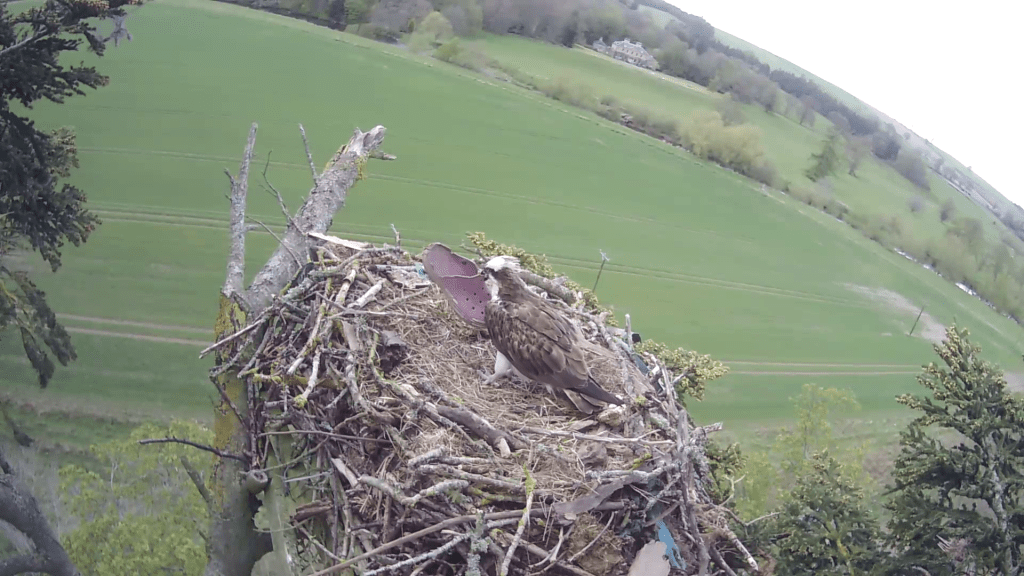
The situation was further complicated by the arrival of an unringed female, who was easy to spot as some of feathers looked distinctly tatty. She joined in with 110 on 13 and 14th of June to disrupt the peace and quiet on the nest but did not land on the nest on either day. However, as the camera switched on at 0500 on 16 Jun, there was the unringed female, sitting on the nest perch, working her way through a grayling! She flew off later in the day, having eaten the fish, and hasn’t been seen since but who’s to say how far away she may be?

Later on on 16 Jun, we had a repeat performance of the fish exchange between Samson and 110 but Samson very much missed out on this one. Her fish was very much alive but tiny. His fish was sizeable and looked suspiciously like a salmon, which will upset and make jealous the fisherman who have found salmon fishing quite challenging this year. So after the exchange, he had finished his meal in a few bites and she was able to eat and eat!
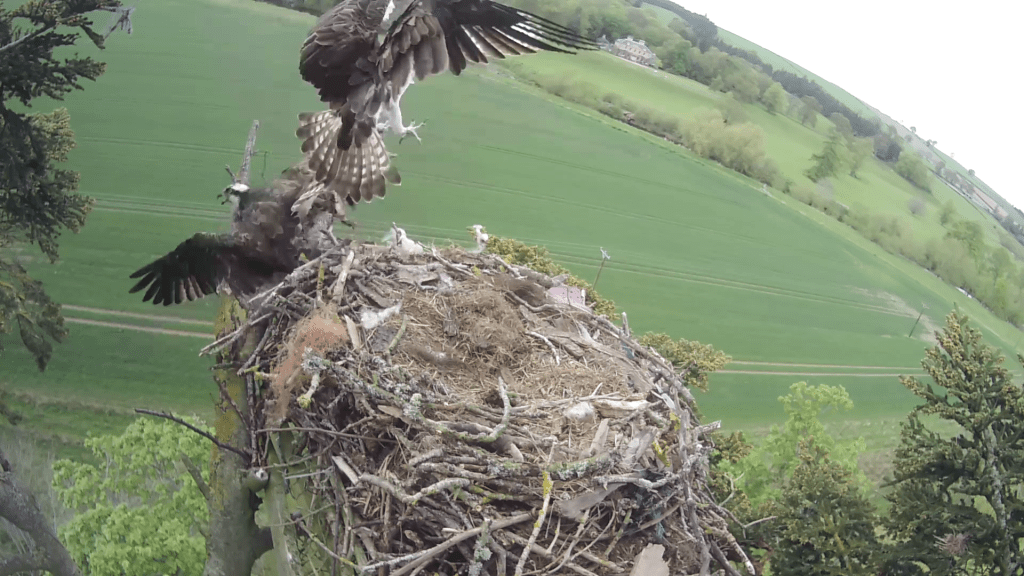
The most recent time we saw 110 was on 17 Jun, when she was on the nest with Samson early in the morning and they got caught “in flagrante” by JW6 who chased 110 off the nest. 110 responded by circling and coming in hard, with talons lowered, forcing JW6 to pancake herself on the nest. The two females took off and battled away into the distance, and neither were seen for the rest of the day. As usual, it was JW6 who emerged victorious and she was back in residence the following day.


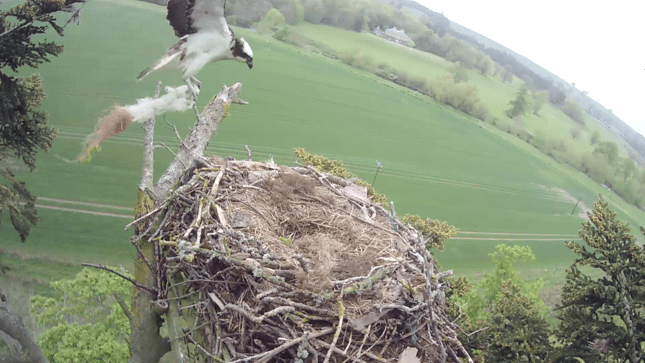
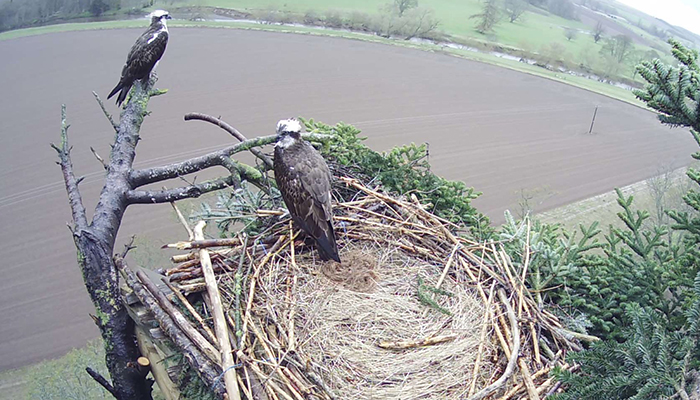
So, with the exception of osprey intrusions, there has been very little action on the nest and in the immediate area. JW6, apart from seeing off any rivals, has been seen less and less frequently and often only visits to demand food from Samson when she’s hungry. She is taking no part in any other activity to assist bonding, apart from defending the nest, refusing to allow Samson to mate and has stopped bringing in nesting material or rearranging the nest itself. Samson, on the other hand, spends lots of time busying himself with the nest, including nest cupping. The arrival of any female sends him into a flurry of activity, rushing backwards and forwards with sticks and grass to line the nest cup; it really is very sad to see his efforts. He also continues to supply fish throughout the day to whoever happens to be in residence at the time. I doubt either JW6 or Samson will leave until August because the need to defend the nest and territory from potential new incumbents will remain; I can only hope that JW6 makes up her mind whether she wants to settle with Samson or, if she decides to go elsewhere, she leaves and allows Samson to find a more amenable mate. At the moment, it’s the worst of both worlds with her seeming no longer interested in Samson, apart from what fish he can bring, but not allowing any other female to become established. It will be interesting to observe her attitude and that of Samson for the rest of the season.










 Border Ospreys