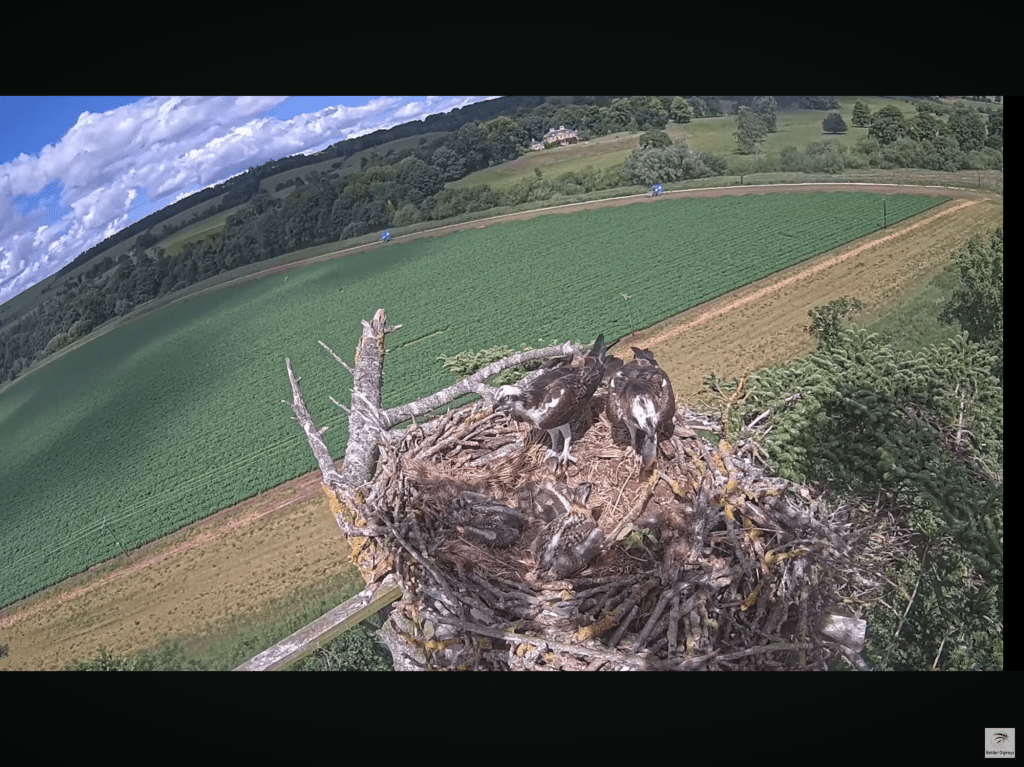
I hope that you have all had the opportunity to watch our osprey family on the nest now, thanks to the marvels of fibre broadband and YouTube. The time is passing so quickly and it was only when I read that one of the earliest nests in the UK had their chicks ringed yesterday that I realised that I’d better get a grip and write another blog.
The family have done really well this year. Augusta has been a great mum in protecting (we’ve had a few visiting ospreys) and feeding the rapidly growing family and Samson has been a star, having found a supply of decent sized rainbow trout with which to keep the family well fed.
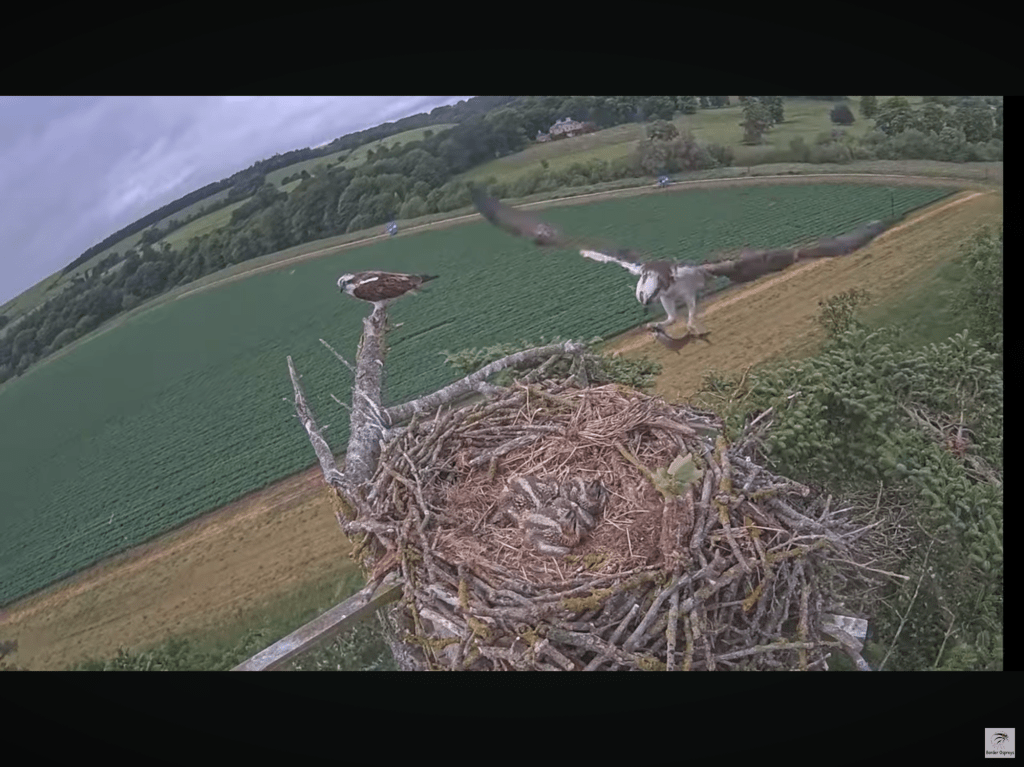
You can’t fail to have noticed how quickly the chicks develop. From the time they were hatched, their one priority has been to eat and their growth has been noticeable every single day that you see them. Chatting to one of our “regulars“, she commented particularly on how the length of their wings has changed. If you recall, when they first hatched, their wings were tiny useless little stubs. After a day or so, they were able to use them to help prop themselves up when food begging and for a while they could be used a little like forearms in the battle to be first to the most recent fish. Now, however, they are clearly developing into the long, elegant wings that will carry the chicks in the months to come, initially around the area and eventually on that incredible journey of migration.
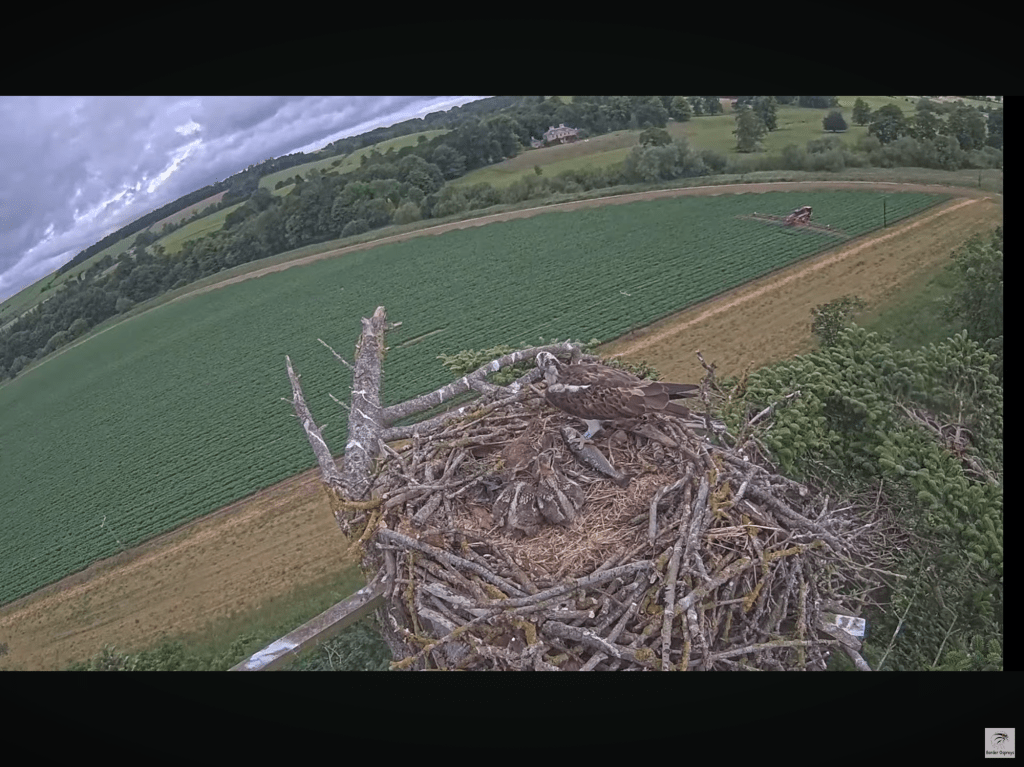
Their mobility has also increased and they now chase Augusta around the nest when she has a fish or just need her to supply some shade. Several times she has almost been pushed completely off the nest.
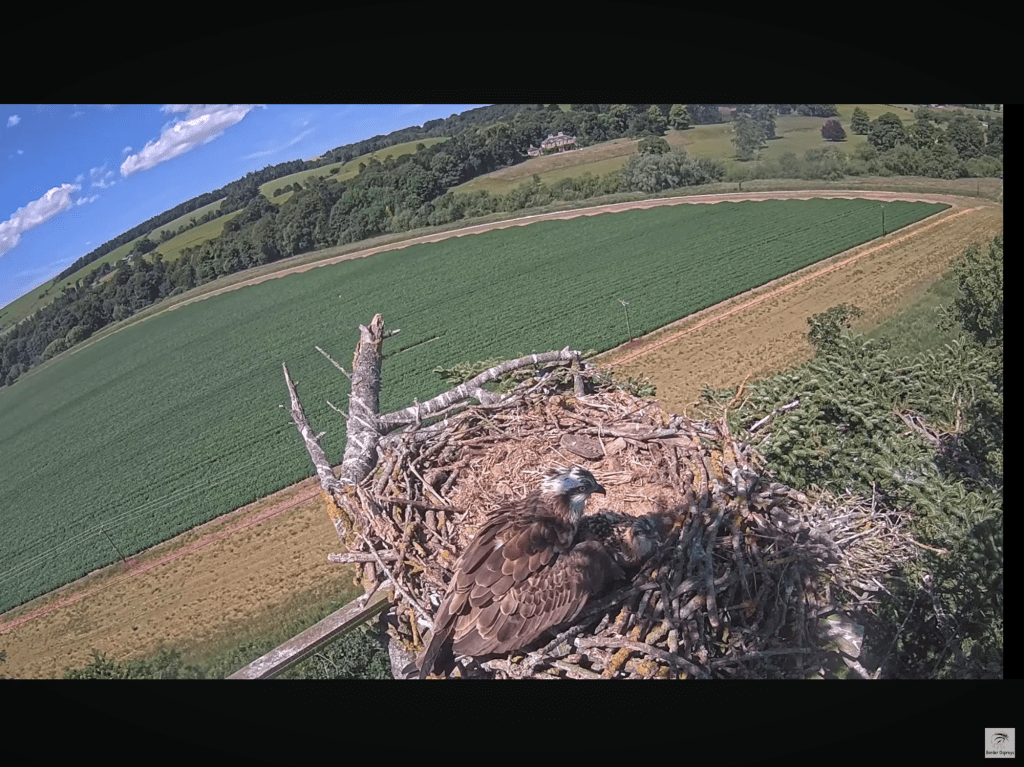
The hot weather is another challenge for the chicks. Both adult birds can, of course, go for a dip in the river to cool down but the chicks are limited to finding shelter on the nest and often Augusta ends up as a “mumbrella”, standing tall with her wings slightly open to provide some shade. Their only source of moisture is the fish that they eat, so these are long, uncomfortable days for them. You will also see both chicks and adults with open mouths and looking like they are panting. It is known as gular fluttering where they oscillate the skin below their beaks (mine is called a double chin but we’ll move quickly on!) to keep cool. While the chicks can all temperature regulate now, ospreys have no capacity to sweat so this is the only method they have to self cool their bodies.
As I mentioned, Samson appears to have found a good source of decent sized rainbow trout which has taken some of the pressure off him that we’ve seen in previous years. However, he still brings in quite a few grayling from the river and some of them are found close to the nest as they are still flapping when they arrive. The regular supply of fish has meant that inter-sibling squabbling hasn’t got too bad although there have been a few instances where one has picked on another. The main aim seems to be for the aggressor to grab the back of the victim’s neck and give it a good shake. The defence is then to turn one’s back and hunch the body over while lowering the head and just presenting one’s back end. This is sometimes done when food arrives to prevent the younger chicks from getting the food or in between meals to assert dominance. In 2023, the second chick actually killed the third one by bullying it constantly and denying it access to food. I don’t envisage any such problem this year with the supply of fish as generous as it is, but a large fish arriving as I write this caused a bit of a scuffle with Titch having to scurry out of range of its siblings.
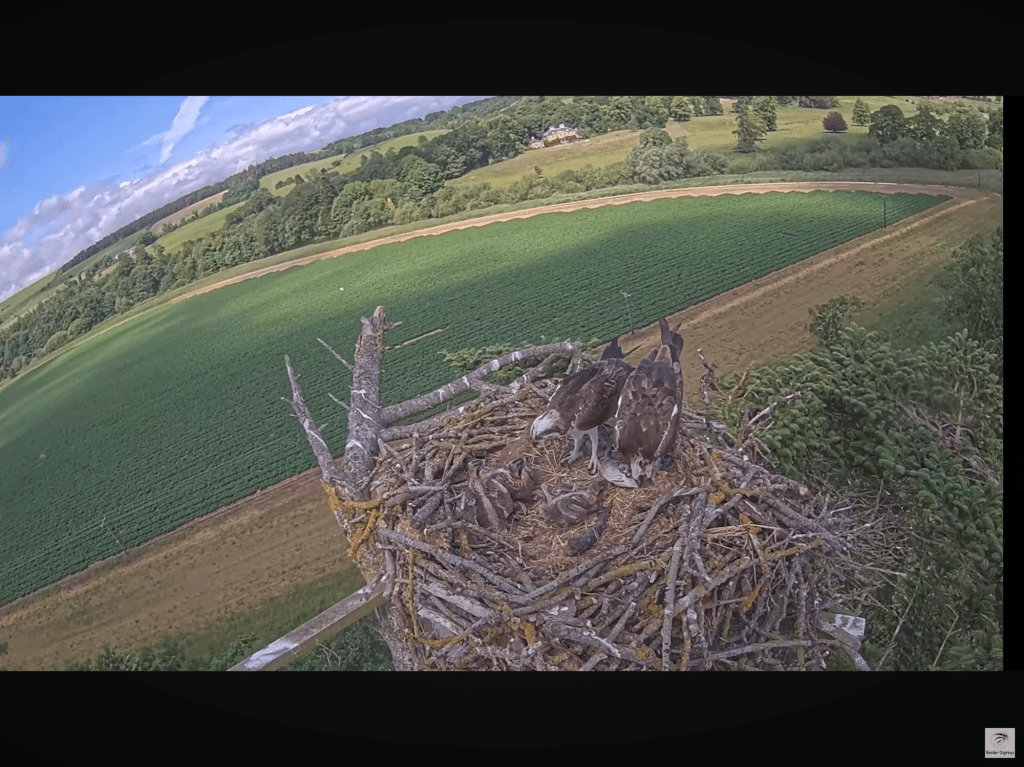
The next obvious signs of progress will be the continued growth of feathers of the chicks so they start really looking like ospreys and not something out of Jurassic Park, and then they will also start standing up on their feet rather than shuffling around on their “heels”. All things being equal, we will look to ring the chicks at about the 6 week point and we should then have an idea of which are male and female. I’d be interested in your thoughts if you’ve been watching them. Remember, the females tend to be larger; chicks #1 and #2 were hatched a day apart and then there was a 4 day gap to chick #3. So what do you think we’ve got? Is #2 a female as it’s the same size as #1? Does Titch’s ability to outwit its siblings and get ahead of the food queue suggest a wily male or a clever female? Let me know what you think.


Concern that I’ve not seen the live feed recently. Thunderstorm damage?
LikeLike
Yes. Something has been damaged during the storms we had. Everything that I can get to still works, so I’m afraid we’ve lost the live feed until we can get at the camera itself and that will be at ringing time in a couple of weeks. It may or may not be repairable at that stage.
LikeLike
ignore me. My techy magician got it working again!! Should be running fine for you now.
LikeLike
all good again live feed back 👏👏
LikeLike
Yes. The camera was damaged during a storm so we’ve lost the live feed until at least ringing
LikeLike
I always root for bobby bach and am so glad titch has found a strategy that works him/her. Sorry ! just too hot to think straight and the kids have all my sympathy in this regard. Well done mumbrella Augusta. And a ‘well done’ Samson on the fish source you’ve found, I am very pleased indeed for you. Male Ospreys really have the hard work in the family season. Thanks Rosie for a super Blog and photos
LikeLike
Wonderfull to see the chicks develop, boy they must be hot, well done to Augusta trying to keep them cool and for dad keeping up the steady food supply 🥰
LikeLike
Well done Augusta and especially Samson for being the provider of fab fish. The little ones are certainly getting big and have been fun to watch. I couldn’t hazard a guess
LikeLike
I am really enjoying watching this family Rosie, thank you for the chance. I think Titch must be a clever female, outwitting her two brothers when she gets the opportunity. Looking forward to be proved right!! Seriously though as long as they all continue to thrive I don’t mind being wrong. Cheers
LikeLike