I said in my last blog that I would chat a little about what the future might hold for this little family. While some of the points may be of interest to those of you who are experienced followers of ospreys nests, they are primarily aimed at those following this nest, or any nest, for the first time and to manage expectations or warn you that it can be a tough, as well as rewarding, experience.
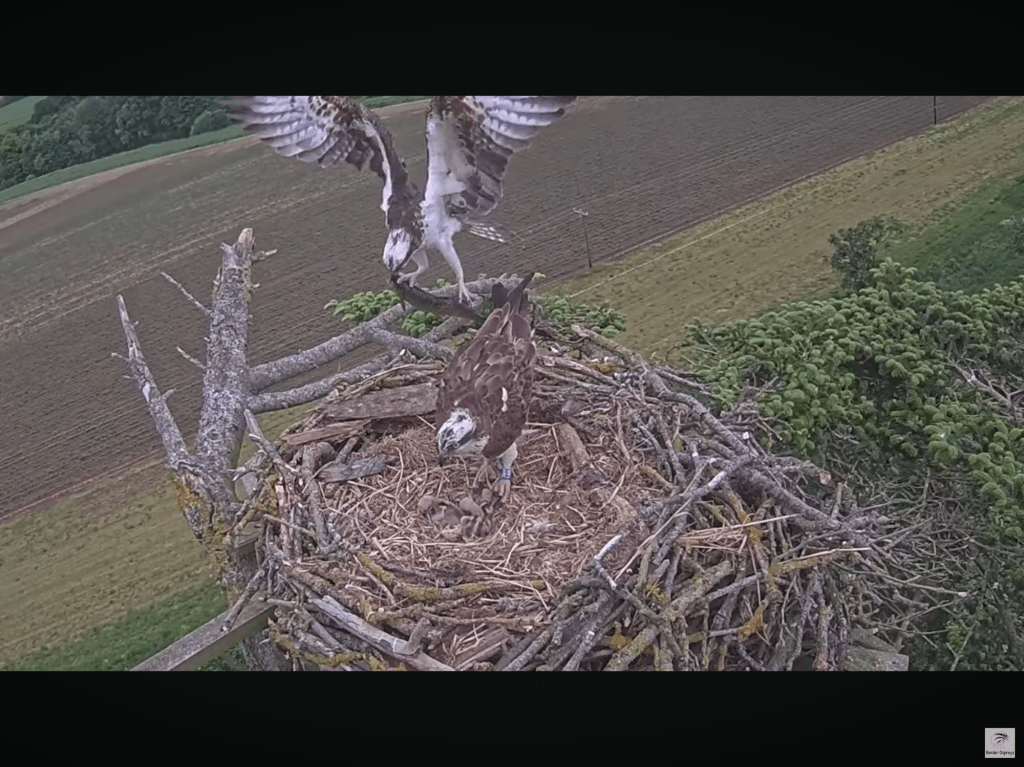
A serious obstacle has already been overcome in that the pair have succeeded in hatching out a complete family. In 2024, in Augusta’s first year with us, they were forced to abandon the clutch, with eggs only a few days from hatching, because extended bad weather had made fishing conditions atrocious. Samson was unable to provide food for both of them on his own and Augusta was literally in danger of starving before she decided to fly off and try to catch a fish for herself. The eggs were exposed for over 30 hours and so never hatched, even though the parents returned and heartbreakingly continued to try to incubate them. So getting to where we are now is already an achievement.
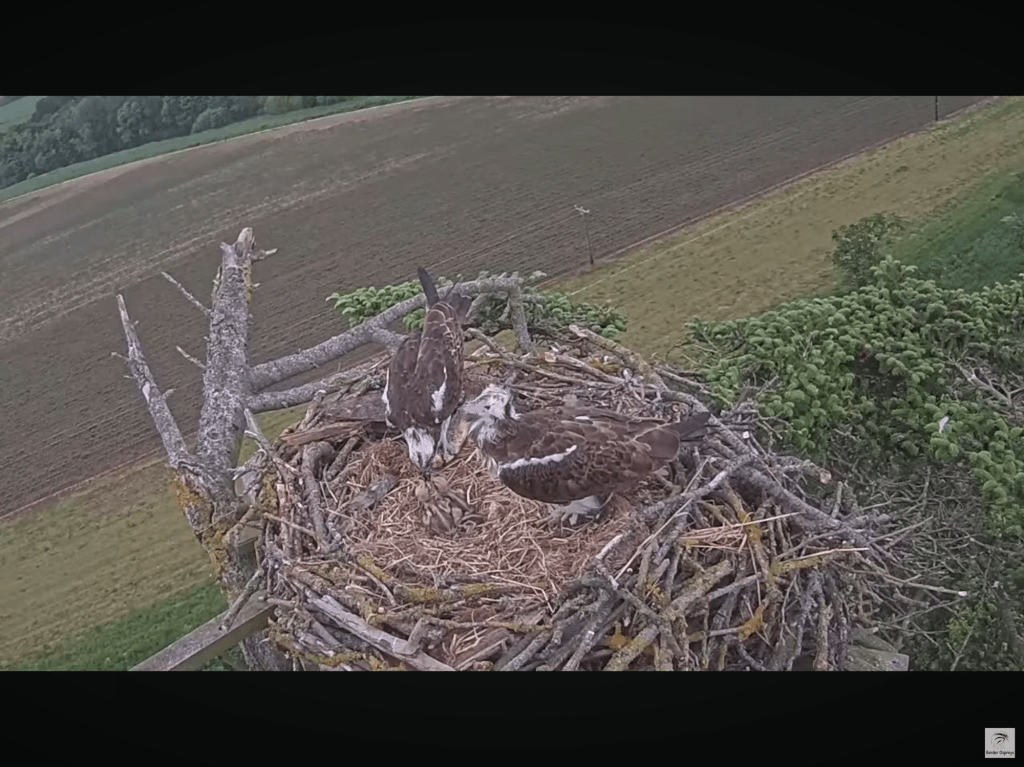
The next potential problem is along the same lines in that Samson now has to provide for the 2 adult birds and 3 chicks; not such a difficulty at this stage, where appetites are easily appeased with only a few mouthfuls of food, but it will become increasingly challenging to keep up with their rapidly growing bodies and associated feeding needs. That is why chicks hatch at different times. The sad reality is that, when food is scarce, what gets delivered is fed to the chick(s) that are able to force themselves to their mother’s attention best. That tends to be in age order as the eldest will be stronger and larger than its siblings and so on down the line. The youngest is the insurance policy and will always be in danger of missing out. It seems harsh but survival of the fittest is as true in the nest as it is on the savannah or in the mountains. What makes it particularly difficult in our nest this year is that the 3rd chick is so much younger than the other two. Normally there’s a gap of one or 2 days but, in this case, it’s 4 days and you can all see the distinct difference in size, so it is already at a significant disadvantage in its ability to compete with its siblings. So, keep your fingers tightly crossed that Samson can keep everyone satisfied. However, I’ve noticed in the past that the youngest chicks tend to develop good coping strategies and often use their brains rather than their brawn and it’s certainly the case with our 2026 brood. As soon as Samson arrives with a fish, Titch (as we’ve nicknamed chick no 3) is on the move, and while its older siblings take prime position, Titch is busy coming up between them or sneaking around the sides, and you watch where it ends up – often right in front! So that is a great sign that it will use skills at its disposal to ensure it gets a decent share of the food.
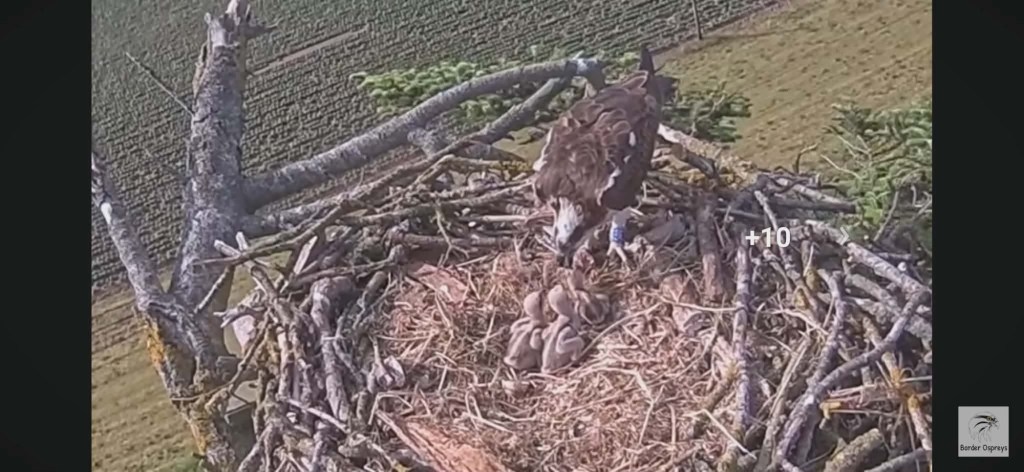
As the chicks continue to grow, they will start bickering and that can be tough to watch on occasions. However, you must remember that they are apex predators and they will need to build up strength and skill to fight for their rights as adults, be it for fishing grounds or, ultimately, for nests and territories, so it’s hardly surprising that they will be discovering aggression and will fight, usually by trying to grab each other on the back of the neck. It’s less noticeable when there’s plenty of food but, if food is short, the third chick can be bullied and attacked to the extent that it is unable to feed and can starve to death or be killed by its siblings. Our nature is to feel for the weakest but that is a luxury not available to ospreys and, again, with a chick much smaller than its siblings, Titch is vulnerable. Chick no 3 was killed this way in 2023. It’s can be very harsh to see but it is a necessary part of them growing up and, thankfully, the behaviour only tends to last for a few weeks until they seem to grow out of it.
I don’t mean to depress you all but osprey watching can be like a roller coaster with a constantly changing scenario and no one knows what is waiting around the corner. We seem to have had more than our fair share of dramas on this nest over the years and each year I hope for a text book season. Perhaps the advent of the live stream will tilt the scales and we will have only good news; if nothing else, it spreads the tension, increased heart rate and bitten nails around a bit more as it’s a monopoly I am more than willing to share! I don’t like to speculate and I will never tempt fate with forecasts but I am hopeful about this pair of adults; they seem to have a good working relationship when there are chicks around. I look forward to watching how they get on.
Just a final note. You will see chick 1 has already lost its fluff and has entered the dinosaur phase and chick 2 is close behind. Titch has a few days of fluffiness left. The two older chicks will now rapidly start developing their proper feathers and growing exponentially. It’s interesting to take a screenshot either every day or every other day and just see how quickly they grow. They are already too big for Samson to brood effectively and you will already be able to see bits of chicks where they haven’t been able to fit completely under Augusta, despite her much larger size. Let’s hope for decent weather to keep them all fit and healthy as they grow.
 Border Ospreys
Thanks for the updates Rosie. Always entertaining and informative. Hope all the chicks continue to thrive, including Titch!
Ingrid & Shayne
LikeLike
Thanks for that Rosie. I find I cannot watch as the mother does not feed the little chick poor thing.Joy
Sent from the all-new AOL app for iOS
LikeLike
Titch is doing really well, Joy. It may have to wait while the larger ones eat but it certainly gets a good feed. One of us is watching most of the day and it is having plenty. Augusta knows what she is doing. Don’t forget, it doesn’t need as much as its larger siblings but is doing its best to catch up!
LikeLike
Yes I agree Rosie. Titch is getting plenty to eat every time I see a fish being fed to all. Both parents are very experienced and seem to be making sure that each baby is getting a full share of the latest catch. So far so good.
LikeLike
An excellent explanation, Rosie. That’s why we hope for a good fish supply from Sampson. As you say, watching ospreys is always such a rollercoaster ride when do much can happen unexpectedly. Fishing hooks and lines.and disappearing parents are already on the list for this year. Fingers crossed!
LikeLike
A very good summary – thanks Rosie
LikeLike
very interesting blog as usual Rosie not sure if my replies ever reach you. We keep missing meeting you too. Enjoying the live feed.
LikeLike
Yes, they do Linzi. With the advent of the YouTube streaming, I am able to move around more so I’m more difficult to track down but am always happy to meet up if we can organise it.
LikeLike
‘Let’s hope for decent weather to keep them all fit and healthy as they grow.’
Absolutely
Thank you for such a lengthy Blog Rosie . I am a seasoned Osprey nest watcher but (forgive me) I’ve learned not to watch feeding sessions.
LikeLike
It’s not a problem. It can be a tough watch on occasions but I have high hopes of young Titch.
LikeLiked by 1 person