REALITY CHECK

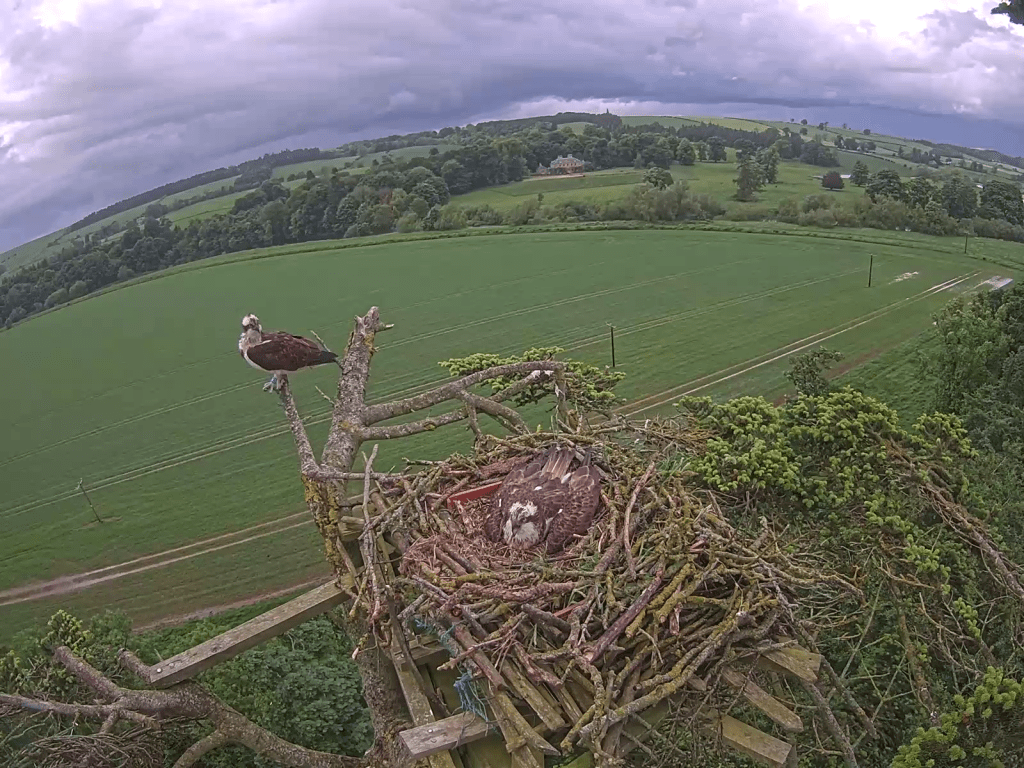
As you will probably have guessed as a result of the deafening silence from me, the miracle that we all hoped for didn’t happen and the eggs failed to hatch. Both Samson and Augusta (Blue 500) continued to incubate for a few days but Augusta in particular seems less and less inclined to sit and Samson has been increasingly reluctant to pay any attention to her fish soliciting calls. However, the instinct is also still strong in the pair and they have both spent time incubating and carefully turning the unviable eggs. They must be very confused with what has happened.
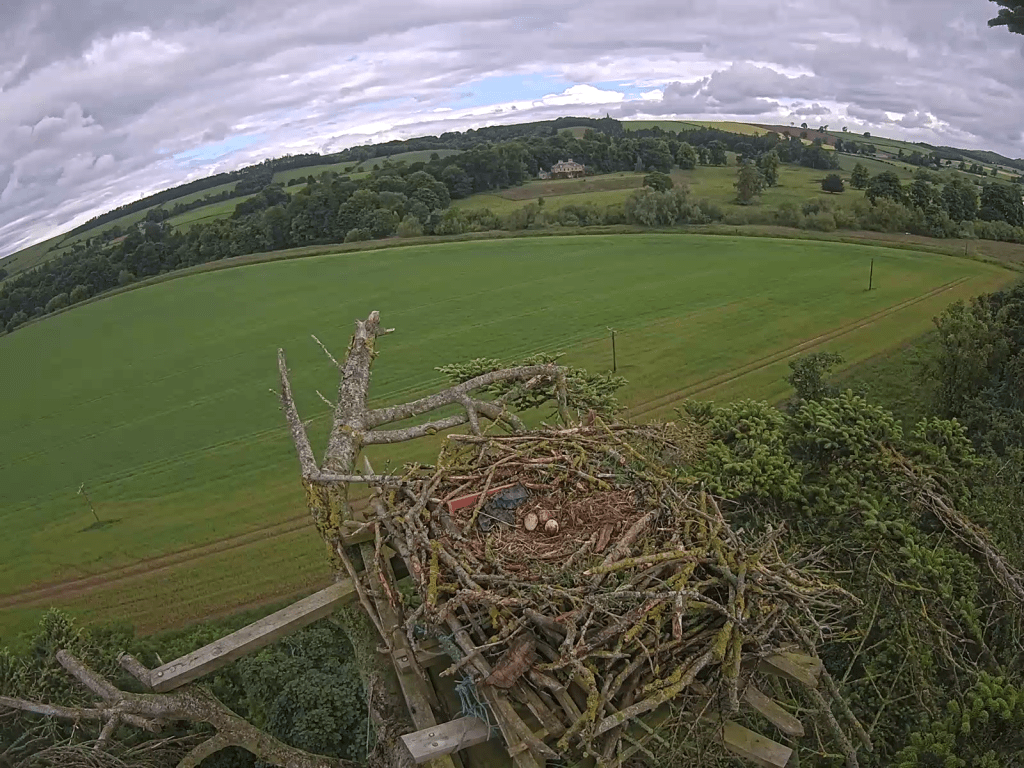
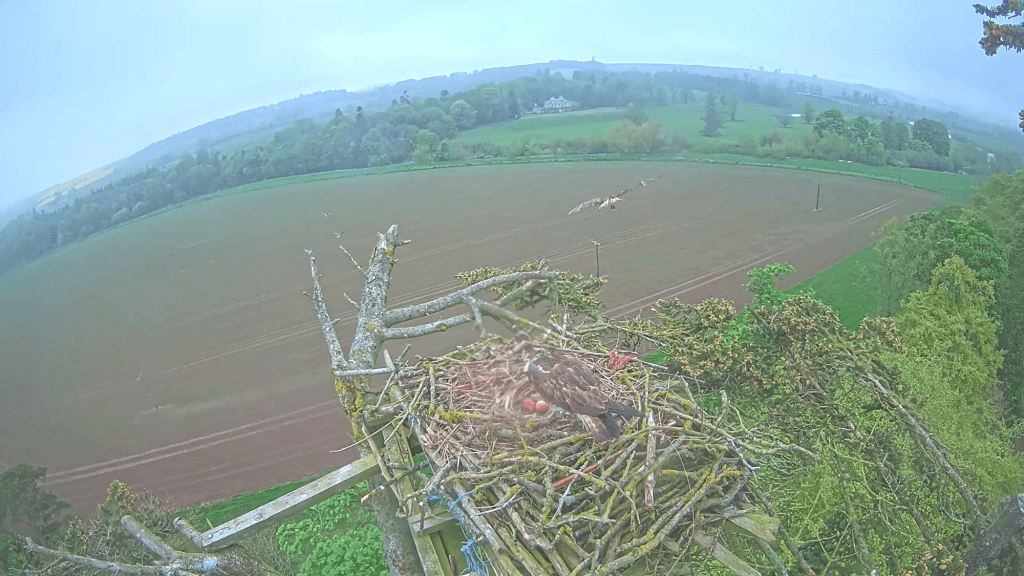
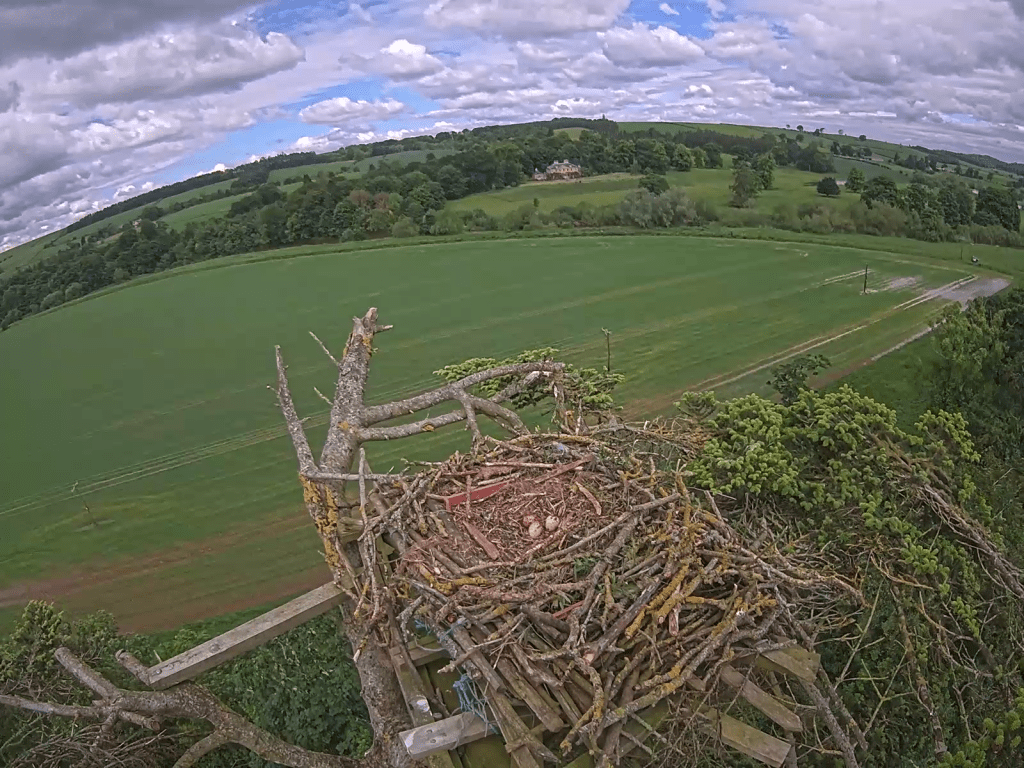
The sad sight of the eggs on an otherwise empty nest

Another bout of heavy rain caused the river to rise and become impossible to fish so Samson was forced to fly further afield to have any chance of catching anything. Both birds are spending far more time off than on the nest with neither being seen at all on 18th June during the 13 hours the camera was operating; we did see however, that Samson returned during the evening with a fish which he proceeded to eat on the nest perch. I am hoping that both will continue to strengthen their bond with each other and, in Augusta’s case, with the nest. It is important that they continue to guard the territory from other ospreys who may be looking to take it over from them.

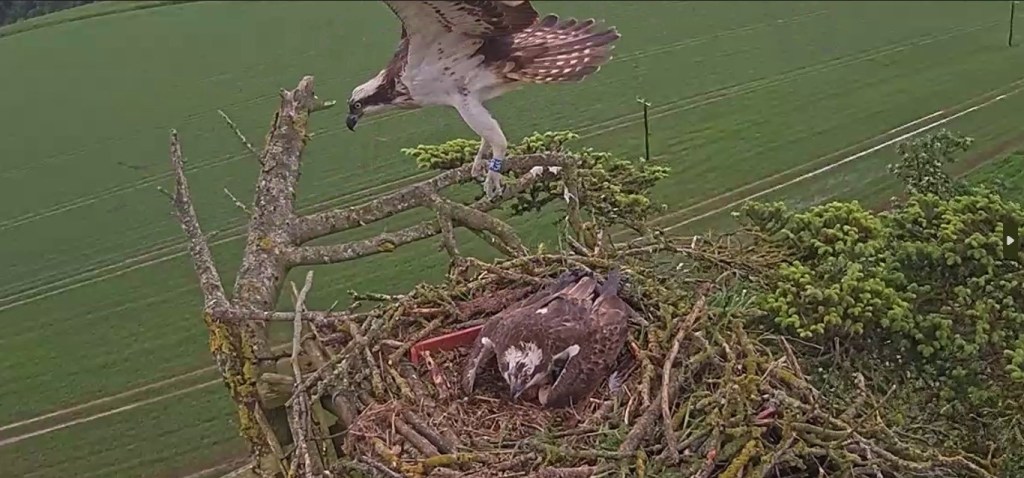
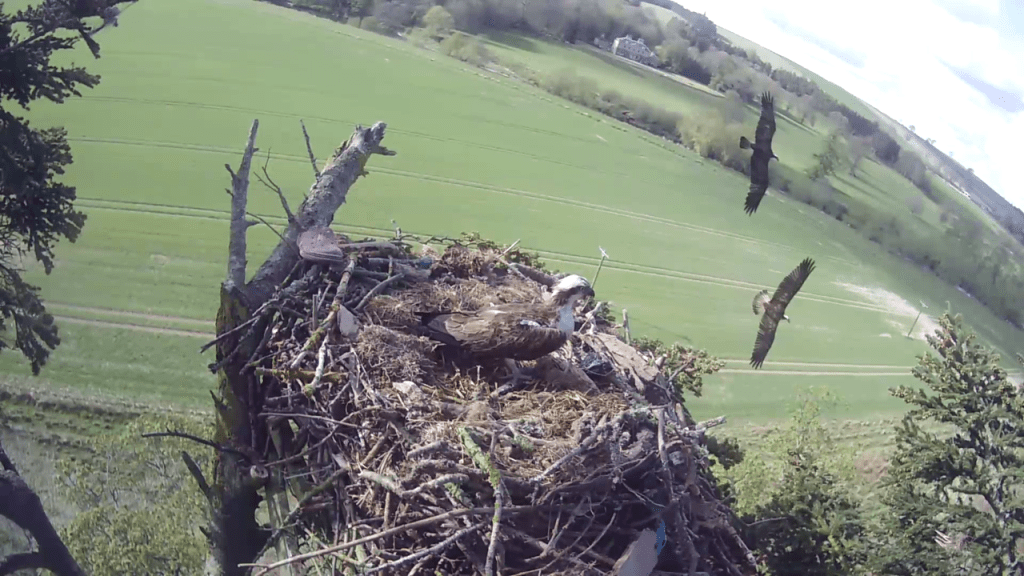
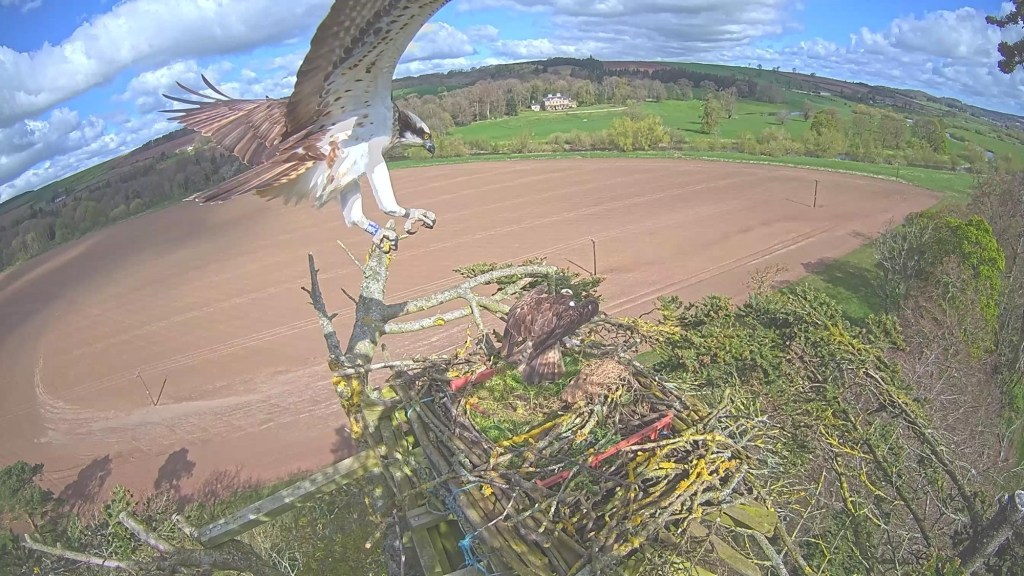
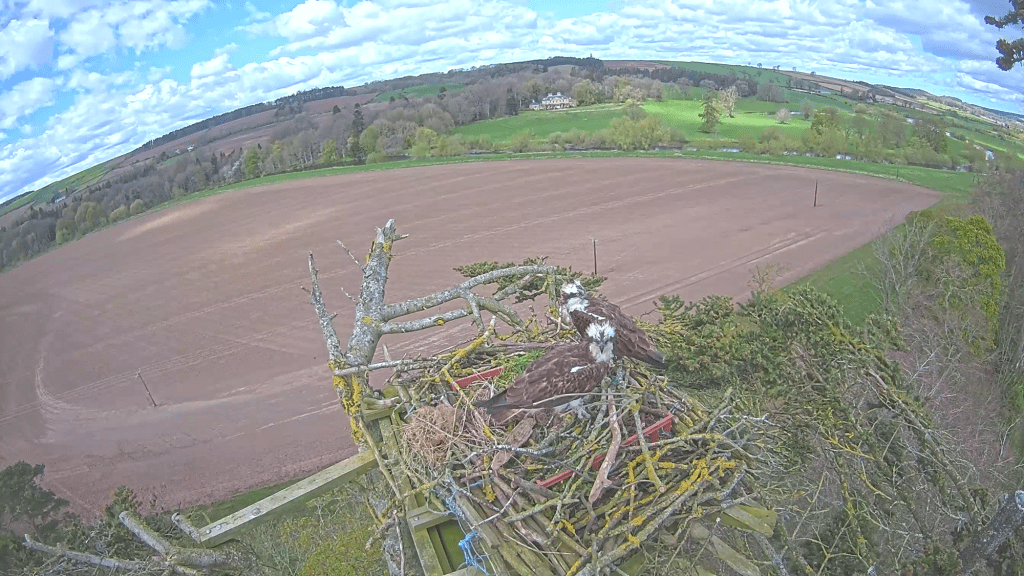
Talking of intruders, we have had a number of visiting ospreys over the past few weeks. I’ve already mentioned 565 and 561, both hatched in nearby Dumfries and Galloway. We also had a visit from 680, a 2021 male hatched elsewhere in the Tweed Valley, and two unknown intruders, one female with a BTO ring but no blue Darvic ring and an unringed female who landed in the nest and was quite reluctant to leave. Accepting the fact that the wide angle lens made her look bigger as she was quite close to the camera, she was nevertheless a monster and Augusta seemed rather unwilling to tackle her. So the threat to the nest is real and both our birds will need to remain vigilant for the rest of the season,
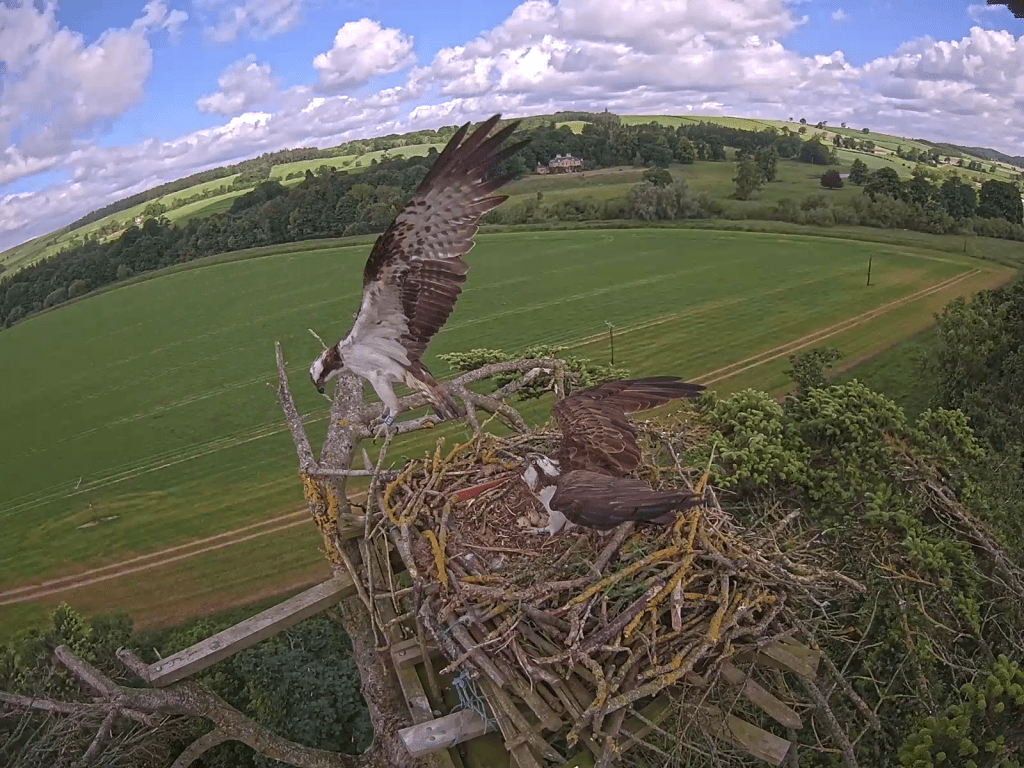
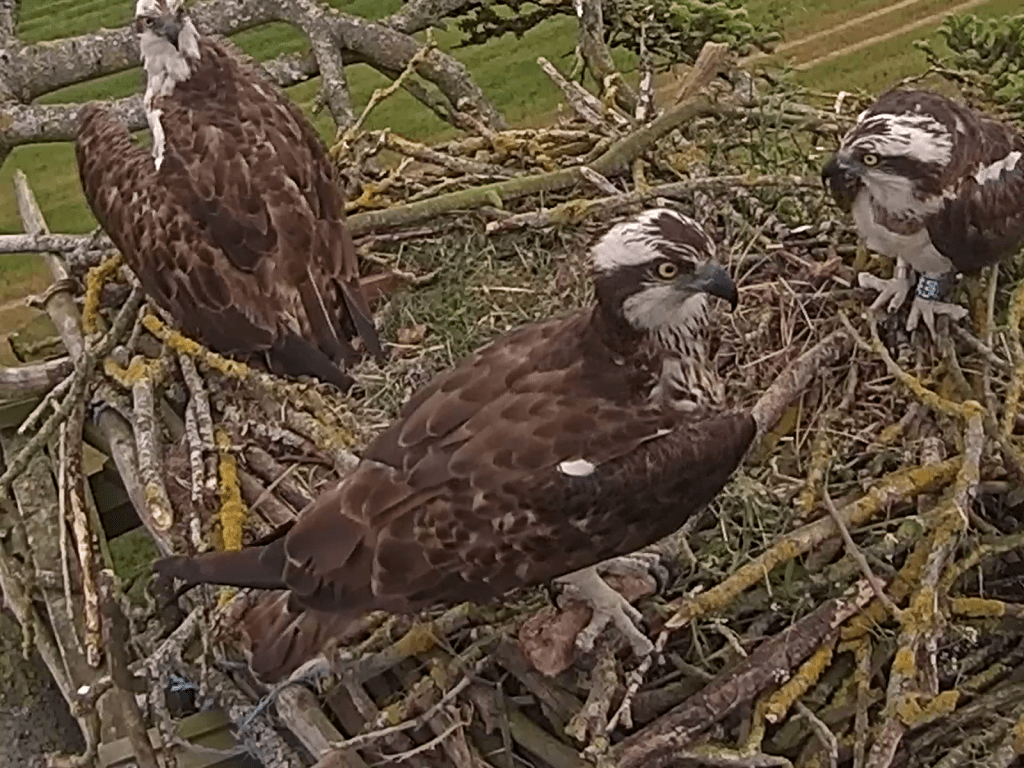
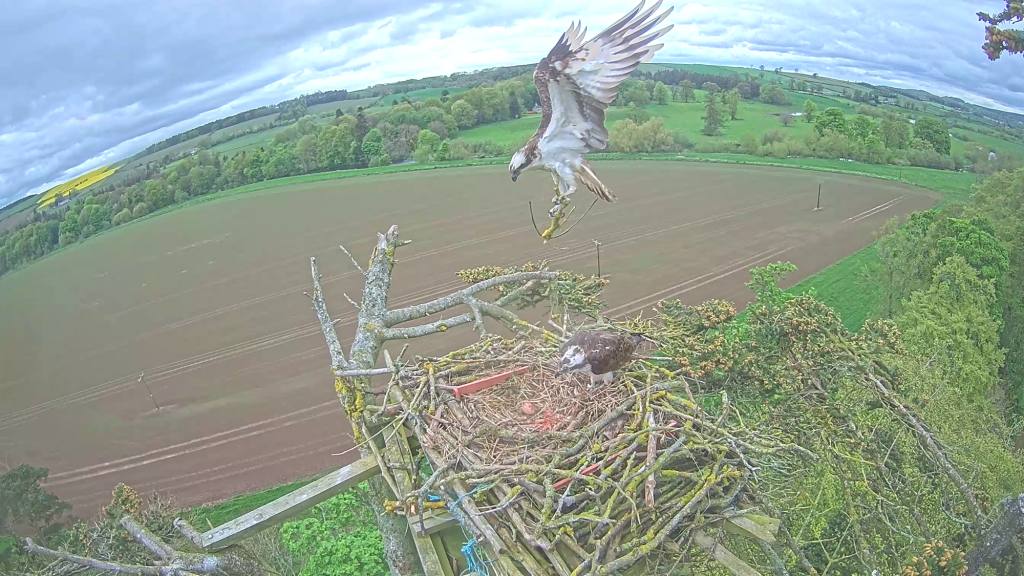
680 annoying Augusta
Samson (on the left) making it clear that, as a female, the intruder was Augusta’s responsibility to chase off!!! Augusta was not being quite so keen.

So a very sad end to our 2024 breeding season but I am encouraged by the number of birds “visiting” which shows a healthy influx of new blood to the Borders. Hopefully, some of them will find territories and mates in the area and we will continue to see the increase of these magnificent birds in the coming years.

I will let you know of any developments on the nest here as and when they occur but I will miss the patter of tiny talons. This poor early summer has been disastrous for so many birds and animals but one highlight was that, last week, I saw 3 bright blue jewels of kingfisher fledglings follow their parent upstream from a nest on the river that I feared had been washed away. It was a delightful surprise for me and there will be other stories of survival against the odds to offset the sadness of lost youngsters; let us hope that the weather we have witnessed was a one-off this year and not a foretaste of things to come.
WHAT IF…?

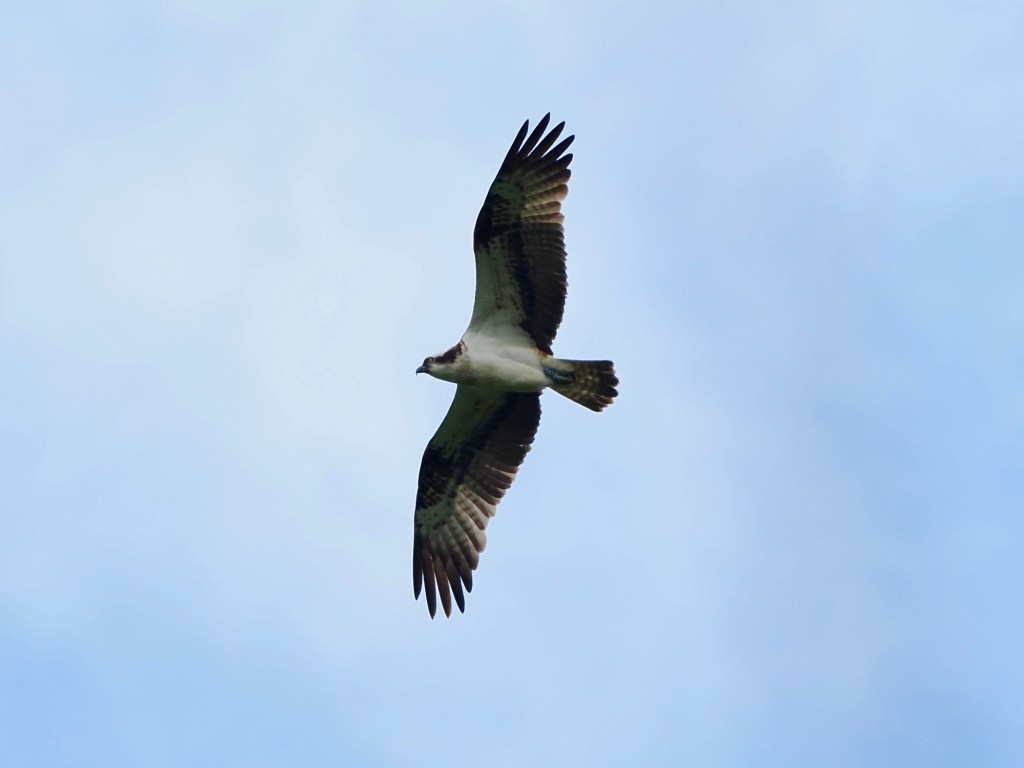
Lots of you have been asking if there is any way that one or more of the eggs will hatch, so I’m going to try and explain the various factors that will have an impact on the survivability or otherwise of the eggs.

Right at the start, I must say that the chances are minuscule in view of what we have seen and what we can surmise. Augusta left the nest at midday on Thursday 30 May and no one incubated the eggs in the 5 hours until the camera went off. When the camera came back on at 0600 on 31 May, there was no one on the nest until Samson arrived at approximately 0900. The eggs looked unmoved while the camera was off, which would suggest that they had been exposed for 21 hours. I extended the hours on the camera and Samson stayed on the eggs until just before it went off again at 1800. On the morning of Saturday 1 June, there was no one on the eggs when the camera came on at 0500 but Samson arrived at 0700, so possibly another 13 hours’ exposure and he stayed there until Augusta arrived at about 1300 and took up incubating duties again. She was on the nest when the camera went off at 1800 and when the camera came on at 0500 on 2 June. Since then, the pair have incubated continuously as before.

So, the critical timeframes are the two overnight periods during the time the camera was off. There is no reason to assume that the eggs would have suffered lasting damage during the times when we know they were exposed ie when the camera showed the empty nest, as long as they were incubated for the periods when the camera was off. However, what evidence we have is that they weren’t. First, they looked unmoved from their position of the previous evening, in both cases, and second, the overnight incubation has been done entirely by Augusta in the past and subsequent to this time. There is no evidence that she was around until she returned on the Saturday (1 June), especially as Samson greeted her initially almost as a stranger, with that cowed, half mantle that males do in the presence of unknown or barely known females. It is, of course, possible that Samson incubated overnight but it would be quite a deviation from the norm for a male to incubate overnight, although his absence as the camera came back on could be explained by the need to find an early morning fish to sustain him through the day.

The other factor would be the weather. It was warm and mainly sunny, meaning that the eggs would have stayed warm without being incubated for longer. However, there was a cool breeze and the temperatures overnight did drop but not by too much. There was no rain to speak about during this period. So, all in all the weather would have aided the survivability of the eggs.

One thing that is strange and might work in the favour of the overnight incubation theory is the lack of predation of the eggs. We have several families of crows nearby and a couple of buzzard pairs, all of which know that the ospreys are nesting and are incubating. I would have expected them to at least investigate the nest, upon seeing it empty of protective parents, but that doesn’t appear to have happened, so perhaps there was an adult bird around for longer than the camera showed, who kept potential predators away.

Finally, the attitude of the parent birds must be considered. Since they both returned, clearly both having successfully fished and built up their strength again, they have been incredibly conscientious about incubating the eggs. Unfortunately, that is pure instinct and not a sign of them “knowing” that the eggs are still viable. In the 24 or so hours before hatching, it is clear that parents can hear their chicks calling and starting to break out of the shell. However, if they don’t hear that, they will continue to incubate well after any likely hatching date. Augusta is a first time breeder and will not know to stop and Samson, although far more experienced, was rarely allowed by his previous partners to incubate close to hatching so, again, may not have any knowledge of signs, or lack of them, by which to judge when to cease incubating. I find this aspect very difficult to watch as they are taking such care and are totally oblivious to the fact that they may be wasting their time.

So there you have it. The 37th day since the first egg was laid will be 10 June, so any viable eggs that have beaten the odds stacked against them will be hatching in the next week. If there’s one thing you can always say about ospreys is that you “Never say never” and I would dearly love for my forecast about a year without chicks to be wrong. I’ll let you know.

TRAGEDY

You will recall from my last blog how the bad weather meant that we lost the camera as the solar panels couldn’t charge and the battery went flat. We therefore couldn’t monitor fish deliveries but we knew they would be difficult in the pouring rain and flooded areas. We hadn’t seen a fish delivery on camera or by active monitoring for several days. On Tuesday, there was the incident I recounted whereby I’d hoped that there had been an off camera fish exchange. However, as soon as she returned to the nest, Augusta was immediately fish soliciting again. Samson went off fishing at about 0930 and wasn’t seen on camera again for 48 hours. When he returned, he went straight onto the nest and started incubating the eggs; there was no fish. Eventually she drove him off again and we didn’t see him on camera from another 24 hours (Friday) when he returned, again without a fish. In the meantime, Augusta was getting more and more anxious throughout Thursday morning (30th). She left for about 10 minutes and came back wet but, at 1158, after standing at the side of the nest looking at the eggs for several minutes (that broke my heart), she took off and we haven’t seen her since. The camera went off at 1800 and came on again at 0500 and the eggs had not been moved, suggesting that had been exposed the whole time. When he returned on Friday, they had probably not been covered for 21 hours and were therefore cold and unviable. He incubated them all day until just before the camera went off before departing. He was back again on Saturday and again incubated during the day but without any chance of success.

Augusta has not been seen at any of the other nests so far with cameras. I thought she would go to Kielder where she knows the fish supplies are good. She might come back to Samson; she might not. However, the 2024 breeding season came to a sudden end on Thursday. It just shows what a knife edge breeding is for these birds, especially when the weather turns.

I hope Samson is ok and has managed to find himself something now the weather has improved. He looked very unlike himself on Tuesday and Thursday but better on Friday. I feel desperately sorry for Augusta as she was so keen to breed and that picture of her looking at the eggs just before she flew will live in my mind for a long time.

I’ll let you know of any developments.

Post script. Augusta (500) is back and caught a fish for herself this morning (Sunday 2 June). They are both still incubating and turning the eggs.

ALL RELATIVELY QUIET

As we approach the final third of the incubation period, everything seems quiet although fish supplies to 500 have been rather hit and miss, mainly as a result of the dreadful weather which has limited Samson’s fishing options. On a couple of occasions, she hasn’t waited for him to come in but has flown to meet him and they’ve exchanged off the nest. That is not ideal on a number of counts but primarily it leaves the eggs unguarded and it is a sign of her lack of experience as well as her hunger. It also means that I have no means of knowing what he’s bringing in and where he might be finding success, not that either of them know or care about my problems!

We have had several osprey intruders, both male and female. A couple have been ringed and we managed to identify 561, a male who intruded last year and 565, a 2021 Threave female who we haven’t seen before. She cheekily stayed on the nest perch for a good 20 minutes, with 500 pancaked over the eggs before finally departing.

561 (his ring is on upside down) doing a circuit of the nest on 25 May
565 doing a low pass on 27 May…
…before landing on the nest perch

The weather looks like it will improve over the next few days, which will be a great relief to a soggy 500 and Samson, who should find fishing a little easier. It will also mean that my nest camera will have a good supply from the solar panels, something which has not been the case recently. The eggs will hopefully start to hatch in about 10/11 days time and I’ll let you know when we see anything.

THE FULL SET

Blue 500 (Augusta) wasted no time in completing her clutch of eggs when she laid her third, and hopefully final, egg of the season at precisely 1100 this morning. She has spent longer this morning on the nest perch than the last few days, allowing Samson the luxury of incubating, although he did go fishing and provided her with a hearty breakfast just after 0900. She still doesn’t have the confidence or the know-how to push him off the eggs when she wants to take over and she must have been getting a little worried when she could feel herself ready to lay and he would not give up the nest cup to her. He eventually gave way and she settled down and produced for us the wonderful sight of the moment of laying her egg. You can see it drop during this video as she stands up.

What a wonderful thing to be able to see
Augusta admiring her clutch

We now have the wait of just over 5 weeks from the first egg being laid until it is due to hatch, so around 9/10 June, and this should be something of a hiatus for the parents. He will continue to catch fish for both of them and she should do the majority of the incubating and will also be responsible for guarding the nest and precious eggs from predators of various kinds, and intruding ospreys.

In my last blog, I recounted the first incident that I wanted to bring to your notice and will now tell you of the second. Many of you regular osprey followers might have seen the normal process of the male bringing in a fish, having often eaten the very nutritious head beforehand, and handing it over to the female who usually flies off with it. If she has eaten her fill she often brings back the remainder and gives what’s left back to the male to finish off. Samson has always followed this, as have his previous mates. However, 500 hasn’t yet got to that chapter on her book of how to have a successful and fruitful osprey partnership and, on 1 May, she returned to the nest with the remains of the fish that Samson had previously caught and given to her. He naturally came forward and tried to remove the remains from her talons but she was in no way going to give up the portion she had left. A bit of a scramble then ensued, very like when adolescent osprey chicks try to grab food to feed themselves and end up grabbing their parent’s foot instead. In the end, she decided to fly off with the now rather tatty bit of fish but failed to warn Samson who was still trying to wrestle it from her grasp, with the result that he got dragged across the nest and she got airborne with him still hanging on! In the video, Samson is in the nest and 500 then comes in with the fish.

A bit of a “domestic” misunderstanding

They did disentangle themselves and she made off with the prize. One of the things that struck me was the sheer power of 500 to drag Samson across the nest and then get airborne with him, initially at least, as a dead weight. The second thing I thought about was thank goodness there were no eggs in the nest at that stage!

I think they must have worked things out after that because, since then, she has given up remains if she’s come into the nest but has been left alone by Samson if she’s brought back fish onto the nest perch. it was an interesting part of them learning about each other and developing a bond.

I’m hoping that the birds have an uneventful incubation period; however, there is usually some drama or otherwise to disturb what should be a peaceful time before the mayhem of the chicks arriving and I will let you know if there anything to report.

EGG NO 2

Augusta (Blue 500) duly laid her second egg at 1421 yesterday, 6 May, realising that the laying of her first egg overnight when the camera was off was not going to endear her to her new fan club. She was attended by a pair of jackdaws but whether or not that speeded the process I’m not sure but they have been annoying her for several days now, even cheekily snatching bits of nesting material for themselves from almost under her beak.

First view of the second egg with attendant jackdaw

She is a lot calmer now and is settling more readily and for longer than she did when the first egg arrived. Samson still loves to incubate but she is increasingly coming back quickly from her wing stretches and wanting to take that duty back over; I’m sure that a part of it is her reminding him to concentrate more on bringing in fish. He brought in a large rainbow trout a couple of days ago and I wonder whether he’s found a new food source as I cannot remember the last time he brought one in. That would be a welcome situation indeed.

Samson being allowed to incubate the two eggs while Augusta flies off for a wing and leg stretch

I mentioned in my last blog about a couple of instances to bring to your attention. The first was about, despite being so careful normally about moving about on the nest, especially when there are eggs or youngsters about, this rule being ignored by both birds when bringing sticks in. Many of you will know of the Loch Arkaig pair, Louis and Dorcha, who are notorious for having to tackle really awkward sticks that the other has brought in. Well, Samson and Augusta have entered a couple of bids to wrest the title of The Most Awkward Stick award for this year from the Arkaig pair. The first was not so much awkward as potentially dangerous, with Samson polevaulting in with a stick that got caught up in his tail feathers, so that the end that went into the nest missed the egg by only a few millimetres.

Wow, that was close!

The second occasion was Augusta arriving with a large and awkward stick, which the two of them took turns at wrestling around the nest, luckily before any eggs had arrived. I think it finally disappeared over the side after both birds admitted defeat with trying to place it on the nest in an acceptable position. This was the first positioning attempt.

Will you get out of the way, Samson!

The second matter I wanted to tell you about I’ll leave for if and when a third egg is laid. I’d be quite happy for there to be only 2 eggs this year as I’ve mentioned before but, if a third egg is laid, it will be probably be on Friday and I will let you know either way.

It’s been great seeing some of you down viewing the birds and having a chance to chat and update you. As the weather improves, I hope to be around for longer, although I may be on site but in my little den, reviewing footage on the big screen. Please let me know beforehand if you’re travelling from some distance and I will make every effort to be available.

AT LAST!

Oh, I can see that this one is going to be trouble!

Here’s a fish for you. Now will you lay an egg?

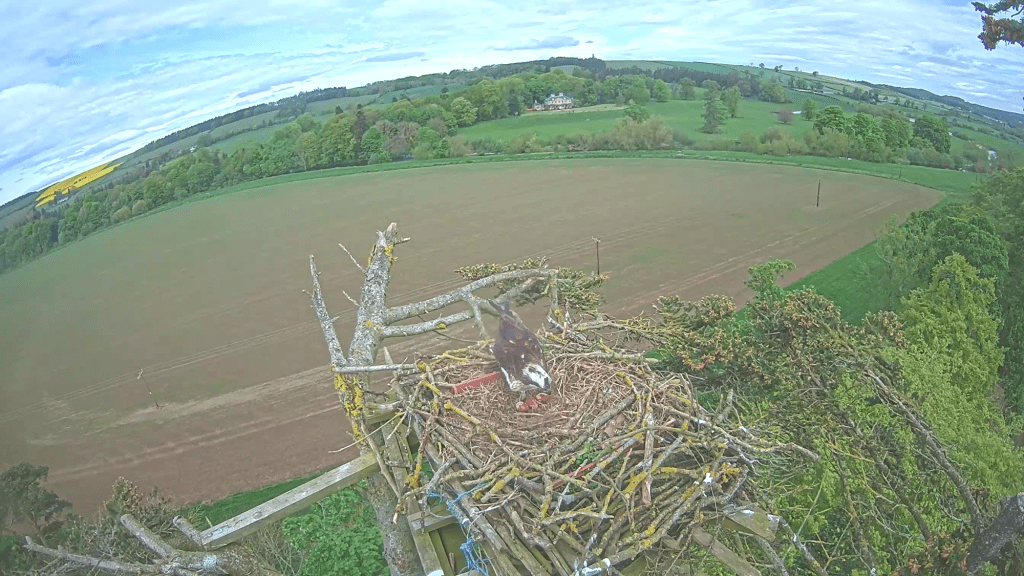
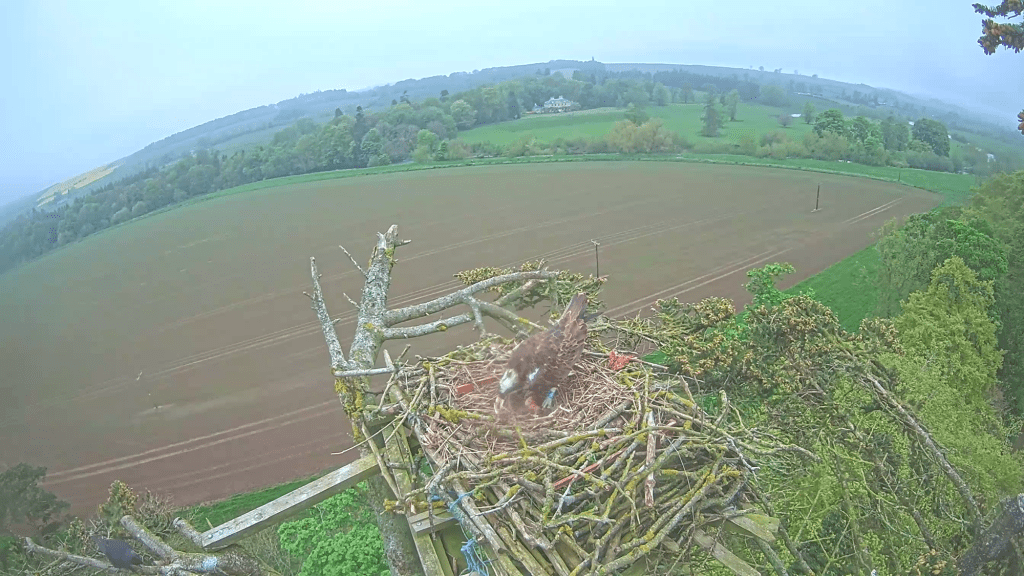
Blue 500 has kept me dangling on a bit of string all this week about when she would lay her first egg. First of all, she started rejecting Samson’s advances for a day, so I thought perhaps there’s an egg on its way. Then she underlined that with being very fidgety as if she could feel something going on inside her. Then she reverted to normal. A day or so later, she suddenly got all keen on tidying up the nest and getting more material and even nest cupping, so I thought “here we go”…and then nothing. Even Samson seemed to be looking down into the nest thinking that something should be happening. Finally, she sat on the nest perch just before the camera went off at 6pm yesterday looking for all the world like there was nothing going on.

Nothing to see here. Move along

When the camera came on at 5am this morning, it revealed her innocently lying in the nest on a very murky morning; a switchover between her and Samson about 5 minutes later revealed her first egg, laid sometime when the camera was off! Anyway, we have two proud parents, both of whom want to incubate although the poor little embryo will be scrambled if 500 turns the egg over many more times. Like any new parent, she is super-conscious of her duties and gets up every minute or so to shuffle around, roll the egg and settle down again. Samson is of course far more experienced and quietly goes about his business as he has seen it all before. She has even forgotten to fish beg for most of this morning, although he did eventually go fishing without her normal encouragement.

Samson taking over incubation duties allowed us the first sight of

As I did with JW6, I decided against naming 500 until the first egg was laid and the commitment to the nest was physically established. Blue 500 will be named Augusta, in memory of a very dear friend and neighbour who sadly passed away 3 days before Blue 500 arrived at the nest. I have to say that any character similarities between bird and human are strictly coincidental and had nothing to do with the naming decision, although feistiness does seem to be a characteristic common to both!

We’ve seen some amusing incidents between the birds this week but I think I’ll leave relating them until we’re sitting twiddling our thumbs waiting for the incubation period to pass. The next egg is due in a few days, possibly Monday, and Samson has already been eager to start making it, although I wish he’d wait until she was off the egg before he clambers onto her. Incubation will last for 37-42 days so Augusta is going to have to learn a bit of patience, not something that has been much in evidence so far.

JW6 – A SHORT LIVED REIGN

As we wait to see whether/when Blue 500 decides to lay an egg, I just wanted to write a few words about JW6, nicknamed Juno, our previous female who failed to return from migration this Spring.

JW6 burst onto the scene at Border Ospreys on 20 Apr 2021, the fourth year that we hadn’t had a settled female, or a brood. She was one of 11 females we had visiting the nest that year, some ringed and some not; some eager to breed and others not. She definitely fell into the latter category and actually was a complete nuisance that first year. She chased off any other females about but refused Samson’s advances (but never his gift of fish) and then would disappear for days at a stretch, before returning and ousting any other female who had attempted to settle in the meantime. I expect she was checking out any other options but kept returning to Samson.

Persuading a rival to leave (1). Samson pretending he’s not there
Persuading a rival to leave (2). Samson watching on

When she arrived on 2 April 2022, I thought that we were in for another frustrating season but I couldn’t have been more wrong. She became the ideal mate for Samson and produced two fine chicks, although one sadly was injured in a nest accident whereby it lost an eye and has to be euthanised. In 2023, she went one better and produced 3 chicks.

The 2023 family

Despite losing one as a result of poor fish stocks, she did so well again, and even helped Samson out with fishing for the family. She looked set for a long reign as the Border Ospreys matriarch but something happened between her leaving on 15 Aug 2023 and her due back time this year and she failed to return. We have no idea what was the cause of her death but there are so many dangers for even the most experienced ospreys, both on migration and in their winter homes.

She was a strong, confident and very large presence on the nest. I sometimes worried about the survivability of the camera lens when her fish begging reached full volume but she was impressive in how quickly she learned to overcome the many difficulties in bringing up a family. One of my enduring memories of her was watching entranced via the camera as she worked out how to feed her first day old chick a meal of fish without trampling on it or stuffing pieces far too large for it down its throat.

Attempting a first feed

She was very dominant and Samson was not allowed to incubate very much or brood, or even feed the chicks, something he had enjoyed with his first mate. However, she was a dedicated parent and a fierce protector of the nest and she was wise enough to take the risk of leaving the nest in 2023 to catch fish to supplement Samson’s efforts and ensure that the two remaining chicks survived.

Protecting the 2023 brood from an intruder

I hope that her demise was quick and as painless as possible and I have my fingers firmly crossed that her genes will have survived in the shape of 688 (Sacha) who is due back this year and/or 733 (Jed) and 732 (Ursula), the last being a real chip off the old block. She left indelible memories during her time here and I am grateful for her deciding to make Lanton her summer home for those few years. I will never forget her. Fly high Juno.

SEEING DOUBLE

For those of you who follow several osprey nests, you will know of Joanna Dailey from Kielder, who is an encyclopaedia of osprey knowledge and is brilliant at keeping track of all the Kielder nests and who is mating with whom there and who is intruding, how many eggs each nest has and when chicks are due to arrive etc etc. (I struggle with just the one and she has 10 to monitor!). However, to add to her many talents, we must now add Osprey Whisperer. An unattached 4 year old female osprey, hatched south of Inverness and ringed Blue 500, has been causing all sorts of trouble at Kielder, intruding at various nests and creating a great deal of angst for the resident birds, even landing in the cup of one nest that already had an egg. JW6 is, sadly, lost to us and so I asked Joanna to tell 500 that there was a situation vacant just north of Kielder, ie here at Border Ospreys. No sooner said than done and 500 arrived here this morning at 1049, much to the excitement of Samson. I missed all this because I was looking at another local osprey nest (!), but was delighted to see two birds on the nest when I finally arrived at Lanton at lunchtime.

Blue 500 touching down

500 has made herself very comfortable. She hasn’t left the nest for more than a few minutes all day and is clearly making her opinion known that yes, this nest will do nicely. Samson has been dashing backwards and forwards with sticks and various bits of nesting material, most of which were quite suitable but one particular branch he brought in, he landed with it across her back and then proceeded to almost put her eye out with one of the side shoots while manoeuvring it into position. Each time he brought a stick in, he attempted to mate with her but she was uncooperative and he eventually got the hint and went fishing. After he’d brought her about half the fish he’d caught, she was far more amenable and several successful matings have already taken place. He even waited until she finished eating before trying to mate, a restraint that he has only recently learnt as regular readers of this blog will know.

Yes, it’s a lovely stick but what part of my “fish, fish, fish” call are you misunderstanding?

So things are looking promising. Kielder may have got rid of a problem and we may have acquired a new mate for Samson. Time will tell but things are certainly looking a lot more optimistic than 24 hours ago. I will keep you posted on developments.

Looking comfortable with each other already

I TOLD YOU….

Well, it took 48 hours from writing the blog expressing my concern about the non-arrival of the birds, but the ploy worked and Samson duly arrived this morning, in torrential rain and pursued by the local jackdaws. He was soaked, and I struggled to see him properly (see the picture below) but eventually he dried out sufficiently to make out the head feather pattern. His behaviour was certainly that of the laird returning to his castle, ignoring the jackdaws and sitting proudly and confidently on the nest perch.

I defy anyone to identify an individual osprey from that (or jackdaw)!!

His first gardening job was to tackle a self seeded rape plant which was several inches high on the nest and about to flower. Using his beak like a pair of secateurs, that was quickly snipped off and then he used the egg cupping technique of lying on his keel and scuffing with his feet to get rid of some of the other vegetation on the nest. Well, I think that’s what he was doing behind the big blob of rain on the camera lens. All I could see of that activity was an occasional wing, or a head with his chin on the ground, or a foot!

He flew off after being on the nest for about 90 minutes and didn’t return while I was there, so I imagine he’s gone fishing. He’ll have to find a loch because the river is almost bursting its banks, is fast flowing and very muddy, so he’ll have no luck there today.

Now, the question is, has JW6 been in the area, lurking like she did last year, but not on camera? I rather doubt it but the next few days will show us. Once he has recovered from his flight and has done more to the nest to make it presentable, Samson will be skydancing to attract a mate. If JW6 arrives, he will settle with her, but if she doesn’t, then hopefully another female will be attracted by him and come calling.