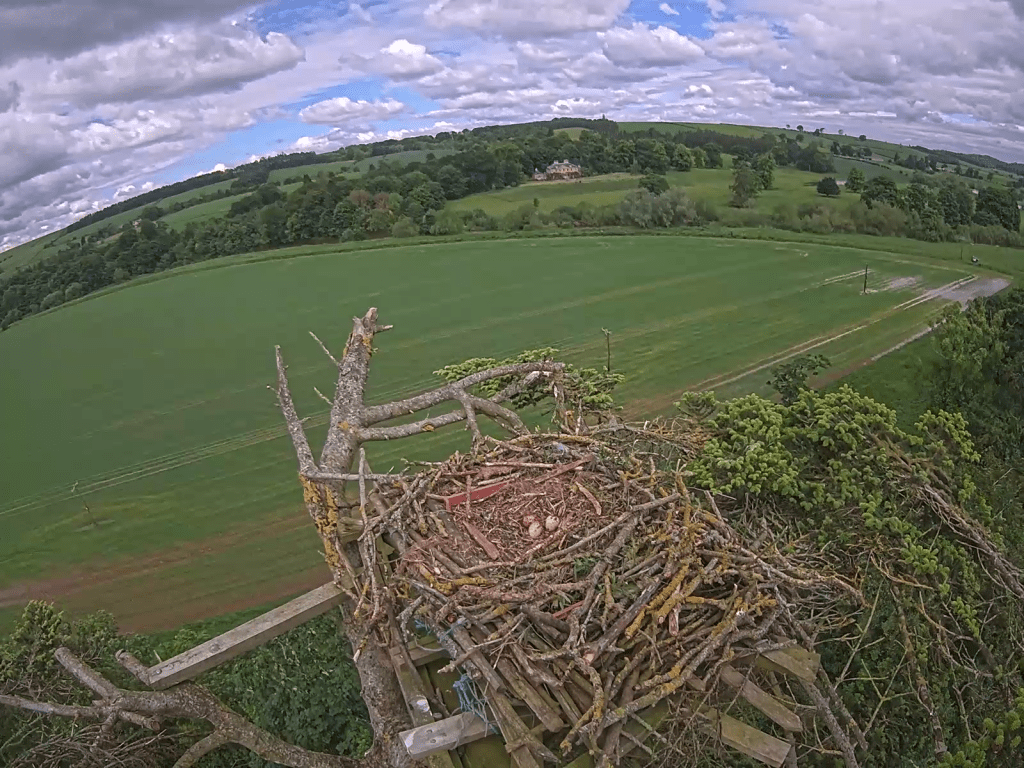
Lots of you have been asking if there is any way that one or more of the eggs will hatch, so I’m going to try and explain the various factors that will have an impact on the survivability or otherwise of the eggs.
Right at the start, I must say that the chances are minuscule in view of what we have seen and what we can surmise. Augusta left the nest at midday on Thursday 30 May and no one incubated the eggs in the 5 hours until the camera went off. When the camera came back on at 0600 on 31 May, there was no one on the nest until Samson arrived at approximately 0900. The eggs looked unmoved while the camera was off, which would suggest that they had been exposed for 21 hours. I extended the hours on the camera and Samson stayed on the eggs until just before it went off again at 1800. On the morning of Saturday 1 June, there was no one on the eggs when the camera came on at 0500 but Samson arrived at 0700, so possibly another 13 hours’ exposure and he stayed there until Augusta arrived at about 1300 and took up incubating duties again. She was on the nest when the camera went off at 1800 and when the camera came on at 0500 on 2 June. Since then, the pair have incubated continuously as before.
So, the critical timeframes are the two overnight periods during the time the camera was off. There is no reason to assume that the eggs would have suffered lasting damage during the times when we know they were exposed ie when the camera showed the empty nest, as long as they were incubated for the periods when the camera was off. However, what evidence we have is that they weren’t. First, they looked unmoved from their position of the previous evening, in both cases, and second, the overnight incubation has been done entirely by Augusta in the past and subsequent to this time. There is no evidence that she was around until she returned on the Saturday (1 June), especially as Samson greeted her initially almost as a stranger, with that cowed, half mantle that males do in the presence of unknown or barely known females. It is, of course, possible that Samson incubated overnight but it would be quite a deviation from the norm for a male to incubate overnight, although his absence as the camera came back on could be explained by the need to find an early morning fish to sustain him through the day.
The other factor would be the weather. It was warm and mainly sunny, meaning that the eggs would have stayed warm without being incubated for longer. However, there was a cool breeze and the temperatures overnight did drop but not by too much. There was no rain to speak about during this period. So, all in all the weather would have aided the survivability of the eggs.
One thing that is strange and might work in the favour of the overnight incubation theory is the lack of predation of the eggs. We have several families of crows nearby and a couple of buzzard pairs, all of which know that the ospreys are nesting and are incubating. I would have expected them to at least investigate the nest, upon seeing it empty of protective parents, but that doesn’t appear to have happened, so perhaps there was an adult bird around for longer than the camera showed, who kept potential predators away.
Finally, the attitude of the parent birds must be considered. Since they both returned, clearly both having successfully fished and built up their strength again, they have been incredibly conscientious about incubating the eggs. Unfortunately, that is pure instinct and not a sign of them “knowing” that the eggs are still viable. In the 24 or so hours before hatching, it is clear that parents can hear their chicks calling and starting to break out of the shell. However, if they don’t hear that, they will continue to incubate well after any likely hatching date. Augusta is a first time breeder and will not know to stop and Samson, although far more experienced, was rarely allowed by his previous partners to incubate close to hatching so, again, may not have any knowledge of signs, or lack of them, by which to judge when to cease incubating. I find this aspect very difficult to watch as they are taking such care and are totally oblivious to the fact that they may be wasting their time.
So there you have it. The 37th day since the first egg was laid will be 10 June, so any viable eggs that have beaten the odds stacked against them will be hatching in the next week. If there’s one thing you can always say about ospreys is that you “Never say never” and I would dearly love for my forecast about a year without chicks to be wrong. I’ll let you know.
 Border Ospreys
What a welcome surprise that would be. I’m keeping everything crossed just in case …
Catherine
LikeLike
Fingers crossed Rosie. We’ll be up to see Samson and Augusta sometime in July anyway, so should see you then. Cheers
LikeLike